Key Points
- Havering Council is supporting the Home Office’s Knife Surrender Scheme running from 3 August to 31 August.
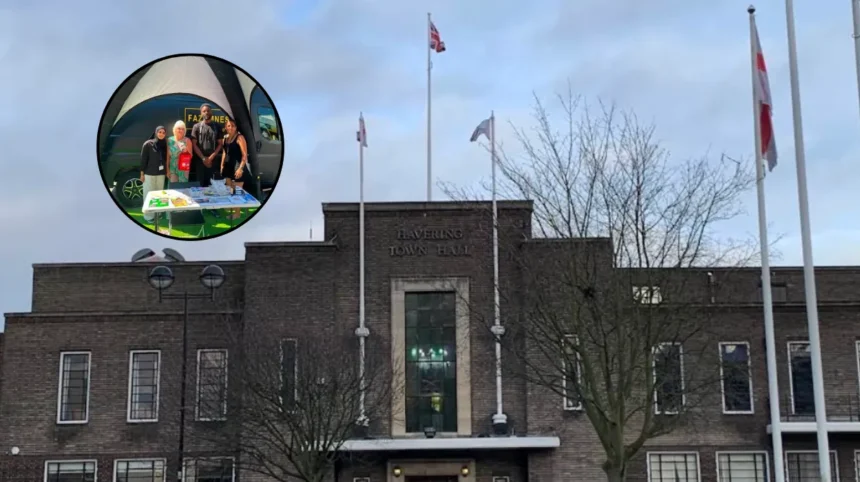
- A mobile surrender van operated by FazAmnesty was stationed at Arcade Place in Romford on Thursday 13 August to accept weapons anonymously.
- A new Ninja Knife Surrender bin, donated by OpenView and Romford BID via Word 4 Weapons, has been installed outside Romford Town Hall.
- An existing surrender bin in Central Park, Harold Hill, collected over 270 knives and weapons within its first six months in 2025.
- Specific legal guidelines require members of the public to seal and wrap weapons securely before traveling directly to a surrender location.
Romford (East London Times) August 18, 2026 – Havering Council has renewed its participation in the national Home Office Knife Surrender Scheme, introducing targeted local initiatives throughout August to remove dangerous weapons from public spaces. Operating between 3 August and 31 August, the borough-wide campaign aims to provide accessible, anonymous mechanisms for individuals to dispose of knives without fear of prosecution or police station visits.
As part of these efforts, a mobile surrender van operated by FazAmnesty and funded directly by the Home Office was deployed to Arcade Place in Romford on Thursday 13 August. The vehicle served as a dedicated, non-judgemental drop-off point where members of the public could hand over weapons to trained staff. The mobile initiative ran for its second consecutive year, offering an entirely anonymous procedure designed to break down barriers to weapon surrender.
Alongside the FazAmnesty team, the deployment included officers from the Council’s Community Safety team, representatives from the Havering Youth Service, and prominent anti-knife campaigner Sue Hedges. Hedges, representing the Ricky Hayden Memorial, worked alongside municipal safety officers to distribute bleed emergency kits across the borough to mitigate the physical harm of violent incidents.
Where are the new knife surrender bins located in Romford?
In addition to the mobile drop-off location, municipal authorities and private partners permanently expanded physical infrastructure by installing a new Ninja Knife Surrender bin outside the Romford Town Hall on Main Road on Thursday 13 August. Situated adjacent to the car park recycling bins, the collection facility was donated through a joint venture involving OpenView, the Romford Business Improvement District (BID), and the anti-violence charity Word 4 Weapons.
The newly erected unit supplements an existing permanent Word 4 Weapons Surrender Bin located at Central Park in Harold Hill. Official municipal figures confirm that during its initial six months of operation following its installation in 2025, the Harold Hill bin resulted in more than 270 knives and offensive weapons being voluntarily surrendered and removed from circulation.
To ensure safety and legal compliance during transit, authorities released explicit instructions for individuals carrying items to surrender points:
- Wrap the weapon securely in newspaper, bubble wrap, or heavy fabric, and seal it inside a durable bag or box.
- Refrain from adding identifying labels or names to the exterior packaging.
- Travel directly to the designated surrender point without taking detour stops or secondary journeys.
While carrying offensive weapons in public remains illegal under UK law, authorities highlighted that traveling on a direct route to a designated surrender site establishes a valid legal defense regarding weapon possession if stopped by law enforcement officers.
How are local leaders and community partners responding to the initiative?
Municipal leadership emphasized that the multi-agency approach forms a crucial component of local crime prevention strategies. Havering’s Cabinet Member for Public Protection, Councillor Terry Brown, called upon the community to engage with the surrender opportunities to prevent further violence.
Councillor Terry Brown stated that:
“We encourage anyone in possession of any weapons to do the right thing and surrender them. This means more lives will be saved. But we also urge not to carry them in the first place. Hosting the knife amnesty van and having another knife amnesty bin in Havering is part of our commitment along with our partners, to do what we can to help make our borough as safe as possible for all our residents and visitors. We do not tolerate knife crime in Havering and the fear and devastating impact it has on communities. Not only are we working with police and our partners towards the prevention and reduction of this crime, but we are also working alongside the police to help bring perpetrators to justice. The message is clear: we won’t tolerate knife crime in Havering.”
Commercial leadership in Romford also underscored the economic and social necessity of creating safer town center environments. Romford BID Director Julie Frost noted the broader impact of public-private partnerships on community welfare.
Julie Frost stated that:
“Romford BID is proud to support this important initiative to help make our town centre safer for everyone. Providing a safe and anonymous way for people to surrender knives and dangerous weapons can help prevent them from ending up on our streets and potentially causing devastating harm. We are pleased to work alongside Havering Council, the Home Office and our partners to support practical measures that help tackle knife crime and keep our community safe.”
Background of the particular development
The adoption of localized weapon surrender infrastructure in Havering reflects a broader, multi-year strategy across Greater London to combat youth violence, weapon possession, and knife-enabled offenses through preventative infrastructure. Following elevated public concern over violent incidents across East London, local councils have increasingly integrated public health approaches into traditional law enforcement frameworks.
The deployment of surrender bins began expanding significantly when charities like Word 4 Weapons partnered with local authorities to provide secure, tamper-proof disposal receptacles in accessible public locations. The strategic placement of bins outside civic centers, such as Romford Town Hall, and within residential hubs, like Harold Hill, is engineered to reduce the friction associated with surrendering illicit items. Historical data from the Harold Hill site, which collected over 270 items in six months during 2025, demonstrated to local planners that anonymous collection infrastructure yields measurable results in removing edged weapons from public circulation.
Furthermore, the involvement of community campaigners such as Sue Hedges highlights the crucial role played by grassroots organizations following local tragedies. The integration of life-saving bleed kits alongside weapon surrender points signals an evolved strategy focused simultaneously on reducing weapon prevalence and improving survival outcomes for victims of trauma.
Prediction: How this development can affect local residents, businesses, and youth
The installation of additional surrender infrastructure and mobile collection units is expected to deliver tangible impacts across key demographics within the London Borough of Havering:
- Local Residents and Families: The physical removal of hundreds of edged weapons from local neighborhoods directly reduces the probability of opportunistic violent offenses. Anonymous disposal options allow families or guardians who discover weapons in the home a safe, legal mechanism to remove them without subjecting family members to criminal prosecution.
- Town Centre Businesses and Shoppers: Enhanced public safety measures around commercial corridors such as Arcade Place and Main Road help bolster public confidence in the town center economy. Reduced perceptions of knife crime generally correlate with higher footfall, improved night-time economy activity, and lower security costs for local retail establishments represented by the Romford BID.
- Youth and At-Risk Individuals: Providing non-judgemental, direct intervention tools gives young people caught up in weapon-carrying cultures an accessible off-ramp. Clear guidelines regarding legal protections during transport directly lower the legal risks for individuals attempting to disengage from violent environments, potentially altering trajectories away from criminal justice outcomes.