Key Points
- Developers Truman Estates Ltd and Zeloof LLP proposed a £500 million masterplan for the Old Truman Brewery site on Brick Lane, including a 5,200-square-metre data centre on Grey Eagle Street alongside offices, shops, and commercial facilities.
- Planning documents show the facility is intended for high-frequency trading in the City of London, rather than artificial intelligence applications.
- Tower Hamlets Council rejected the planning application in July 2025, following local concerns about power usage, environmental effects, and gentrification.
- Central government ministers called in the appeal and recovered the decision, citing the UK government’s classification of data centres as Critical National Infrastructure.
- Campaign group ‘Save Brick Lane’ says the site should provide local housing instead, pointing out that more than 30,000 households are currently on the Tower Hamlets social housing waiting list.
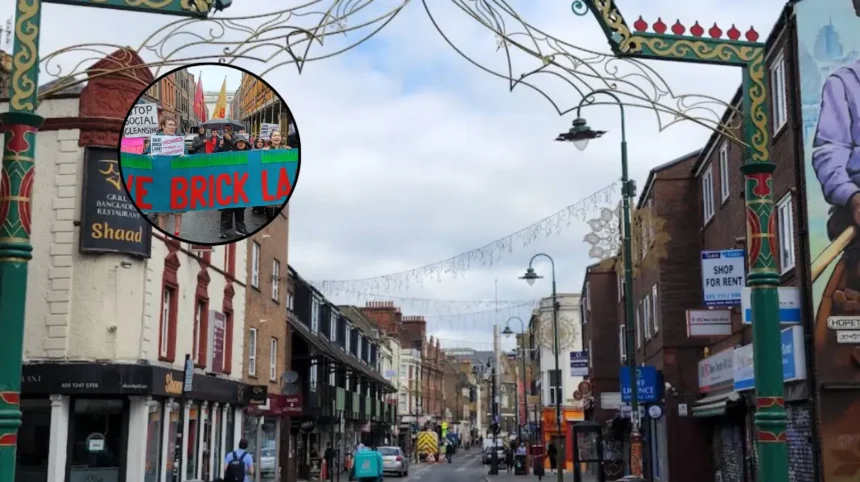
East London (East London Times), August 25, 2026 – East London’s iconic Brick Lane has emerged as the latest battlefield between grassroots community interests and national technological infrastructure, following a protracted dispute over the redevelopment of the historic Old Truman Brewery site. The dispute centers on a multi-million-pound proposal that includes a commercial facility dedicated to housing digital server infrastructure in one of the capital’s most densely populated cultural districts.
- Key Points
- What is driving the opposition from local residents and campaign groups?
- What purpose will the Grey Eagle Street data centre serve?
- How have local political leaders responded to the proposed development?
- Why did central government ministers intervene in the local planning process?
- Background of the Brick Lane Development Dispute
- Future Outlook: How this decision will impact local communities and UK developers
As reported by Matthew Taylor of The Guardian, local residents, business owners, and community campaigners have voiced intense opposition to plans submitted by developers Truman Estates Ltd and Zeloof LLP. The broader £500 million masterplan encompasses five modern office buildings, retail space, market areas, a cinema, and a 5,200-square-metre data centre situated on Grey Eagle Street. The dispute reached a critical junction when central government ministers recovered the planning appeal, overruling the democratic refusal previously issued by Tower Hamlets Council.
What is driving the opposition from local residents and campaign groups?
As reported by Suha Kidwai of The Independent, community members have expressed deep concern over the cultural and environmental footprint of the project in an area historically defined by artistic innovation and vibrant diaspora communities. The ‘Save Brick Lane’ coalition, representing nine local community and resident groups, has continuously argued that the masterplan prioritises commercial computational power over pressing social needs.
As reported by Matthew Taylor of The Guardian, Jonathan Moberly, a local resident and campaigner, highlighted the disconnect between the development and the local borough’s pressing housing demands. Moberly stated:
“We have a severe housing crisis here… This datacentre will bring literally no benefit to anyone living here.”
Campaigners estimate that the footprint allocated for the commercial infrastructure could instead accommodate roughly 350 affordable homes in a borough where over 30,000 families remain on social housing waiting lists.
Furthermore, as noted in reporting by Suha Kidwai of The Independent, local photographer Rodrigo Hammond emphasised the human element of the neighbourhood during ongoing demonstrations. Hammond stated:
“When you walk through central London, all you see is high-end businesses and corporations. I feel like people come here to take a breather from the City. This place is made for humans, not machines.”
What purpose will the Grey Eagle Street data centre serve?
While nationwide discussions around server infrastructure frequently focus on generative artificial intelligence, official planning documentation reveals a different operational focus for the Grey Eagle Street site.
As reported by Matthew Taylor of The Guardian, planning documents reveal that the proposed 5,200-square-metre facility will not be used to train artificial intelligence models, but will instead facilitate high-frequency trading for financial institutions operating out of the nearby City of London. In high-frequency algorithmic trading, geographical proximity to financial exchanges reduces latency by milliseconds, granting automated trading firms a distinct competitive edge.
The facility is projected to operate with a peak electrical output of 5.2 megawatts (MW). According to environmental campaigners and figures published by Save Brick Lane, that amount of energy could power approximately 15,000 average residential homes. Residents have also raised secondary concerns regarding continuous ambient noise, drawing comparisons to existing urban server facilities that generate a low-frequency, persistent acoustic hum.
Explore More Local East London News
Man Charged With Arson After Multiple Fires in London Fields, Hackney 2026
Hackney Council Must Keep Social Housing Tenants Cool Hackney 2026
How have local political leaders responded to the proposed development?
Political representatives across Tower Hamlets have maintained a firm stance against the installation of server infrastructure on the historic brewery grounds. Tower Hamlets Council initially rejected the planning application in July 2025, citing overdevelopment, heritage degradation, and inadequate community benefit.
As reported by Matthew Taylor of The Guardian, Councillor Faysal Ahmed, a cabinet member at Tower Hamlets Council, reiterated the local authority’s clear objection to the location. Ahmed stated that the council and local community stood united in their stance, suggesting alternative commercial zones were far more appropriate. Ahmed commented:
“It defies all logic to propose a datacentre on Brick Lane.”
Similarly, as reported by Suha Kidwai of The Independent, the Mayor of Tower Hamlets, Lutfur Rahman of the Aspire Party, strongly criticized the commercial focus of the planning submission. Rahman stated that it “beggars belief” that Brick Lane was being considered for such an installation, calling the allocation of space to commercial computer servers a “scandal” when thousands of local children remain in temporary accommodation.
Conversely, some local workers hold a different perspective regarding broader economic requirements. As reported by Suha Kidwai of The Independent, local worker Dhananjoy Paul noted the necessity of digital infrastructure, stating:
“The housing crisis is everywhere, every borough is facing it,”
while underscoring the broader economic importance of technological advancement across the United Kingdom.
Why did central government ministers intervene in the local planning process?
The conflict over the Old Truman Brewery site escalated significantly after central government ministers issued a recovery direction on the planning appeal, taking the final decision out of the hands of Tower Hamlets Council and the local planning inspectorate.
As reported by Saf Malik of Capacity, the overarching decision framework was heavily influenced by the UK government’s classification of data centres as Critical National Infrastructure (CNI). This regulatory status affords data infrastructure proposals substantial weight during planning reviews when balanced against local municipal objections.
While Tower Hamlets Council requested that priority be given to residential development due to local demographic needs, government decision letters indicated that the urgent national demand for data handling capacity was assigned “significant weight,” whereas local social housing arguments received “limited weight” within the statutory planning framework.
Tom Larsson, chief executive of development manager Grow Places, welcomed the national policy alignment, describing the ministerial determination as a “significant milestone” for urban infrastructure delivery. In contrast, representatives from Save Brick Lane characterized the override of local democratic refusal as “deeply disappointing.”
Background of the Brick Lane Development Dispute
The dispute surrounding the Old Truman Brewery site forms part of a longer narrative concerning urban regeneration, gentrification, and industrial heritage in East London. Spanning ten acres across Brick Lane and Grey Eagle Street, the former Black Eagle Brewery operated as a major industrial employer from the 1660s until its operational closure in 1989.
Following its closure, the site was transformed by private owners into a hub for independent markets, fashion incubators, art exhibitions, and micro-businesses. Over the past three decades, this creative eco-system turned Brick Lane into an internationally recognized tourist destination, famed for its curry houses, vintage clothing stalls, and cultural diversity.
However, tension between long-standing residents and commercial developers has escalated since 2020, when formal masterplans were introduced to replace older warehouse structures with modern office blocks and retail complexes. The inclusion of server infrastructure in recent plan revisions accelerated community organizing under the ‘Save Brick Lane’ banner. The dispute highlights a growing national challenge across the UK, where around 140 data centre developments are currently in the pipeline, presenting severe grid capacity choices between industrial power users and domestic housing expansion.
Future Outlook: How this decision will impact local communities and UK developers
The outcome of the Brick Lane planning dispute sets a precedent that will directly impact three primary stakeholders across the United Kingdom: local urban communities, commercial property developers, and the financial technology sector.
- Impact on Local Communities and Boroughs: For residents of Tower Hamlets and similar inner-city areas, the ministerial override demonstrates the weight of the Critical National Infrastructure (CNI) designation over local planning authority decisions. Communities facing severe housing shortages may find it increasingly difficult to block commercial technological developments when sites are designated as nationally strategic. Furthermore, local residents surrounding the site face potential long-term exposure to heavy electrical power draws and localized industrial noise in historically residential or light-commercial streets.
- Impact on Developers and Data Infrastructure Operators: For commercial property firms and infrastructure funds, the decision provides a legal blueprint for obtaining planning approvals in high-density urban zones. Demonstrating that even a modest 5,200-square-metre site can clear planning hurdles on CNI grounds despite unanimous local council opposition lowers the regulatory risk for building data hubs near major financial centers. However, developers will likely continue to face prolonged public resistance, reputational challenges, and active community campaigning.
- Impact on Financial Services and Grid Capacity: Financial institutions within the City of London stand to gain enhanced low-latency network performance for automated trading systems. Concurrently, utility providers and municipal planners will need to address regional power allocation. As the demand for high-density power connections increases, municipal authorities will be forced to balance the competing grid capacity demands of commercial data hubs against the electrification of domestic heating and local social housing developments.