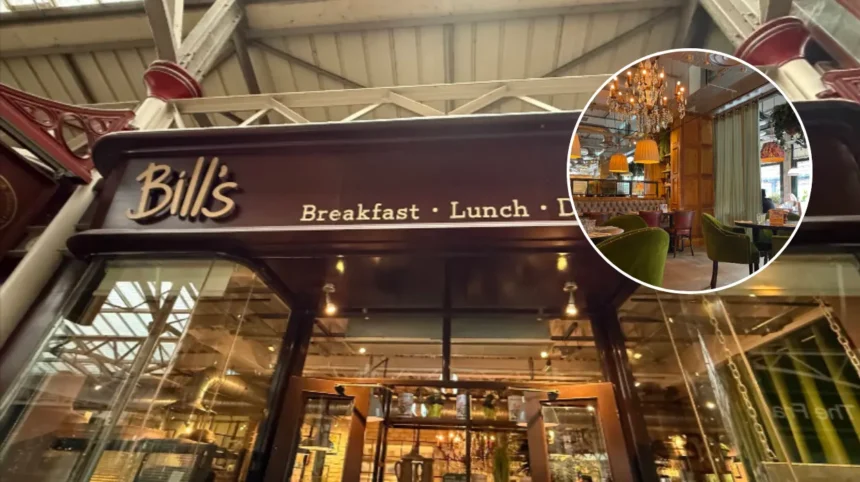
Key Points
- Bill’s restaurant is set to open a new branch at Westfield Stratford City in March 2026, expanding the brand’s presence in east London.
- A dedicated external seating structure is planned on Montfichet Road, directly in front of the new Bill’s restaurant, to accommodate outdoor diners.
- The proposed structure will enclose an area of about 48 square metres, providing covered space exclusively for Bill’s customers.
- The application for the external seating framework was submitted on 12 November 2025 by Bill’s Restaurants Ltd, with Pegasus Group acting as the planning agent on the brand’s behalf.
- Newham Council formally approved the plans on 27 January 2026, allowing the project to move ahead in time for the restaurant’s planned March launch.
- Planning documents state that the framework will be constructed from mild steel, creating a permanent but relatively lightweight structure on the streetscape.
- The scheme does not involve the loss of garden land, nor will it change the use or status of any existing public open space around Montfichet Road.
- The development sits within the wider planning framework for Stratford and Greater London, where the Mayor has powers to request detailed information on spatial planning matters under Section 346 of the Greater London Authority Act 1999.
- The external seating is intended to enhance the dining experience for Bill’s patrons, catering to demand for al fresco options and increasing overall restaurant capacity.
- Planning officers assessed that the modest scale of the 48-square-metre structure would be in keeping with the commercial character of Westfield Stratford and its surrounding public realm.
- The use of mild steel for the framework was set out in technical documents accompanying the application, describing a durable and easily maintainable structure.
- The project forms part of ongoing commercial investment in and around Westfield Stratford, reflecting the area’s role as a key retail and leisure destination in east London.
Stratford (East London Times) January 31, 2026 – Bill’s restaurant is preparing to open a new branch at Westfield Stratford City in March, backed by council approval for a purpose-built mild-steel external seating structure on Montfichet Road that will enclose around 48 square metres for outdoor dining.
- Key Points
- How is Bill’s expanding into Westfield Stratford?
- What does the approved external seating structure involve?
- How will the structure be built and what materials will be used?
- Who submitted the plans and how were they assessed?
- When did Newham Council make its decision?
- Will the development affect open space or garden land?
- How does this scheme sit within wider London planning powers?
- What will the new seating mean for customers and the local area?
- How does this fit into Stratford’s ongoing development?
How is Bill’s expanding into Westfield Stratford?
Bill’s is moving to strengthen its footprint in east London by opening a new restaurant at Westfield Stratford City, one of the capital’s busiest retail and leisure hubs. According to planning documents lodged with Newham Council, the Stratford branch is scheduled to open to customers in March, adding to the chain’s existing network of casual dining sites across the United Kingdom.
The scheme places a particular emphasis on outdoor hospitality, with a dedicated external seating area to be located on Montfichet Road, directly in front of the restaurant’s main frontage. The intention is to create a clearly defined, branded space for al fresco dining, enabling Bill’s to serve more guests while responding to ongoing customer preference for flexible indoor–outdoor layouts in busy urban settings.
What does the approved external seating structure involve?
Planning papers describe a framework designed to enclose approximately 48 square metres of space on the pavement along Montfichet Road. This floor area is earmarked exclusively for Bill’s customers and is expected to accommodate a number of tables and chairs configured for casual dining, coffee and light meals throughout the day.
The scale has been presented as modest in the context of Westfield Stratford’s wider streetscape, which is already characterised by a mix of shopfronts, kiosks and managed outdoor seating zones. The controlled footprint also allows the scheme to remain within planning thresholds for external structures while still providing a meaningful expansion of the restaurant’s usable space.
How will the structure be built and what materials will be used?
The framework itself will be made from mild steel, as set out in the technical specifications submitted with the application. This material choice is intended to provide a durable, stable and relatively lightweight structure that can support any glazing, roofing or weather-protection elements required to make the space comfortable for diners.
Mild steel is commonly used for such frameworks in urban commercial environments because it can be fabricated to precise dimensions, finished in a range of colours and maintained with relative ease over time. The approach is in line with other external seating structures in London which seek to balance robustness with a visually unobtrusive profile in busy pedestrian areas.
Who submitted the plans and how were they assessed?
The planning application for the external seating structure was submitted on 12 November 2025 by the company behind Bill’s restaurant, with Pegasus Group named as the planning agent. Pegasus Group is a consultancy that frequently represents commercial clients in navigating the planning system, preparing design statements and liaising with local authorities on technical matters.
In this case, Pegasus Group acted on behalf of Bill’s to marshal the relevant design, access and planning justification documents required by Newham Council. These documents outlined the rationale for the external seating area, including its size, appearance, materials and relationship with the wider public realm at Westfield Stratford.
When did Newham Council make its decision?
Newham Council granted approval for the scheme on 27 January 2026, following consideration of the application materials and any internal consultations. The timing of the decision provides Bill’s and its delivery partners with a clear window to complete the construction and fit-out of the external seating structure ahead of the restaurant’s planned March opening.
Planning officers concluded that the proposal was acceptable in principle and in detail, noting that the development would support the vitality of the local centre without undermining access or amenity. The council’s approval effectively confirms that the design complies with local planning policies relating to town centre uses, street furniture and pedestrian movement.
Will the development affect open space or garden land?
One of the points addressed in the planning documents is the impact on existing open space and garden land, an issue that can often be sensitive in built-up areas. In this instance, the applicant stated that the framework will not result in the loss of any garden land, nor will it change the designated use of any open space in the vicinity.
This means the structure will occupy part of the hard-surfaced area already associated with the commercial frontage on Montfichet Road, rather than encroaching on planted or recreational green spaces. Newham Council accepted this assessment, allowing the scheme to proceed on the basis that it will not diminish public access to existing open areas or alter their planning status.
How does this scheme sit within wider London planning powers?
Under Section 346 of the Greater London Authority Act 1999, the Mayor of London can request relevant information about spatial planning matters across the capital, including schemes such as those at Westfield Stratford. This statutory power allows the Mayor’s office to monitor development trends, assess cumulative impacts and, where necessary, engage with local authorities on strategic planning issues.
The reference to Section 346 in the context of the Bill’s external seating proposal underscores that, while Newham Council is the local planning authority, the development also lies within a broader metropolitan planning framework. In practical terms, however, the modest scale of this 48‑square‑metre structure and its focus on ancillary restaurant use place it firmly within the category of local town-centre enhancements rather than strategic infrastructure.
What will the new seating mean for customers and the local area?
For customers, the new external seating will provide additional choice in how they use the restaurant, with the option to dine outdoors during suitable weather or simply enjoy a drink while overlooking the bustle of Westfield Stratford. The enclosed nature of the space, supported by the mild-steel framework, is expected to offer some protection from the elements and create a defined, comfortable zone separate from the main pedestrian flow.
From a local economic perspective, the development represents further investment in Stratford’s leisure offer at a time when high streets and shopping centres continue to adapt to changing consumer habits. By adding capacity and a visible street presence on Montfichet Road, the Bill’s restaurant and its new seating area are likely to contribute to extended dwell times and evening activity in and around the shopping centre.
How does this fit into Stratford’s ongoing development?
Stratford has undergone extensive regeneration over the past decade, with Westfield Stratford City and the legacy of the London 2012 Olympic Games transforming the area into a major retail and cultural hub. Within that context, the Bill’s restaurant opening and its associated external seating structure form part of a stream of incremental projects that collectively shape the district’s day-to-day character.
While modest in isolation, the 48‑square‑metre framework adds to the pattern of curated outdoor environments designed to support cafés, restaurants and bars across the wider site. As more operators invest in flexible indoor–outdoor arrangements, the public realm around Montfichet Road and Westfield Stratford continues to evolve as a space where commercial activity and pedestrian movement coexist in close proximity.