Key Points
- City Hall has granted outline planning consent for Phase 1 of the Beckton Riverside development on a former gasworks site in East London.
- The application, designed by architecture practice JTP for developer St William (part of the Berkeley Group), was formally approved by Deputy Mayor for Planning Jules Pipe.
- The decision follows City Hall’s intervention to call in the application after Newham Council failed to conclude Section 106 negotiations, despite the local authority granting unanimous approval in October 2025.
- Phase 1 encompasses 34 buildings ranging from six to 15 storeys in height, delivering 2,977 new homes and 5,000 m² of commercial and community space.
- The initial phase incorporates nearly three hectares of public open space, featuring five significant public realms and a 400-metre linear park linking a potential Docklands Light Railway (DLR) station to the River Thames.
- Affordable housing provision is set at 129 units within the initial baseline—equivalent to 25 per cent by habitable room—with financial and grant mechanisms in place to potentially raise the proportion.
- The project represents the first step in a broader 10,000-home masterplan covering over 100 hectares within the Royal Docks and Beckton Riverside Opportunity Area.
Beckton (East London Times) September 9, 2026 – City Hall has officially intervened to grant planning approval for a transformative 2,977-home masterplan on the historical Beckton Gasworks site in East London, overriding local administrative delays to greenlight one of the capital’s largest brownfield regeneration projects. In an executive decision issued yesterday, Deputy Mayor for Planning Jules Pipe granted outline planning consent for the Phase 1 proposals submitted by architectural firm JTP, alongside detailed permission for critical remediation and site preparation works. The scheme, brought forward by developer St William—a joint enterprise within the Berkeley Group—marks the opening chapter of an ambitious broader strategy to build up to 10,000 homes across the industrial waterfront.
- Key Points
- What Has City Hall Approved for the Beckton Gasworks Site?
- How Will the Physical and Community Masterplan Be Structured?
- What Are the Specific Provisions for Affordable Housing?
- How Does Phase 1 Fit Into London’s Broader Regeneration Strategy?
- Background of the Particular Development
- Prediction: How This Development Will Affect Key Stakeholders
What Has City Hall Approved for the Beckton Gasworks Site?
As reported by Building Design, Deputy Mayor Jules Pipe exercised Mayoral call-in powers to clear the way for Phase 1 of the Beckton Riverside project following a period of procedural stagnation. As detailed by Building, Newham Council originally granted unanimous planning approval for the proposal in October 2025; however, the local authority failed to complete the statutory Section 106 legal negotiations within the prescribed timeframe. Consequently, the Greater London Authority (GLA) called in the application earlier this year to finalize the decision at a regional level.
As reported by Showhouse, Jules Pipe stated during the decision proceedings:
“Having carefully considered the application and the views of the local authority, supporters and objectors, as well as hearing from the developer, today I approved the proposals for Beckton Riverside in the London Borough of Newham.”
As noted by Showhouse, Pipe further emphasized that
“The proposals will remediate and transform the former Beckton Gasworks site and make an important contribution to housing delivery and the regeneration of this part of East London,”
adding that
“Our city is facing a housing crisis and delivering the homes that Londoners need remains a priority for the Mayor of London.”
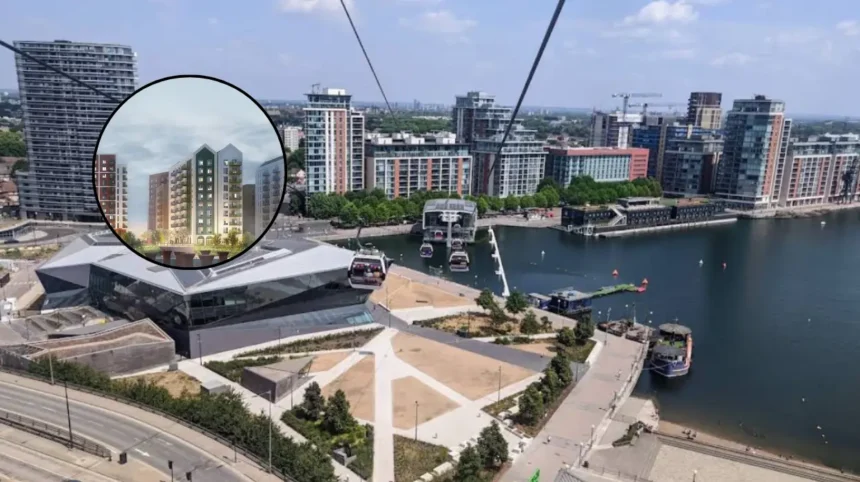
The approved first phase covers a 30-acre sector of the former gasworks footprint north of the Royal Albert Dock. The site is bounded by the Beckton DLR depot and Armada Way to the west. Under the detailed parameters of the consent, St William will undertake extensive decontamination and remediation operations, reinforce existing river flood defences, and upgrade surrounding physical infrastructure to prepare the land for large-scale residential occupation.
How Will the Physical and Community Masterplan Be Structured?
As reported by Building Design, the architectural concept crafted by JTP envisions a high-density urban neighborhood comprising 34 new buildings, with structural heights spanning between six and 15 storeys. The residential distribution will deliver 2,977 homes featuring a mix of one, two, three, and four-bedroom floorplans to accommodate various household sizes.
Complementing the residential units, the scheme integrates 5,000 square metres of mixed-use space designated for commercial, retail, and civic community facilities. The spatial layout incorporates just under three hectares of dedicated open public space divided across five distinct public realms. The centerpiece of this landscape strategy—designed by landscape architecture practice HTA—is a 400-metre-long linear park extending southwards across the site, establishing a direct pedestrian link connecting the location of a proposed Docklands Light Railway (DLR) station extension directly to the River Thames. The wider technical team assisting JTP includes planning consultancy Quod, transport consultant Vectos, and daylight specialists GIA.
What Are the Specific Provisions for Affordable Housing?
As reported by Building Design, the financial and tenure composition of the residential element has been structured around baseline commitments and potential grant-supported uplift mechanisms. Within the initial Phase 1 baseline, 129 homes are designated as affordable housing, representing an allocation equivalent to 25 per cent when measured by habitable room.
As highlighted by Building Design, City Hall documentation indicates that the initial direct share stands at 8.1 per cent by habitable room under baseline private funding, with structured provisions allowing this figure to increase up to 20 or 25 per cent across subsequent delivery stages if public housing grants are successfully secured by the developer. The residential mix across both market and affordable tenures has been designed in accordance with Newham’s local housing targets, catering to single occupants, couples, and larger families.
How Does Phase 1 Fit Into London’s Broader Regeneration Strategy?
The Phase 1 development site is the inaugural component of the wider Beckton Riverside framework—a multi-landowner strategic initiative encompassing more than 100 hectares of industrial land. Formally allocated within Newham Council’s 2024 Local Plan, the overall vision seeks to establish a completely new town centre and riverside community capable of accommodating up to 10,000 homes over successive phases.
Furthermore, the site occupies a core location within the designated Royal Docks and Beckton Riverside Opportunity Area. As one of the largest continuous brownfield urban regeneration zones in Greater London, the region is slated to absorb significant strategic investment in public transport, digital infrastructure, and environmental mitigation over the coming decades.
Background of the Particular Development
The Beckton Gasworks site holds a prominent position in London’s industrial history. Established in the late 19th century by the Gas Light and Coke Company, the location expanded to become the largest gasworks complex in Europe, manufacturing town gas from coal and supplying power to millions of Londoners for over a century. Following the discovery of natural gas in the North Sea during the 1960s, the facility underwent gradual decommissioning, leaving behind heavily contaminated brownfield land and redundant industrial structures adjacent to the River Thames.
In recent years, the land was acquired by St William—a specialist joint venture established by the Berkeley Group to redevelop complex, highly constrained former utility and gasworks sites across London and the South East. Bringing such land into residential use requires complex engineering, soil decontamination, and costly flood prevention infrastructure before above-ground construction can commence.
Planning efforts for Beckton Riverside have spanned several years, involving complex negotiations between private landowners, Newham Borough Council, Transport for London (TfL), and the Greater London Authority. While local councillors unanimously backed the spatial plans in late 2025, the administrative complexity of Section 106 agreements—which legally bind developers to fund local public services, schools, and infrastructure upgrades—led to delays. City Hall’s decision to call in and finalize the planning consent reflects a broader policy trend by the London Mayoralty to streamline regulatory approvals for major brownfield sites to address the capital’s structural housing shortage.
Prediction: How This Development Will Affect Key Stakeholders
The approval of Phase 1 of the Beckton Gasworks scheme will trigger substantial, multi-faceted consequences for several key groups across East London:
- Local Residents and Househunters in Newham: For local residents, the clearance and remediation of a long-derelict industrial site will eliminate an environmental eyesore and open up previously inaccessible stretches of the River Thames. The delivery of nearly 3,000 new homes will increase local housing supply, though local community groups will likely maintain pressure on both City Hall and St William to maximize the actual yield of genuinely affordable and social-rented units. The introduction of 5,000 m² of commercial space and three hectares of public parks will also provide local amenities and recreation areas for existing neighborhoods in Beckton.
- Transport Commuters and Transport for London (TfL): The influx of several thousand new residents will place immediate demand on local transport networks. The success of the development is heavily intertwined with proposed infrastructure expansions, specifically the long-discussed extension of the DLR from Gallions Reach across Beckton Riverside. While the inclusion of a dedicated transit corridor and linear park anticipates this extension, TfL and local authorities will face increased pressure to secure capital funding to build the new DLR station and associated bus routes to prevent localized congestion on Armada Way and surrounding arterial roads.
- The Local Economy and Construction Sector: The project represents a sustained economic stimulus for the East London construction supply chain. Over the multi-year build schedule for Phase 1, the development will generate hundreds of construction jobs, apprenticeships, and civil engineering contracts specializing in land remediation and high-density residential building. In the longer term, the incoming population will boost local high-street expenditure, aiding the establishment of the newly designated Beckton Riverside town centre.