Key Points
- Historical Eviction: The Bethnal Green Weightlifting Club, founded in 1926, has been ordered to vacate its premises of 78 years by Tower Hamlets Council.
- Proposed Development: The site at the Professional Development Centre (PDC) on Bethnal Green Road and Turin Street is earmarked for a new library and 44 residential units.
- Social Housing Priority: Of the proposed 44 homes, 24 are designated for social rent to address the borough’s acute housing crisis.
- Conflicting Statements: Planning documents claim the club agreed to a relocation site “in principle,” a claim the club’s leadership has publicly denounced as “completely false.”
- Heritage vs. Modernisation: The club is one of the oldest of its kind in the UK, fostering generations of athletes and local community cohesion.
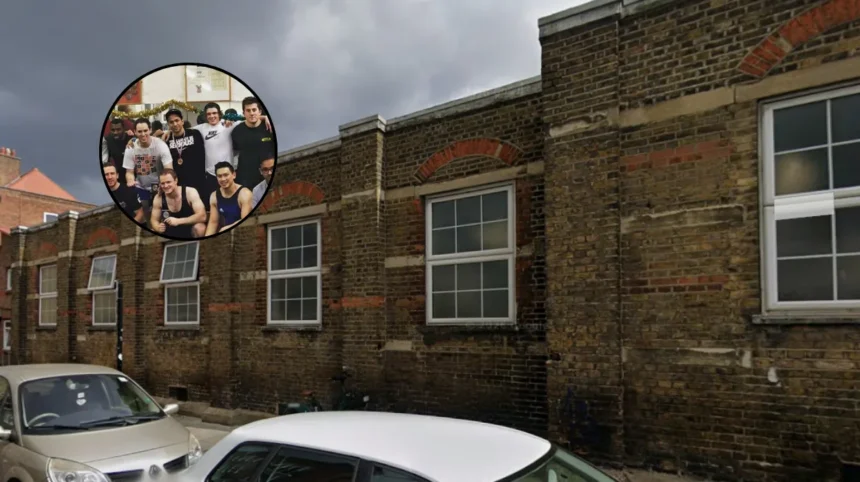
Bethnal Green (East London Times) May 18, 2026 — A century of sporting history is currently hanging in the balance as the Bethnal Green Weightlifting Club (BGWC) faces a forced relocation from its long-standing home. Tower Hamlets Council has formalised plans to redevelop the Professional Development Centre (PDC) site on Bethnal Green Road and Turin Street, a move that would see the demolition of the club’s base to make way for a modern library and dozens of new homes. While the council emphasises the desperate need for social housing, the club’s management has expressed shock over the “false” claims regarding their willingness to move.
- Key Points
- What are the specific plans for the Professional Development Centre site?
- Why is there a dispute over the “in principle” relocation agreement?
- What is the historical significance of the Bethnal Green Weightlifting Club?
- How has Tower Hamlets Council justified the eviction?
- What are the club’s concerns regarding a potential move?
- Background of the Development
- Prediction: How this development will affect the local community
What are the specific plans for the Professional Development Centre site?
According to official planning application documents submitted by Tower Hamlets Council, the local authority intends to transform the Turin Street site into a mixed-use development.
The core of the proposal involves the construction of 44 new homes. Critically, 24 of these units are designated for social rent, which the council argues is a vital step in mitigating the extensive housing waiting lists within the East London borough.
In addition to the residential component, the project includes the establishment of a brand-new public library. This facility is intended to serve the wider Bethnal Green community, replacing older infrastructure with a purpose-built hub for education and digital access.
However, as noted by local reporters covering the Tower Hamlets planning beat, the footprint of this proposed development directly overlaps with the space currently occupied by the weightlifting club.
Why is there a dispute over the “in principle” relocation agreement?
A significant point of contention has emerged regarding the communication between the local authority and the club’s representatives. As reported by local government correspondents, the council’s planning submission states that both parties have “identified and agreed” a potential new site “in principle.”
This phrasing suggests a mutual understanding and a smooth transition for the historic institution.
However, the Bethnal Green Weightlifting Club has issued a firm rebuttal to this narrative. A spokesperson for the club stated that the assertion of an agreed-upon relocation is “completely false.” While the club acknowledged that it would be forced to relocate if the planning permission is granted, they maintain that no suitable alternative has been finalised, nor have they given their formal consent to the move as described in the council’s documents. This discrepancy has raised questions regarding the transparency of the consultation process.
What is the historical significance of the Bethnal Green Weightlifting Club?
The club is not merely a gym; it is a landmark of British strength sports. Founded in 1926, the Bethnal Green Weightlifting Club has been a fixture of East London’s social fabric for 100 years.
It has operated out of the Turin Street site since 1948, shortly after the end of the Second World War. Over the decades, it has served as a training ground for Olympic athletes, competitive powerlifters, and thousands of local residents.
Journalist Ruby Gregory, reporting on the community impact, highlighted that the club is renowned for its affordable membership and its role in keeping local youth engaged in disciplined physical activity.
The Victorian-era sensibilities of the club, combined with its grit and history, have made it a subject of various documentaries and photographic essays over the years, marking it as a site of “cultural and sporting heritage.”
How has Tower Hamlets Council justified the eviction?
The council’s position is rooted in the “greater public good” of housing provision. Tower Hamlets currently faces one of the highest levels of housing need in London.
By providing 24 homes for social rent, the council argues that the Turin Street development provides a life-changing opportunity for families currently living in overcrowded or temporary accommodation.
In a statement tracked by local news outlets, council representatives suggested that the redevelopment of the Professional Development Centre is a strategic priority.
The site is seen as underutilised in its current form, and the integration of a library and high-density housing is viewed as a more efficient use of public land.
The council has maintained that it remains committed to finding a “sustainable future” for the club, even if that future is not at its original Turin Street location.
What are the club’s concerns regarding a potential move?
The leadership of the BGWC has expressed deep-seated fears that a forced move could result in the permanent closure of the institution.
Specialized weightlifting facilities require specific architectural features, such as reinforced flooring and high ceilings, which are not easily found in modern commercial properties.
Furthermore, the club argues that its identity is inextricably linked to Bethnal Green. Moving even a few miles away could alienate its core membership base, many of whom live within walking distance.
The “in principle” site mentioned by the council has not been publicly disclosed in detail, leaving members in a state of uncertainty regarding the club’s viability post-redevelopment.
Background of the Development
The redevelopment of the Turin Street site is part of a broader “Infill” strategy adopted by Tower Hamlets Council over the last decade.
This strategy seeks to identify small-to-medium-sized plots of land—often occupied by older community halls, garages, or administrative buildings—to increase the borough’s housing stock without the need for large-scale estate demolition.
The Professional Development Centre (PDC) itself has seen varying degrees of use over the years, primarily serving as a hub for teacher training and local government services. As budgets for such centres have shifted toward digital and centralised models, the physical space became a target for the borough’s “Homes for Tower Hamlets” initiative.
This context is essential to understanding why the club, despite its tenure, is being viewed as an obstacle to a modernised urban plan that prioritises residential density over low-density heritage sites.
Prediction: How this development will affect the local community
The outcome of this development will likely create a bifurcated impact on the Bethnal Green community.
For families on the housing waiting list, the completion of the 44 homes will be a significant victory. The provision of 24 social rent units in an area where private rents are skyrocketing offers a rare chance for local stability. The new library will also likely provide modernised resources that the aging PDC currently lacks, benefiting local students and job seekers.