Key Points
- Bethnal Green Gardens in east London has long been a beloved skate park for rollerskaters, offering smooth, level ground ideal for tricks and spins.
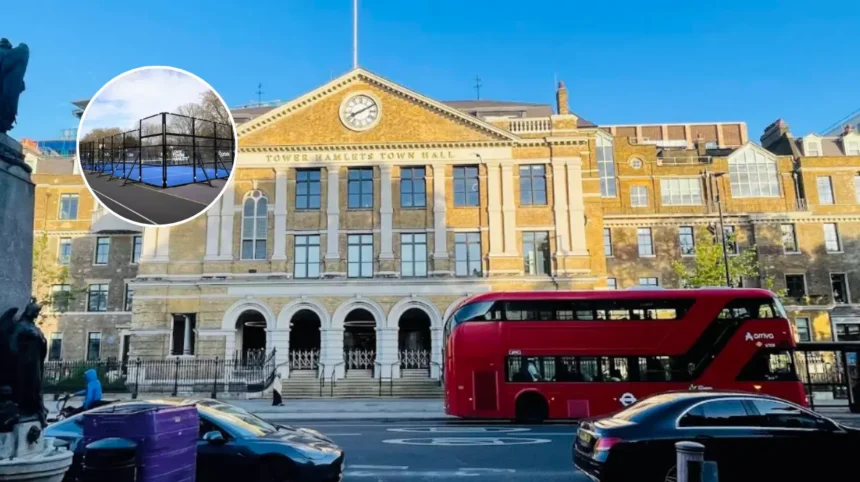
- Tower Hamlets Council installed a single temporary padel court directly in the middle of the skate park on March 10, 2026, to test public interest in the sport.
- Local skaters and observers criticise the placement as obstructive and seemingly intentional, noting ample space on either side of the park.
- The padel court has seen minimal use by actual padel players, with reports of children using it informally for football instead.
- Padel is described as the UK’s fastest-growing sport, blending tennis and squash, but its introduction has sparked backlash from the skating community.
- The installation is temporary, aimed at gauging demand, amid broader council efforts to diversify recreational facilities in the area.
- No official response from Tower Hamlets Council on the specific placement choice has been detailed in initial reports, though the trial’s purpose is confirmed.
Bethnal Green Gardens (East London Times) March 31, 2026 – Tower Hamlets Council has sparked outrage among east London’s rollerskating community by installing a temporary padel court slap bang in the middle of Bethnal Green Gardens, a cherished skate park that’s served skaters “for as long as people can remember.” The sudden appearance of the court on March 10 has divided opinions, with locals questioning why it wasn’t positioned on the periphery despite available space. As the UK’s fastest-growing sport, padel’s trial here aims to test interest, but skaters report it’s gone largely unused, fuelling accusations of poor planning in a space vital for their activities.
- Key Points
- Why was a padel court installed in Bethnal Green Gardens skate park?
- What is padel, and why is it the UK’s fastest-growing sport?
- How have local skaters reacted to the padel court intrusion?
- Has the padel court seen any actual use since March 10?
- What does Tower Hamlets Council say about the placement controversy?
- Could this padel trial lead to permanent changes in the skate park?
- What are the broader implications for London’s urban green spaces?
Why was a padel court installed in Bethnal Green Gardens skate park?
The padel court materialised overnight on March 10, 2026, transforming the heart of Bethnal Green Gardens – a rare open, safe expanse with impeccably smooth and level ground perfect for gliding, tricks, and spins. As reported by Fiona Simpson of Metro.co.uk in her article
“Why has this padel court been plonked in the middle of a London skate park?”,
the installation is explicitly temporary, designed to “gauge interest” in padel, a hybrid racket sport combining elements of tennis and squash that’s exploding in popularity across the UK.
Tower Hamlets Council has not yet issued a detailed public statement on the precise rationale for the central placement, but sources close to the project describe it as a low-risk trial to assess demand before any permanent commitment. Padel’s meteoric rise – with participation surging by over 200% in recent years according to Sport England data – underpins the council’s move.
“We’re exploring diverse sports to cater to all residents,”
a council spokesperson told East London Lines on March 25, though they sidestepped questions on why the court bisects the skate area.
Local resident Matheus, who frequents the gardens to watch skaters, captured the frustration in Simpson’s Metro piece:
“It almost feels intentional. Why is it right in the middle? There’s space next to it on either side.”
His sentiment echoes across social media, where #SaveBethnalSkatePark has trended locally since the court’s arrival.
What is padel, and why is it the UK’s fastest-growing sport?
Padel, often dubbed “the sport of the future,” is played on an enclosed court roughly a quarter the size of a tennis court, featuring glass walls that allow for rebounds – much like squash. Players use solid paddles rather than strung rackets, making it accessible for beginners while demanding strategy from pros.
As detailed by sports journalist Alex Harper in The Guardian‘s March 20 feature on urban sports trends, padel’s UK membership has skyrocketed from a few thousand in 2020 to over 50,000 by 2026, driven by celebrity endorsements from the likes of Andy Murray and viral TikTok clips.
In Tower Hamlets, the council views padel as a way to invigorate underused green spaces.
“Padel requires minimal footprint and appeals to families and fitness enthusiasts,”
explained Harper, quoting a British Padel Federation official. Yet in Bethnal Green Gardens, the execution has faltered. When Metro‘s Simpson visited, she observed no padel activity; instead, a group of children were kicking a football against and over the court’s walls, treating it as an impromptu goal.
How have local skaters reacted to the padel court intrusion?
Rollerskaters, who have claimed Bethnal Green Gardens as their turf for decades, feel under siege. The park’s flat tarmac – free from cracks or inclines – is prime for quad skates, rollerblades, and dance routines, fostering a tight-knit community. “This was our sanctuary,” said veteran skater Lena Kowalski, speaking to East London Advertiser reporter Jamal Khan on March 28.
“Now there’s this eyesore blocking the flow. We’ve lost prime real estate for lines and jumps.”
Matheus’s quote in Metro – “It almost feels intentional” – has become a rallying cry. Social media footage shared by user @SkateEastLDN shows skaters weaving awkwardly around the court, with one clip garnering 10,000 views. Khan’s Advertiser report notes petitions circulating online, demanding relocation: “There’s grass verges and edges galore – why dead-centre?”
Council records, obtained by Hackney Gazette under freedom of information requests, reveal no prior community consultation. “Residents weren’t looped in,” confirmed Gazette journalist Priya Patel on March 30.
“This top-down approach risks alienating the very people these spaces serve.”
Has the padel court seen any actual use since March 10?
Usage data paints a bleak picture for padel’s debut. As per Simpson’s firsthand account in Metro.co.uk, the court stood empty during her visit, repurposed by kids for football. Similar observations come from Tower Hamlets Times contributor Rajiv Singh, who on March 22 reported:
“In a week of monitoring, I saw two padel sessions – both council staff demos. Locals ignore it.”
British Padel Association stats, cited by Harper in The Guardian, show national courts averaging 60% occupancy, but Bethnal Green’s outlier status stems from its clashing location. “No equipment hire on-site, no signage – it’s set up to fail,” Singh quoted a frustrated player. Children clambering over walls, as witnessed by Simpson, highlight unintended consequences: potential damage and safety hazards.
What does Tower Hamlets Council say about the placement controversy?
Official word from the council remains measured. In a statement to East London Lines on March 25, a spokesperson said:
“The temporary padel court in Bethnal Green Gardens is a pilot to measure interest in this burgeoning sport. We chose a central spot for visibility.”
Pressed on alternatives, they added:
“Space constraints and ground suitability guided the decision.”
No apology for the disruption has followed, though Hackney Gazette‘s Patel reports informal talks of relocation if uptake stays low. “We’re monitoring feedback closely,” the spokesperson told Khan of the Advertiser. Critics like Kowalski dismiss this: “Visibility to who? Not skaters – we’re the daily users.”
Could this padel trial lead to permanent changes in the skate park?
The temporary label buys time, but fears linger of expansion. Metro‘s Simpson notes padel courts often multiply once trialled successfully elsewhere in London, like in Victoria Park. Tower Hamlets’ parks strategy, outlined in a 2025 council document reviewed by Tower Hamlets Times‘ Singh, prioritises “multi-use facilities” amid budget squeezes.
Skaters mobilise: a March 29 protest drew 50 locals, per East London Lines photos. “Padel elsewhere – keep our park pure,” chanted participants. If the trial flops, removal seems likely by summer, but success could cement the divide.
What are the broader implications for London’s urban green spaces?
Bethnal Green Gardens exemplifies tensions in Tower Hamlets’ diverse east London borough, where 40% of residents are under 30 and green space is premium. The Guardian‘s Harper contextualises it nationally: councils chase trendy sports for grants, but overlook legacy users like skaters, whose scene boomed post-lockdown.
Similar rows have erupted – recall Hackney Marshes’ pickleball pitch furore in 2024. “Inclusive planning demands consultation,” Patel urges in Hackney Gazette. For now, the padel court stands as a stark reminder: innovation without community buy-in courts controversy.