Key Points
- Construction has officially commenced on Phase 1 of the Harriott, Apsley, and Pattison House (HAP) regeneration scheme in Stepney Green.
- The overall HAP programme is designed to deliver a total of 407 new homes across two distinct phases, alongside a new purpose-built community centre and upgraded public realm.
- Phase 1 will feature 109 council homes—including direct replacement housing for existing residents—and the initial phase of the community facility, with completion and resident move-ins anticipated in 2029.
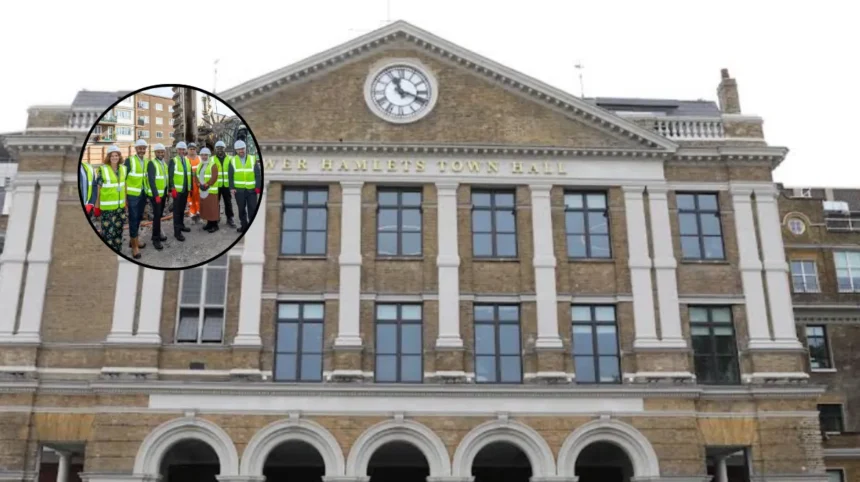
- Key stakeholders, including Executive Mayor Lutfur Rahman, Cabinet Member Cllr Saied Ahmed, and Vistry East London Regional Managing Director Kevin Delve, attended a groundbreaking ceremony on 24 September.
- Main construction works were enabled following the completion of site preparation and successful Building Safety Regulator Gateway 2 approval earlier in the year.
- The project includes developer commitments to provide local employment, apprenticeships, skills training, and community volunteering throughout the construction phase.
Stepney Green (East London Times) September 28, 2026 – Construction has officially commenced on Phase 1 of the Harriott, Apsley, and Pattison House (HAP) regeneration initiative in Stepney Green, marking a significant milestone in one of the London Borough of Tower Hamlets‘ primary residential housing schemes. Local authority leaders, senior council executives, and representatives from developer partner Vistry East London gathered on site on 24 September to celebrate the formal groundbreaking. The event followed the successful completion of site preparation works and the securing of Building Safety Regulator Gateway 2 approval earlier this year, allowing the project to move from preliminary site works into main structural delivery.
- Key Points
- What is Being Built in the First Phase of the HAP Scheme?
- Who Attended the Groundbreaking Ceremony in Stepney Green?
- What Statements Were Made by Local Authority and Industry Leaders?
- What Community and Economic Benefits Are Envisaged During Construction?
- Background of the Development
- Prediction: How This Development Can Affect Local Residents and the Regional Housing Market
What is Being Built in the First Phase of the HAP Scheme?
The HAP regeneration project is structured to deliver 407 new homes across two distinct development phases, supported by updated public realm infrastructure, enhanced pedestrian links, and new civic spaces. Phase 1 specifically focuses on the construction of two residential blocks containing 109 council homes, which encompass replacement dwellings tailored for existing estate residents. Additionally, Phase 1 includes the first stage of a brand-new, purpose-built community facility. According to project schedules established by Tower Hamlets Council and Vistry, the initial contingent of residents is expected to move into these new Phase 1 properties in 2029.
Who Attended the Groundbreaking Ceremony in Stepney Green?
The formal commencement event brought together key political and operational figures overseeing the East London development. Executive Mayor of Tower Hamlets Lutfur Rahman and Cllr Saied Ahmed, Cabinet Member for Homebuilding and Enhancing Council Homes and Neighbourhoods, represented the local authority alongside senior municipal officials. They were joined on site by Kevin Delve, Regional Managing Director for Vistry East London, representing the council’s chosen development partner. The gathering served as the formal transition mark following the earlier execution of the overall Development Agreement and Phase 1 construction contracts between Tower Hamlets Council and Vistry.
What Statements Were Made by Local Authority and Industry Leaders?
During the ceremonial site visit, leadership figures set out the statutory objectives and social delivery goals associated with the regeneration effort.
In a public statement, Lutfur Rahman, Executive Mayor of Tower Hamlets, stated that:
“Tower Hamlets is building for the future. At a time when London desperately needs more genuinely affordable homes, we are getting on with delivering the high-quality council housing local families need.” Rahman added:
“Breaking ground in Stepney Green is another important milestone in our ambitious homebuilding programme. Our commitment is not simply to build more homes, but to create strong, thriving neighbourhoods with the facilities and public spaces our communities deserve.”
Focusing on resident involvement and project scope, Cllr Saied Ahmed, Cabinet Member for Homebuilding and Enhancing Council Homes and Neighbourhoods, observed that:
“This is a significant milestone for the HAP regeneration programme and, most importantly, for the residents and community who have helped shape its future.”
Ahmed further noted:
“Phase 1 will deliver 109 new council homes, including replacement homes for existing residents, alongside new community facilities and improvements to the surrounding neighbourhood. We are committed to working closely with residents and Vistry throughout construction to make sure this regeneration delivers lasting benefits for the local community, from better homes and public spaces to jobs, skills and training opportunities.”
Speaking on behalf of the developer partner, Kevin Delve, Regional Managing Director for Vistry East London, commented that:
“Breaking ground on Phase 1 is a proud moment for everyone who has helped shape this project and reflects the strength of the partnership between Vistry, Tower Hamlets Council and local residents.”
Delve elaborated:
“The successful completion of site preparation works and receipt of Gateway 2 approval have allowed us to move confidently into construction. Over the coming months residents will begin to see the new homes and community facilities taking shape. As well as providing high-quality new homes, we are committed to creating jobs, apprenticeships, training opportunities and wider social value initiatives that benefit people across the borough.”
What Community and Economic Benefits Are Envisaged During Construction?
Beyond physical brick-and-mortar additions, the contractual terms of the HAP scheme incorporate formal social value mechanisms aimed at the local populace. Throughout the active build timeframe, Vistry is obligated to deliver targeted employment, apprenticeship, work placement, and formal training provisions for borough residents. The developer will liaise directly with regional primary and secondary schools, further education colleges, and neighbourhood non-profit groups to coordinate skill development programmes and local volunteering actions that correspond with municipal economic priorities.
Background of the Development
The Harriott, Apsley, and Pattison House (HAP) estate renewal forms part of Tower Hamlets Council’s wider municipal strategy to update aging mid-century housing stock and tackle acute housing pressures across East London. Located within the historic Stepney Green neighbourhood, the original residential structures required extensive modern upgrades to meet contemporary building, structural, and energy efficiency standards.
Following extensive public consultations with existing estate inhabitants, the local authority pursued a masterplan model centered on full estate regeneration rather than minor refurbishment. Under this plan, existing residents were guaranteed rehousing rights within the new development scheme. To execute a project of this scale, Tower Hamlets Council selected Vistry East London as its statutory private development partner, establishing a joint delivery model that combines public land resources with private sector construction capacity. The project passed a crucial regulatory checkpoint earlier this year upon satisfying the Gateway 2 criteria administered by the UK’s Building Safety Regulator, a statutory safety threshold mandated under recent national building control legislation prior to beginning major structural work.
Prediction: How This Development Can Affect Local Residents and the Regional Housing Market
The progression of Phase 1 of the HAP scheme is anticipated to generate direct and multi-layered effects for several specific audiences within the borough:
- Existing Estate Residents: For individuals currently residing in or displaced from Harriott, Apsley, and Pattison House, the start of main construction provides a clear timeline toward modern, highly efficient social housing by 2029. The explicit commitment to deliver direct replacement dwellings minimises long-term displacement risks and ensures returning tenants gain access to contemporary living standards and updated communal infrastructure without leaving their immediate neighbourhood.
- Local Jobseekers and Young Professionals: The binding social value framework integrated into Vistry’s delivery contract provides immediate vocational entry points for local workers. High school leavers and adults seeking entry into technical construction trades will gain access to structured apprenticeships and site training, injecting direct economic investment into the Stepney Green workforce prior to the buildings’ completion.
- The Surrounding Stepney Green Community: Neighbouring households and business owners will experience both temporary physical disruptions typical of major build cycles—such as increased heavy vehicle movements and site noise—and long-term structural improvements. The delivery of a modern community centre and upgraded public realm pathways will serve to integrate the estate more fully into the surrounding neighbourhood context, raising localized public amenity values.
- Tower Hamlets Housing Registrants and Local Authority Strategy: The addition of 109 high-density council homes in Phase 1 (and 407 units across the full project lifetime) incrementally relieves pressure on Tower Hamlets Council’s extensive housing waiting list. Success in navigating Gateway 2 regulatory pathways also establishes a working operational model for how the borough and private partners can execute future high-density social housing projects under current national safety regulations.