Key Points:
- External auditors from professional services firm Ernst & Young (EY) have flagged “significant concerns” regarding the “deteriorating financial position” of Tower Hamlets Council.
- The local authority in east London is projected to overspend by £19 million for the financial year ending in March 2027.
- Independent auditors noted that this multi-million-pound budget overshoot is “not consistent with effective financial planning and budgetary control”.
- EY stated that the persistent overspending raises serious doubts regarding the overall “robustness of the council’s budget-setting assumptions”.
- In July, the council initially disclosed it was on target to exceed its planned expenditure by £19.2 million for the financial year ending in March 2027.
- The warning follows a previous financial year in which the local authority recorded a £19.4 million budget overspend.
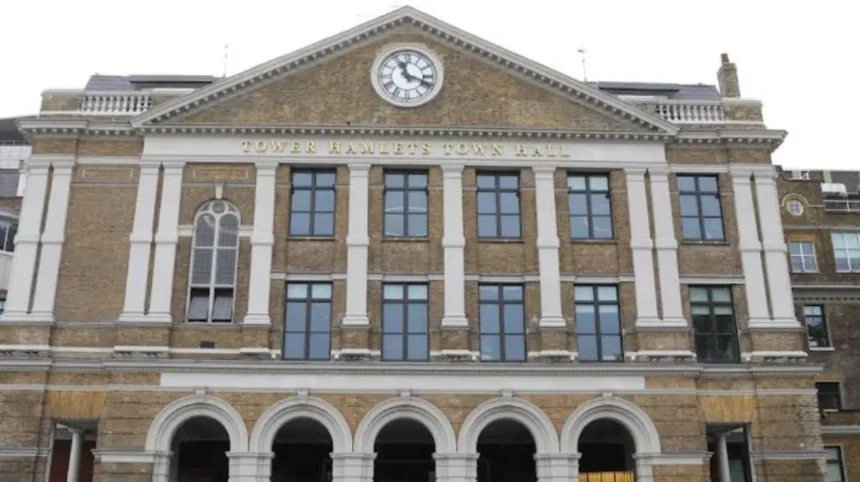
Tower Hamlets (East London Times) September 30, 2026 — External auditors have officially flagged significant concerns regarding what they describe as a deteriorating financial position at Tower Hamlets Council, with the local authority currently projected to overspend its annual budget by £19 million for the financial year ending in March 2027. As reported by Nick Clark, LDRS Reporter, and Patrick Daly of The Standard, an official audit report compiled by professional services firm Ernst & Young (EY) revealed that the prospective multi-million-pound deficit represents a notable risk to the council’s overall financial management framework.
The independent auditing body emphasized that the projected deficit raises troubling questions about the local authority’s long-term fiscal discipline. Within the audit documentation, EY experts highlighted that the £19 million overspend figure is “not consistent with effective financial planning and budgetary control”. Furthermore, as documented by Nick Clark and Patrick Daly in The Standard, auditors concluded that the ongoing expenditure trajectory “raises significant concerns” about the overall “robustness of the council’s budget-setting assumptions”.
The warning comes after the east London local authority initially revealed in July that it was tracking toward an overspend of £19.2 million for the financial year ending in March 2027. That disclosure followed a difficult preceding financial period in which the council recorded a budget overshoot of £19.4 million, illustrating a multi-year pattern of budgetary pressures within the borough’s operational departments.
What Does the Latest Financial Report Reveal About the Council’s Spending Profile?
The primary drivers behind the local authority’s deteriorating fiscal stance involve cumulative pressures within municipal services. According to details outlined in media coverage by Nick Clark and Patrick Daly of The Standard, external auditors from EY found that consecutive years of budget overruns are eroding the financial flexibility of the borough.
The council’s early internal projections had identified a potential £19.2 million shortfall earlier in the summer, which has now been formally benchmarked around £19 million by external auditing reviews. The continuation of significant departmental overspends—matching or approaching the £19.4 million overspend noted in the previous financial year—indicates persistent structural challenges in maintaining expenditure within approved parameters.
In assessing these figures, the audit report underlines that relying on operational overruns undermines the predictability of municipal services and weakens the council’s capacity to absorb unforeseen financial obligations in future financial years.
Background of Tower Hamlets Council’s Financial Position
The financial pressures at Tower Hamlets Council reflect broader fiscal challenges across local government in London, alongside borough-specific governance history. Over recent years, local authorities throughout the capital have experienced mounting cost pressures driven by heightened demand for statutory services, including adult social care, children’s services, and temporary accommodation.
Prior to the current audit warnings regarding the £19 million overspend projected for the financial year ending March 2027, Tower Hamlets Council had already contended with complex budgetary conditions. The council recorded an overspend of £19.4 million in the prior financial year, requiring reliance on municipal reserves and internal realignments to balance the accounts.
When the local authority published its mid-year financial update in July, showing a projected £19.2 million overspend for the financial year ending in March 2027, internal finance officers acknowledged the necessity of tighter cost-control measures. However, the formal evaluation by EY confirms that external oversight bodies view the recurring deficits as a structural issue rather than a temporary anomaly. The report from the professional services firm indicates that without significant adjustments to budget-setting practices and enforcement of departmental caps, the council risks further instability in its medium-term financial strategy.
Explore More Tower Hamlets Council News
Tower Hamlets Approves McLaren Property Co Living Scheme Fish Island 2026
Tower Hamlets Education Awards Honours Over 200 Students Tower Hamlets 2026
Prediction: How This Development Could Affect Residents and Local Taxpayers
The warning from EY regarding the £19 million projected overspend for the financial year ending in March 2027 is likely to have direct consequences for residents, businesses, and service users within the London Borough of Tower Hamlets.
If the local authority moves to correct its budget trajectory and address the auditor’s concerns over financial planning, the administration may need to implement rigorous cost-reduction measures. For local residents, this could result in adjustments to non-statutory municipal services, potential reductions in discretionary community funding, or longer wait times for public-facing council departments.
Furthermore, persistent budgetary shortfalls frequently place upward pressure on local taxation. To bridge structural gaps between planned expenditure and actual departmental costs in future fiscal cycles, council leaders may consider proposing increases in Council Tax rates up to the maximum allowable threshold without a referendum.
For local businesses and voluntary organizations reliant on municipal procurement or grant programs, the demand for stricter budgetary control could lead to tighter contract reviews and scaled-back local authority spending. In the long term, if financial performance fails to align with independent audit standards, the council could also face heightened monitoring from central government oversight bodies, constraining its operational autonomy in future financial planning cycles.