Key Points
- Cabinet Approval Granted: Tower Hamlets Council’s Cabinet approved a proposal on Wednesday 22 October 2025 to acquire four office buildings at 191, 193, 195, and 197 Marsh Wall in Canary Wharf.
- Intended Capacity: The scheme aims to convert the commercial properties into approximately 180 family-sized temporary homes, comprising 167 two-bedroom and 13 three-bedroom units.
- Mounting Housing Pressure: Tower Hamlets currently has over 3,100 households in temporary accommodation, including roughly 2,700 families, with homelessness applications increasing by approximately 11 per cent annually.
- Objective of the Scheme: The council seeks to reduce reliance on expensive nightly paid accommodation and keep homeless families within the borough near local schools, workplaces, and support networks.
- Outstanding Requirements: The buildings are not yet converted; the project requires further statutory and planning approvals, building surveys, detailed architectural design, contractor procurement, and extensive refurbishment before occupation can occur.
- Unresolved Timetable and Costs: The local authority has not disclosed the financial details of the acquisition, the overall conversion budget, or an expected completion date for the project.
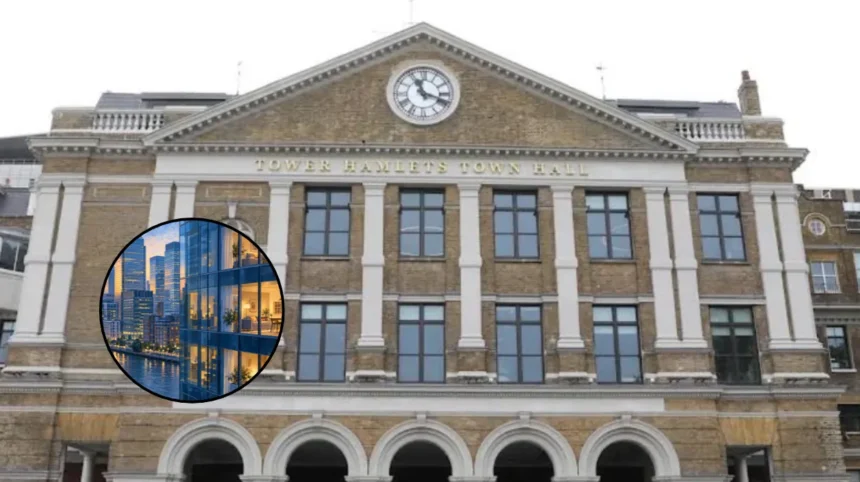
Tower Hamlets Council (East London Times) October 2025 – Tower Hamlets Council has formally approved a proposal to acquire four commercial office buildings located in Canary Wharf with the intention of converting them into temporary accommodation for local families facing homelessness. As reported in the official decision documents of Tower Hamlets Council, the local authority’s Cabinet backed the strategic acquisition plan during its meeting on Wednesday 22 October 2025, targeting the properties situated at 191, 193, 195, and 197 Marsh Wall. The proposed development is designed to deliver approximately 180 family-sized residential units to help alleviate the severe housing pressures currently affecting the East London borough. However, the municipal authority noted that the site remains unconverted commercial office space, and significant statutory approvals, technical design assessments, and construction works must be completed before any residents can move into the properties.
- Key Points
- How Many Temporary Accommodation Units Are Planned for the Site?
- Why Is Tower Hamlets Facing Increasing Pressure on Temporary Accommodation?
- What Are the Main Goals of the Marsh Wall Housing Proposal?
- What Steps Must Be Completed Before the Properties Can Be Occupied?
- What Information Remains Unannounced Regarding Costs and Timetables?
- What Does the Recent Cabinet Approval Change in the Immediate Term?
- Background of the Particular Development
- Prediction: How This Development Can Affect Local Homeless Families and the Borough Community
How Many Temporary Accommodation Units Are Planned for the Site?
According to the published Cabinet reports from Tower Hamlets Council, the draft scheme sets out an intended capacity of around 180 family-sized accommodation units within the four office structures. As reported by the municipal policy team, the spatial breakdown of the proposal comprises 167 two-bedroom units and 13 three-bedroom units. Local authority officials specified that these figures represent the target capacity of the office-to-residential conversion project rather than immediately accessible residential capacity. The decision taken by the Cabinet authorizes municipal officers to proceed with negotiations and technical evaluations for the property acquisition; it does not indicate that residential refurbishment has commenced, that final building approvals have been granted, or that families have been assigned to the location.
Why Is Tower Hamlets Facing Increasing Pressure on Temporary Accommodation?
As outlined in statistical data released by Tower Hamlets Council, the authority is managing a growing demand for emergency housing, with more than 3,100 households presently residing in temporary accommodation across the borough. As reported in the Cabinet agenda papers, this figure includes approximately 2,700 families with children. Municipal housing figures further demonstrate that the total number of homeless households seeking local authority assistance is rising by approximately 11 per cent each year. These figures explain why the local authority is actively pursuing large-scale acquisition schemes within Tower Hamlets boundaries to avoid placing vulnerable families in locations far removed from the borough.
What Are the Main Goals of the Marsh Wall Housing Proposal?
As stated by the policy team at Tower Hamlets Council, the primary objective of acquiring the Marsh Wall office properties is to keep homeless families close to their established support networks, local schools, and places of employment. By increasing internal housing capacity, the local authority intends to reduce its current reliance on external borough placements and costly nightly paid temporary accommodation, such as commercial hotels and bed-and-breakfast units. Council documentation highlights that temporary accommodation remains distinct from a permanent local authority housing allocation, serving as an intermediate housing solution while long-term housing arrangements are pursued.
What Steps Must Be Completed Before the Properties Can Be Occupied?
As detailed in the technical summary provided by Tower Hamlets Council, converting four commercial office blocks into residential living spaces requires several major procedural and technical steps beyond the initial Cabinet decision. The local authority must complete detailed structural and building surveys, produce comprehensive architectural designs, secure full planning permission and statutory building control consents, conduct competitive procurement processes to appoint construction contractors, and oversee full structural refurbishment. Council officials noted that potential disruptions or delays at any point during these statutory phases could affect the ultimate schedule and the final number of homes delivered.
What Information Remains Unannounced Regarding Costs and Timetables?
According to statements published in the council’s public record, Tower Hamlets Council has not yet specified a target completion date or an estimated timeline for when the initial residential units might become available for occupation. Furthermore, as reported in the Cabinet finance documents, the local authority has not disclosed the precise commercial terms, overall purchase price, or full refurbishment costs associated with acquiring 191–197 Marsh Wall. Consequently, core operational details—including the overall financial expenditure, the contract delivery timetable, and the definitive count of finished units—remain pending further administrative decisions.
What Does the Recent Cabinet Approval Change in the Immediate Term?
As documented in the official proceedings of Tower Hamlets Council, the decision represents a policy and strategic asset management milestone that authorizes officers to pursue the acquisition framework. The decision does not constitute a completed housing development, and the 180-unit figure remains an operational planning target subject to physical surveys, statutory planning consents, and construction performance. The key ongoing metric for the local authority will be whether the necessary planning consents and building alterations can successfully transform the commercial office spaces into viable, long-term temporary accommodation for families in need.
Background of the Particular Development
The proposal to convert office buildings at 191–197 Marsh Wall reflects broader macroeconomic and administrative challenges within the London Borough of Tower Hamlets and the wider London housing sector. Tower Hamlets has long experienced acute housing demands driven by rapid population growth, elevated private rental prices, and a limited supply of social housing stock. Over recent years, local authorities across Greater London have faced substantial financial burdens due to the cost of emergency temporary accommodation, often relying on nightly paid hotel rooms or housing placements outside borough boundaries.
Simultaneously, changes in working patterns and the expansion of commercial property developments in Canary Wharf have led to shifts in office space utilization across the Isle of Dogs. The practice of converting vacant or underutilized commercial office space into residential units—frequently executed under permitted development rights or full planning applications—has increasingly been explored by London councils seeking to generate municipal housing solutions. Tower Hamlets Council’s decision to evaluate office acquisitions along Marsh Wall forms part of a wider strategic push by local government bodies to repurpose commercial real estate to manage rising homelessness burdens locally.
Prediction: How This Development Can Affect Local Homeless Families and the Borough Community
If fully realized, the conversion of 191–197 Marsh Wall into approximately 180 temporary family homes will directly impact local homeless families currently awaiting housing support in Tower Hamlets. For these residents, access to self-contained two- and three-bedroom temporary units within the borough means children can remain enrolled in their existing local schools without enduring long daily commutes from distant placements outside the authority. It also allows parents and caregivers to maintain employment, childcare arrangements, and proximity to local healthcare and community networks, offering improved stability during a period of housing insecurity.
For the wider Tower Hamlets community and local taxpayers, the successful execution of the project could alleviate financial pressures on the council’s operational budget by diminishing reliance on expensive, nightly paid private accommodation and hotel rooms. However, the localized impact on Canary Wharf and the Marsh Wall area will depend on the final execution of the scheme. Nearby residents, businesses, and infrastructure services will see a shift in property usage from commercial office space to residential family accommodation. In the interim, until planning approvals, building surveys, and refurbishment works are completed, the immediate daily routine for local residents and surrounding commercial properties will remain unchanged, with the long-term effectiveness of the initiative dependent on the council’s ability to deliver the project within budget and without significant delays.