Key Points
- Tower Hamlets Council has warned of a funding shortfall that may prevent proper enforcement of the new Renters’ Rights Act, effective in May.
- The borough hosts one of London’s largest private rental populations, with private renting households rising from 32.6 per cent in 2011 to 38.2 per cent in 2021, per a 2024 council report.
- The Renters’ Rights Act bans no-fault evictions, rent bidding wars, and excessively long contracts, while introducing a Decent Homes Standard requiring landlords to ensure properties are safe, warm, and in good repair.
- Campaigners from the Renters’ Reform Coalition, including press officer Paul Shanks, argue enforcement failures will not halt improvements, citing future Renters’ Ombudsman by 2028 and new council duties.
- Government funding stands at £18m nationwide for enforcement, deemed insufficient by advocates as it is shared across all councils.
- Less than one per cent of landlords face prosecution for illegal evictions, highlighting existing enforcement gaps.
- Two-thirds of English councils prosecuted no landlords from 2022 to 2024, with nearly half issuing no fines and over a third taking no formal action against unlawful renting.
- Paul Williams, national organiser at ACORN, criticised the Decent Homes Standard timeline as scheduled for 2035, calling local authorities unprepared for illegal evictions.
- Tower Hamlets and two other councils recently raised staffing and funding concerns at a London Assembly hearing alongside tenant rights groups.
- The London Assembly Housing Committee advocates new training for police and councils on illegal evictions.
- Risks include landlords resorting to illegal evictions if unpunished, potentially increasing as others observe impunity.
- Tower Hamlets Council did not respond to EastLondonLines’ request for comment on enforcement plans.
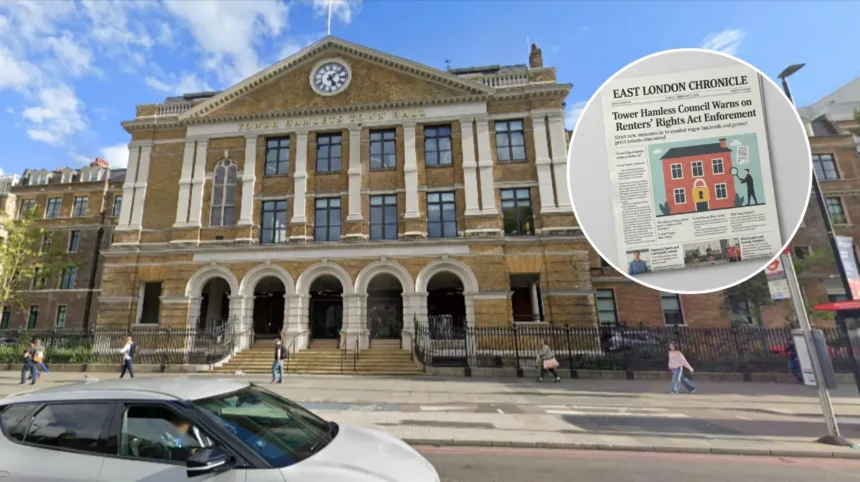
Tower Hamlets (East London Times) February 3, 2026 – Tower Hamlets Council has issued a stark warning that a funding shortfall could render new nationwide protections under the Renters’ Rights Act meaningless for the borough’s tenants, which boasts one of London’s largest private rental populations. The legislation, set to come into effect in May, aims to overhaul tenant-landlord relations but faces local enforcement challenges due to inadequate resources. Campaigners maintain that systemic improvements will emerge regardless, bolstered by forthcoming mechanisms like a Renters’ Ombudsman.
- Key Points
- Why Can’t Tower Hamlets Enforce the Renters’ Rights Act?
- What Does the Renters’ Rights Act Entail?
- How Have Campaigners Responded to Enforcement Fears?
- What Enforcement Gaps Plague English Councils?
- When Did Councils First Raise These Alarms?
- What Risks Do Illegal Evictions Pose?
- How Does Tower Hamlets’ Rental Profile Factor In?
- What Has the Government Committed Financially?
- Why Might Tenants Still See Improvements?
- Has Tower Hamlets Responded to Queries?
Why Can’t Tower Hamlets Enforce the Renters’ Rights Act?
Tower Hamlets Council has explicitly cautioned that insufficient funding will hinder its ability to enforce the Renters’ Rights Act effectively. As detailed in the EastLondonLines report, the council highlighted risks stemming from resource constraints in a borough where private renting has surged significantly. A 2024 Tower Hamlets Borough Profile report, accessible via the council’s statistics page, documents the proportion of private renting households climbing from 32.6 per cent in 2011 to 38.2 per cent in 2021, underscoring the scale of affected tenants.
Just weeks prior, representatives from Tower Hamlets and two other councils voiced identical concerns at a London Assembly hearing, as covered by MyLondon. The session, scrutinising the London mayor’s activities, featured testimony from council officials and tenant advocacy groups on funding and staffing shortfalls for punishing rogue landlords. Paul Shanks, press officer for the Renters’ Reform Coalition—which represents 19 housing organisations campaigning for private renting reform in England—echoed these worries in his comments to EastLondonLines.
What Does the Renters’ Rights Act Entail?
The Renters’ Rights Act seeks to rebalance power dynamics between landlords and tenants. Key provisions include a ban on no-fault evictions, rent bidding wars, and excessively long contracts, according to the legislation hosted on the UK Government’s website. It also mandates a new Decent Homes Standard, compelling landlords to maintain properties that are safe, warm, and in good repair, as explained in an MHCLG explainer blog post.
As reported by EastLondonLines, these changes address longstanding imbalances in the private rental sector. The Act’s enforcement, however, hinges on local authorities, where capacity issues loom large.
How Have Campaigners Responded to Enforcement Fears?
Tenant advocates remain optimistic despite council warnings. Paul Shanks told EastLondonLines:
“The government will eventually launch a Renters’ Ombudsman by 2028, so that will be another body that can be appealed to. Councils will also have new duties once this Act comes through.”
He emphasised that these developments would provide routes to justice over time, even amid initial enforcement lapses.
Shanks further noted the Renters’ Reform Coalition’s prior submissions at the London Assembly, aligning with council critiques. The group highlighted that less than one per cent of landlords are prosecuted for illegal evictions, a statistic underscoring chronic under-enforcement. Regarding government pledges, Shanks stated:
“That’s shared across all councils, so that’s actually very little, per council,”
referring to the £18m allocated nationwide.
Paul Williams, national organiser at the Association of Community Organizations for Reform Now (ACORN), addressed the London Assembly directly, as quoted in Inside Housing:
“[The Decent Homes Standard, I think that’s scheduled for…2035, which is ridiculous, what’s the point of that?]”
Williams added:
“Local authorities seem completely unprepared on how to deal with illegal evictions or enforcing the law as it stands at all.”
What Enforcement Gaps Plague English Councils?
Existing data paints a grim picture of landlord accountability. In November, The Guardian reported that two-thirds of English councils had not prosecuted a single landlord in the past three years. Specifically, from 2022 to 2024, nearly half of housing-responsible local authorities issued no fines, while more than a third took no formal action against unlawful private rentals. Shanks observed to EastLondonLines that the scale of abuse in the sector far outstrips councils’ resources.
This backdrop amplifies Tower Hamlets’ concerns, where high rental density exacerbates vulnerabilities.
When Did Councils First Raise These Alarms?
Concerns surfaced prominently at the recent London Assembly hearing. As per MyLondon’s coverage, Tower Hamlets joined two other councils in flagging enforcement hurdles under the new Act. The platform, tasked with overseeing the mayor’s remit, heard from both local government and tenant groups, including the Renters’ Reform Coalition.
EastLondonLines noted the timing—just weeks ago—heightening urgency as the May implementation approaches.
What Risks Do Illegal Evictions Pose?
Shanks warned EastLondonLines of heightened dangers post-Act. He said:
“There’s the risk, obviously, that if landlords see other landlords getting away with illegal evictions without punishment, more and more landlords might try this tactic to kick people out of their homes.”
The London Assembly Housing Committee has pushed for enhanced training and duties for police and councils to combat such tactics.
Williams’ ACORN testimony reinforced this, decrying current unpreparedness for even existing illegal evictions.
How Does Tower Hamlets’ Rental Profile Factor In?
The borough’s demographics intensify the stakes. Tower Hamlets’ 2024 Borough Profile report confirms its status among London’s top private rental hubs, with the noted 2011-2021 rise signalling growing reliance on this sector. This profile, cited across EastLondonLines and council documents, means enforcement shortfalls could impact thousands disproportionately.
What Has the Government Committed Financially?
Funding remains contentious. Shanks critiqued the £18m as meagre when divided nationally, per his EastLondonLines interview. No additional allocations for Tower Hamlets were specified, contributing to the council’s pessimism.
Why Might Tenants Still See Improvements?
Optimism persists via structural shifts. Shanks highlighted the 2028 Ombudsman and council duties as backstops. Campaigners like those from ACORN and the Renters’ Reform Coalition view the Act as a foundational step, even if local enforcement lags.
Has Tower Hamlets Responded to Queries?
Tower Hamlets Council has not replied to EastLondonLines’ request for comment on its enforcement strategy. This silence leaves questions unanswered as the deadline nears.