Key Points
- Mayor Calls for Tougher Stance: Executive Mayor of Tower Hamlets, Lutfur Rahman, has called on council enforcement officers to take firmer action, including issuing more formal warnings and financial penalties.
- Targets Missed: Tower Hamlets Enforcement Officers (Theos) issued 48 anti-social behaviour (ASB) warnings, community protection warnings, and community protection notices between January and March, missing the quarterly target of 50 and dropping from 58 in the previous quarter.
- Management Defense: Council officers defended the reduction, stating that 160 ASB cases were resolved through early intervention, engagement, and problem-solving without formal statutory notices.
- Financial and Deterrent Concerns: Mayor Rahman questioned the return on the council’s £8 million investment in enforcement since 2022, emphasizing that penalties must act as a deterrent and help balance council finances.
- Policy Implementation Gap: Chief Executive Stephen Halsey confirmed that a revised, tougher enforcement strategy adopted approximately 18 months ago has not been fully implemented by operational teams.
Tower Hamlets (East London Times) August 4, 2026 – Mayor Lutfur Rahman has demanded a stricter enforcement approach against anti-social behaviour across the London Borough of Tower Hamlets after municipal officers fell short of official enforcement targets in the first quarter of the year. As reported by Local Democracy Reporter Nick Clark, Mayor Rahman instructed council-employed officers to issue more formal statutory warnings and financial fines, maintaining that enforcement action is critical to deterrence and local authority financial sustainability.
- Key Points
- Why Have Tower Hamlets Enforcement Targets Become A Point Of Contention?
- How Did Local Leadership Respond To The Informal Resolution Strategy?
- What Did Chief Executive Stephen Halsey State Regarding Policy Non-Adoption?
- What Is The Background Of Anti-Social Behaviour Enforcement In Tower Hamlets?
- How Can This Development Affect Local Residents, Businesses, And Council Operations?
Why Have Tower Hamlets Enforcement Targets Become A Point Of Contention?
As reported by Nick Clark of the Local Democracy Reporting Service, data presented to cabinet members revealed that Tower Hamlets Enforcement Officers (Theos) issued 48 anti-social behaviour warnings, community protection warnings, and community protection notices between January and March. This total fell below the council’s quarterly benchmark target of 50 statutory notices.
The figures also represented a decline from the preceding quarter—between October and December—when officers issued 58 warnings and notices.
According to official council performance reports, council managers insisted that the numerical drop did not signify a decline in operational performance. In documentation submitted to cabinet members, managers detailed that officers successfully resolved 160 anti-social behaviour incidents during the same period via early intervention, direct community engagement, and informal problem-solving, avoiding the necessity for statutory enforcement.
As stated in the official council report cited by Nick Clark:
“This demonstrates a balanced approach, ensuring enforcement is used where appropriate while maintaining a strong focus on prevention and sustainable resolution.”
How Did Local Leadership Respond To The Informal Resolution Strategy?
The informal management strategy faced direct criticism from borough leadership during the cabinet meeting held on July 29. As reported by Nick Clark, Executive Mayor Lutfur Rahman explicitly questioned whether the borough was obtaining adequate returns on the £8 million allocated to safety and enforcement initiatives since 2022.
Addressing cabinet members, Lutfur Rahman stated:
“This light touch business, although I’m in favour of it, that’s not why we invested money. We invested money in order to see the borough is performing when it comes to safety, security, when it comes to disturbances, ASBs.”
Furthermore, Mayor Rahman asserted that enforcement measures should actively assist in funding council operations through penalty income. As reported by Nick Clark, Rahman stated:
“Of course, there are some cases where TLC is sufficient, but it’s also about deterrence, isn’t it? And it’s also about balancing our books as a council.”
What Did Chief Executive Stephen Halsey State Regarding Policy Non-Adoption?
Adding to the Mayor’s remarks, Tower Hamlets Chief Executive Stephen Halsey acknowledged that the council’s formal strategy shift toward firmer penalties had not been completely integrated into daily enforcement operations.
As reported by Nick Clark of the Local Democracy Reporting Service, Halsey explained that while the Theos unit was originally established with a heavy focus on informal community engagement, the executive direction was officially recalibrated around 18 months prior to prioritize enforcement.
Confirming the administrative disconnect, Stephen Halsey stated:
“We changed the emphasis because there was a degree of enforcement that wasn’t happening, and that has serious financial impacts for the council as well. It’s clear that hasn’t been adopted.”
The exchange highlights an ongoing debate within local government over whether anti-social behaviour is more effectively addressed through preventative resolution or through strict statutory enforcement and financial penalties.
Explore More Tower Hamlets News
UK Government Approves Brick Lane Data Centre Plans, East London 2026
What Is The Background Of Anti-Social Behaviour Enforcement In Tower Hamlets?
The background of this operational debate stems from the establishment and funding of the Tower Hamlets Enforcement Officers (Theos) service.
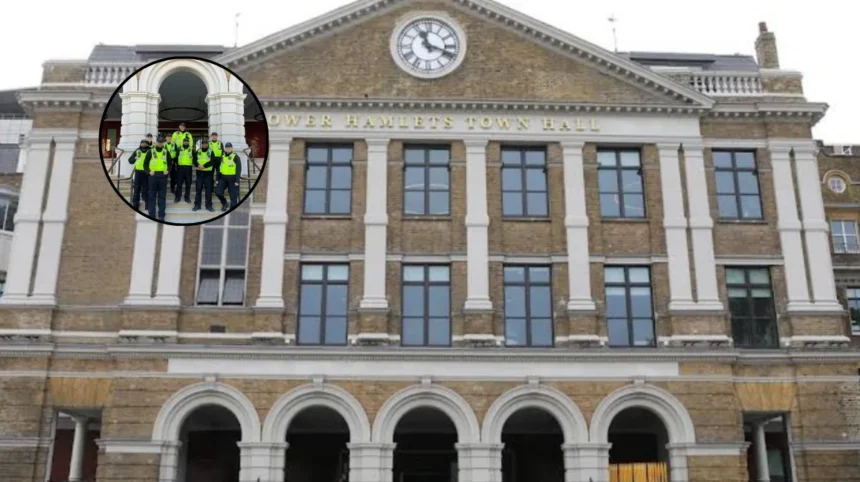
Introduced as a dedicated council-employed safety force to complement Metropolitan Police patrols, Theos officers are empowered to address public nuisance, environmental crime, noise disturbances, and anti-social behaviour across the borough.
Since 2022, Tower Hamlets Council has committed over £8 million into enforcement and community safety infrastructure. While early operational models prioritized community presence, mediation, and verbal warnings, executive leadership pushed for a strategic pivot approximately 18 months ago.
This shift was intended to transition the service toward stricter statutory mechanisms, including Community Protection Warnings (CPWs), Community Protection Notices (CPNs), and Fixed Penalty Notices (FPNs).
The transition aimed to address persistent public concerns regarding street safety while simultaneously generating revenue through regulatory fines to offset municipal budget pressures.
However, friction has persisted between front-line operational reporting—which emphasizes informal resolution and de-escalation—and executive leadership’s demands for measurable, penalty-driven deterrence.
How Can This Development Affect Local Residents, Businesses, And Council Operations?
This policy push toward zero-tolerance enforcement is expected to impact several key stakeholder groups across Tower Hamlets:
- Local Residents and Victims of ASB: Residents in high-disturbance areas may see an increase in formal officer interventions and quicker issuance of legally binding Community Protection Notices. While proponents argue this will improve neighborhood security and deter persistent offenders, community groups advocating for early intervention may express concern over reduced focus on informal conflict resolution.
- Tower Hamlets Enforcement Officers (Theos): Front-line council officers face immediate pressure to alter their daily operational routines. Staff will likely be required to meet strict quarterly quotas for formal notices, potentially shifting workload priority away from unrecorded mediation toward formal administrative documentation and fine issuance.
- Local Businesses and High Street Visitors: Increased enforcement presence and stricter compliance monitoring could lead to reduced street-level disturbances around commercial hubs, but may also lead to higher instances of fines for minor infractions, impacting local footfall dynamics.
- Borough Taxpayers and Council Finances: If enforcement officers successfully implement the Mayor’s directive, increased fine collection could generate additional revenue streams to help balance council budgets. Conversely, failure to align operational outputs with executive goals may prompt further restructuring of the council’s £8 million enforcement investment.