Key Points
- Unanimous Ballot: 100% of collections access officers at the V&A East Storehouse in Stratford who participated in the Prospect union ballot voted to take strike action.
- Core Grievance: Staff allege they face “Amazon-style” working practices, including a lack of adequate time for toilet or hydration breaks during long shifts involving physical labour.
- Union Demands: Prospect is requesting two 15-minute paid breaks per day, a minimum 4% salary increase for staff earning above the living wage, time-and-a-half for bank holidays, and official London Living Wage accreditation within 12 months.
- Wider Dispute Across Sites: Across all four V&A sites in London—South Kensington, Young V&A, V&A East Museum, and V&A East Storehouse—83% of voting Prospect members supported strike action on an 82% turnout.
- Separate PCS Union Action: Over 300 staff members represented by the Public and Commercial Services Union (PCS) are also currently being balloted for strike action over pay, working conditions, and heatwave safety policies.
- Management Response: The Victoria and Albert Museum stated that formal pay negotiations have been ongoing since February, offering a 3.6% increase to the overall pay bill with up to 6.9% for the lowest-paid workers, while emphasizing that all staff have access to restrooms and water.
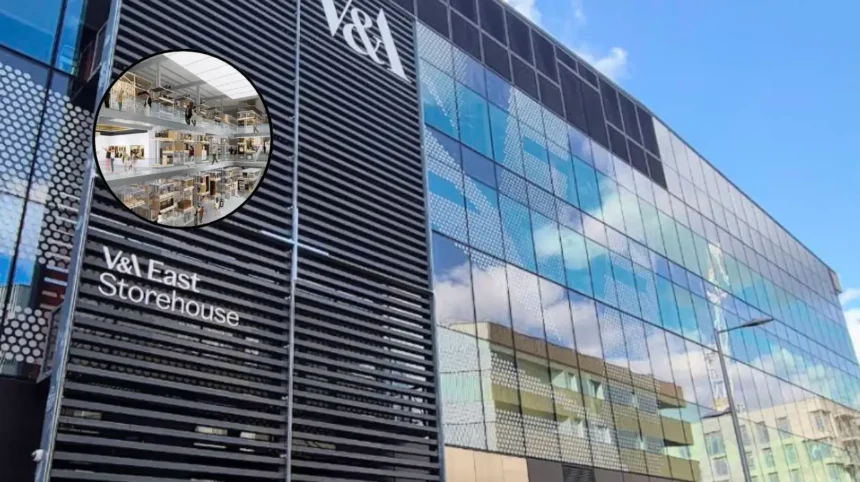
East London (East London Times) July 31, 2026 – Staff working as collections access officers at the newly opened V&A East Storehouse in Stratford have voted unanimously in favour of industrial action following a dispute over daily shift structures, rest periods, and pay. As reported by Gareth Harris of The Art Newspaper, 100 per cent of collections access officers who participated in the ballot organized by the trade union Prospect voted for strike action, with 92 per cent also backing action short of a strike on an 88 per cent turnout at the Stratford site.
- Key Points
- What Do Union Leaders and Museum Staff Say About Working Conditions?
- How Has Management Responded to the Union’s Claims?
- What Is the Scope of Industrial Unrest Across Other V&A Sites?
- Background of the Particular Development
- Prediction: How This Development Can Affect Visitors, Workers, and the Cultural Sector
The primary catalyst for the dispute centers on allegations that staff are subjected to “Amazon-style” operational conditions. Union representatives assert that workers responsible for running the flagship “order an object” service—which retrieves items from the institution’s vast archival collections for public viewing—are subjected to a punishing daily schedule without sufficient allocation for basic hydration or toilet breaks.
The union stated that its repeated requests for two 15-minute paid breaks per shift were rejected by management, despite such customary break allocations existing across other parts of the Victoria and Albert Museum network.
What Do Union Leaders and Museum Staff Say About Working Conditions?
Trade union leaders and frontline employees have raised severe concerns regarding staff welfare, physical exertion, and institutional equity.
As reported by Lanre Bakare and Alexandra Topping of The Guardian, one Prospect union member described the operational reality inside the purpose-built storage facility:
“The Storehouse is purpose-built for storing objects, but they haven’t really thought about the human aspect – how far we have to travel around the building or where the bathrooms are. We’ve experienced a lot of dehydration, and sometimes people don’t even go to the bathroom for the whole day.”
Another worker highlighted the operational pressures that prevent staff from stepping away:
“Every day we go into work, there’s someone who has a headache because they’re dehydrated. Management says we always have time to take breaks and drink water. But we need someone to relieve us because we can’t leave trolleys of collection objects unattended.”
A third employee underscored the demographic context of the workforce:
“We are the newest department at the V&A. We are the most diverse back-of-house department. It’s not lost on us that we were hired to represent the east London community, but our welfare is being neglected.”
As reported by Blooloop, Mike Clancy, the General Secretary of Prospect, criticized the management structure overseeing the site:
“This brand-new flagship site of one of the country’s most popular national museums opened with great fanfare last year and it has been a huge success. However, this incredible new way of showing off our heritage is being delivered by workers who are denied adequate break time to use the toilet or have a drink of water.”
As noted by The Evening Standard, Clancy further remarked:
“Visitors will be appalled to learn that the kinds of working practices unions campaign against in companies like Amazon also exist in an internationally renowned heritage institution.”
How Has Management Responded to the Union’s Claims?
The Victoria and Albert Museum management maintains that employee health, safety, and welfare remain paramount, pointing to ongoing statutory union negotiations and strict heritage conservation regulations.
In an official statement released to The Evening Standard, a V&A spokesperson stated:
“The V&A has been in negotiations with the trade union side since February and those negotiations are ongoing. Our offer sees a 3.6% increase in the overall pay bill, an above inflation pay award as a minimum, and 6.9% increase for our lowest paid colleagues. As always, we have maintained our long-standing commitment to paying at least the London Living Wage.”
Addressing the specific allegations regarding breaks and access to liquids, the spokesperson added:
“The safety and wellbeing of our staff is of utmost importance to the V&A – all our staff have access to water and toilet facilities and regular breaks while at work.”
The museum administration also clarified that strict rules prohibiting open food and drink within main collection halls and storage zones are essential regulatory standard practices designed “to ensure the safety and security of national collections”.
What Is the Scope of Industrial Unrest Across Other V&A Sites?
The vote at the V&A East Storehouse forms part of a wider wave of industrial friction across all four of the museum’s primary London locations: South Kensington, Young V&A in Bethnal Green, V&A East Museum, and the V&A East Storehouse.
As reported by The Art Newspaper, Prospect members across all four sites voted 83 per cent in favour of strike action on an 82 per cent overall turnout, with 95 per cent backing action short of a strike. Beyond the break structures at Stratford, Prospect’s broader claim demands:
- A minimum 4 per cent pay increase for employees earning above the living wage.
- Premium pay calculated at time-and-a-half for bank holiday coverage.
- Formal accreditation as a London Living Wage employer within 12 months.
- Enhanced catering and break provisions across East London sites.
Concurrently, a second union, the Public and Commercial Services Union (PCS), representing over 300 museum workers, launched its own industrial action ballot on July 23, running through August 20.
As detailed in The Art Newspaper, the PCS union expressed anger over health and safety management during recent summer heatwaves. The PCS is calling for a formal policy mandating the closure of museum doors when internal gallery temperatures reach 30 degrees Celsius, alongside improved heat mitigation protocols.
Background of the Particular Development
The V&A East Storehouse, located at Queen Elizabeth Olympic Park in Stratford, opened to the public in May 2025 as part of the East Bank culture and education district. Designed as a radical departure from traditional, hidden museum storage, the Storehouse was constructed to consolidate over 250,000 objects, 350,000 books, and 1,000 archives into a single publicly accessible venue.
Central to its public attraction is the “order an object” initiative, which enables visitors, researchers, and local residents to book time to view almost any item in the reserve collection up close. To service this model, the museum hired a dedicated team of collections access officers, recruiting heavily from the local east London borough to build a diverse workforce reflecting the surrounding community.
However, the physical scale of the purpose-built venue, combined with high public demand for retrieved artifacts, created unforeseen operational strains. Staff members subsequently submitted collective internal grievances, initiated petitions, and raised welfare issues during one-to-one management reviews throughout late 2025 and early 2026, citing long walking distances, unattended transport trolleys, and rigid break scheduling before taking the decision to ballot for strike action.
Prediction: How This Development Can Affect Visitors, Workers, and the Cultural Sector
This impending industrial action stands to impact three main stakeholder groups across the cultural and heritage landscape:
1. Museum Visitors and Researchers
If Prospect and PCS members exercise their strike mandate, operations at the V&A East Storehouse could face severe disruptions or temporary suspensions. The primary service affected would be the “order an object” system, as collections access officers are essential to retrieving and securing artifacts. Disruptions could also spread to the flagship South Kensington and Young V&A sites, leading to temporary gallery closures or restricted opening hours during peak tourist periods.
2. Frontline Museum Staff
For the workforce, securing formal paid break agreements and London Living Wage accreditation could set a landmark precedent for back-of-house cultural workers. Resolution in favor of the union may force institutional adjustments to shift patterns, staffing ratios, and duty rotations, relieving physical strain and reducing workplace dehydration risks. Conversely, prolonged industrial action without concessions could heighten staff turnover and strain labor relations within the newly established East London facilities.
3. The Wider Heritage and Arts Sector
As national museums increasingly adopt high-throughput, publicly accessible storage models, this dispute serves as a test case for labor conditions in modernized archival spaces. A successful strike could prompt unionization drives and operational audits across other national institutions—such as the British Museum and the Science Museum Group—forcing management boards across the UK to re-evaluate how physical workload demands and environmental conditions are balanced against public access mandates.