
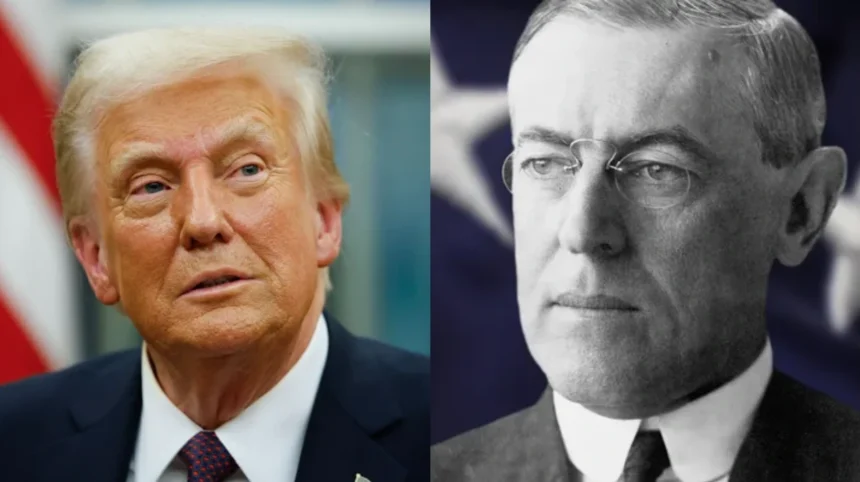
On 8th January 1918, during World War I, President Woodrow Wilson outlined his proposals for a post-war peace settlement. Essentially, unlike the current predicament facing Trump’s war in Iran, Wilson called for more openness in diplomacy between sovereign states, for freedom of navigation of the seas, reduction of armaments, a readjustment of certain frontiers, self-government for some nationalities, the removal of economic barriers an association of nations to be formed for the purposes of affording mutual guarantees of political independence and territorial integrity to sovereign states. In short, he called for self-determination, collective security and something unique in the history of civilisation: a League of Nations. Wilsons Fourteen Points as they were called did not immediately end the war to end all wars. It took another ten months for an Armistice to be agreed after the defeat of the German 1918 offensive.
Fast forward to 2026 and Trump’s war on Iran and his so called Fourteen Points.
Reports in various papers from the Wall Street Journal to reports from Israel and Pakistan suggest the existence of an unconfirmed US plan whereby Iran stops its production of nuclear weapons, restricts ballistic missile capabilities limiting their range and numbers, ends support for terrorist proxies and designate the Straits of Hormuz as a “Free Maritime Zone.” Apart from denying the existence of any negotiations with the US, it is reported that Iran demands war reparations for all the damage caused by attacks on Iran’s infrastructure and oil facilities, international guarantees against any future aggression, an end to all hostilities and to the killing Iranian officials, free exercise of its national sovereignty over the Straits of Hormuz, ability to permit the transit of non-hostile vessels, and the imposition of charges on transit through the Straits similar to the levy on passage through the Suez Canal. If such an exchange is true then an agreement such as Trump suggests is a forlorn hope.
The fact remains that Trump’s war is illegal under international law and unconstitutional under the Constitution of the United States. It appears that there was no immediate threat to the US from Iran, no Congressional approval (only Congress has war making power) only belated consultation, no notice to US allies, nor to those states in the region that could reasonably foreseeably be affected. Such conduct demonstrates a lack of concern and planning for inevitable consequences. In terms of settling this illegal war after four weeks of attrition it is hard to foresee how that can be achieved. The war Wilson tried to stop had lasted nearly four years, as long as the war in Ukraine has now lasted, but Wilson understood something of international relations and international law. Indeed, he had the advice of the British Foreign Secretary Sir Edward Grey who suggested a League of Nations which Wilson promoted.
As every military expert knows wars are unpredictable even if you start with overwhelming force. Russia attacked Ukraine thinking that it would be over in days, it continues today. The Kaiser in July 1914 wanted a quick war; it became Armageddon. The Vietnam war was a defeat for France initially, then the US sent advisers to help the South Vietnamese and later committed ground troops. The US tried to bomb North Vietnam into submission: it failed demonstrating yet again the lesson that bombing alone does not win wars. In war you need to take the ground to ensure victory. Here it appears that Trump is using overwhelming air superiority and missiles to force Iran to submit, but his aims are uncertain. Trump cannot define what his war aims are. It would appear he is more reliant on predictions for the stock market than military strategy. The curious statement he made on Monday 23 March regarding a successful negotiation, quickly denied by Tehran, affected a fall in the oil price curiously benefitting speculators betting that the price would reduce. Their bets were placed 15 minutes before Trump made his delusional announcement.
Despite undue pressure upon the British government and our NATO allies Britain has tried to avoid a war with Iran. NATO has no duty to go outside the scope of its North Atlantic Treaty obligations to defend any member that is attacked by an aggressor. At present NATOs focus must be on the war in Ukraine which presents enormous threats to European security. President Roosevelt once said before the US entered the Second World War that if Britain fell the US would be vulnerable to a Nazi Europe and a belligerent Japan. Today we might say if Ukraine falls then Europe may be next. That being the prospect Britain must focus on its security first through NATO whilst protecting its interests elsewhere.
In sum the conflict in the Middle East which is endangering not only global economic security and international trade it is threatening world peace. Already 11 states are directly or indirectly involved and 20% of the worlds oil is lost. The damage caused to refineries and other infrastructure in the region will, in some cases, take years to repair.
At the end of all this the price of this reckless adventure will have to be reckoned. The damage in terms of human life, to the world economy, to international relations and most of all to the reputation of the United States is incalculable. It is simply the price that will be paid for ignoring international law.