


Key Points
- Home Secretary Shabana Mahmood told police to leave political matters to politicians.
- A new College of Policing impartiality standard will address concerns about unequal treatment and perceived two-tier policing.
- About 200 Local Police Commands are planned across England and Wales.
- The guidance will cover community engagement, political symbols and treatment of victims and offenders.
- Consultation on the impartiality standard is expected next year.
Inverted pyramid:
- Key Points
- What did Shabana Mahmood tell police officers?
- What is the new impartiality standard?
- What other policing reforms were announced?
- How have police and political figures responded?
- What is the background to the policing reforms?
- How could the changes affect police, communities and political groups?
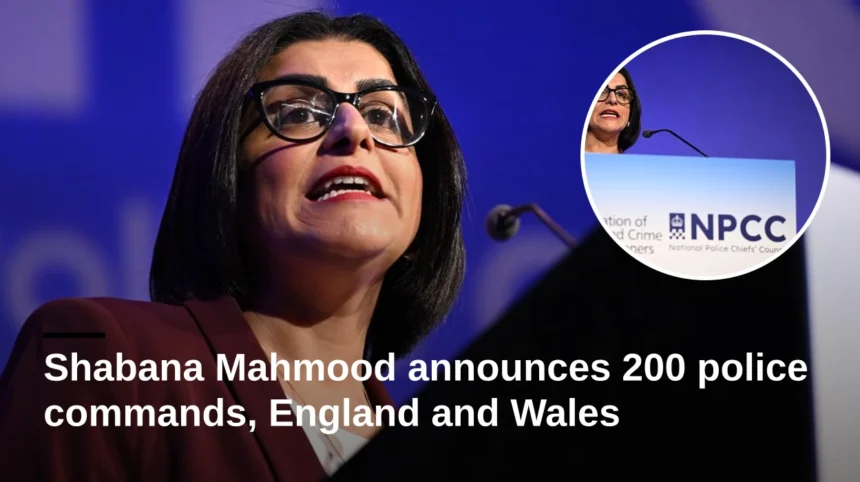
England and Wales (East London Times) November 18, 2026 – Home Secretary Shabana Mahmood has instructed police forces to avoid political activism and focus on impartial law enforcement as she announced a new policing standard and plans for around 200 Local Police Commands. Speaking at the annual Association of Police and Crime Commissioners and National Police Chiefs’ Council summit, Ms Mahmood said community engagement should involve residents’ associations rather than activist groups pursuing political agendas. The reforms aim to improve public confidence and ensure officers treat victims and offenders fairly, regardless of race, faith or other characteristics.
What did Shabana Mahmood tell police officers?
As reported by the Keighley News, Home Secretary Shabana Mahmood said: “When it comes to political groups, leave the politics to the politicians, and we will leave the policing to you.”[2]
She said community engagement could involve attending local residents’ meetings, but should not mean working with activist groups or campaigners advancing their own political agendas.[2][5]
The Evening Standard reported that Ms Mahmood also questioned police participation in events such as Pride marches where she said political issues could be involved.[4]
What is the new impartiality standard?
The Government said the College of Policing has been commissioned to develop an “Impartiality in Policing” standard. It will bring guidance on impartiality into one place and explain how officers should apply the law consistently, use evidence and professional judgement, and avoid prejudice, favouritism or discrimination.[1][3]
The standard is expected to cover policing public events, political symbols on badges and lanyards, community engagement and the treatment of victims and offenders. Consultation is planned for next year.[3][7]
Ms Mahmood said most officers police impartially, but acknowledged that examples of differential treatment had damaged confidence and allowed the perception of two-tier policing to grow.[2][7]
What other policing reforms were announced?
The Government announced plans for around 200 Local Police Commands across England and Wales, each broadly comparable in size to a unitary authority and led by a named commander accountable to the local community and elected officials.[1][3]
Ms Mahmood also set out plans to recruit about 200 people each year from inside and outside policing and fast-track them to superintendent within five to 10 years, according to the reported summit proposals.
How have police and political figures responded?
National Police Chiefs’ Council Chairman Gavin Stephens said impartiality involved using police powers fairly, while officers needed discretion because emergency calls often presented different circumstances and incomplete information. He warned that apparently similar incidents could require different responses because of operational nuance.
Shadow Home Secretary Chris Philp said it was wrong for police to treat people differently because of skin colour. Reform United Kingdom leader Nigel Farage said the Home Secretary’s acknowledgement of differential treatment supported his party’s previous claims about two-tier policing.
The Home Secretary rejected the claim that police forces routinely operate a system of two-tier policing, describing that suggestion as false while acknowledging individual examples that had affected public confidence.[2]
What is the background to the policing reforms?
The Government’s announcement follows continuing political debate about whether police forces treat different groups unequally. The issue was also linked in reporting to the murder of Henry Nowak, who was handcuffed while dying after his killer falsely accused him of racist abuse. Ms Mahmood criticised earlier anti-racism guidance, saying some wording had undermined confidence in impartial policing. She also said the proportion of black police officers remained virtually unchanged decades after the murder of Stephen Lawrence.
How could the changes affect police, communities and political groups?
The proposed standard could give officers clearer instructions when dealing with politically sensitive events, community organisations and symbols associated with causes. Police forces may face greater scrutiny over whether engagement is viewed as operationally necessary or politically aligned. Local Police Commands could make accountability more visible by giving communities and elected officials a named senior contact. The effect on public confidence will depend on how consistently the guidance is applied and whether consultation addresses concerns about both unequal treatment and excessive political influence.

