Key Points
- Former West Ham United and Manchester United academy striker Ashley Fletcher has officially completed a transfer to a new, as-yet-unnamed club following a prolific 2025/26 campaign.
- Fletcher, 30, experienced a career renaissance during his recent stint with League One side Blackpool, registering the highest single-season goal tally of his professional career.
- The forward remains a notable member of West Ham United’s infamous “zero-goal club,” an moniker shared with several high-profile strikers who failed to score a single competitive goal during their tenures in East London.
- The transfer is being framed by representatives and close sources as a “really exciting” next step for the well-travelled frontman, capitalize on his resurgent form in front of goal.
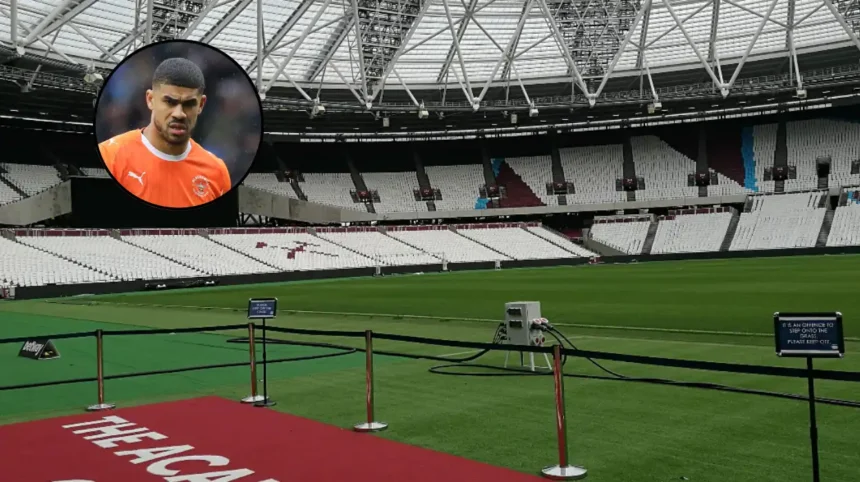
West Ham United (East London Times) June 13, 2026 – Former West Ham United and Manchester United academy forward Ashley Fletcher has finalized a transfer to a new club following a standout 2025/26 season with Blackpool, where he recorded the most prolific goal-scoring numbers of his professional career. The 30-year-old striker, who has traversed the English football pyramid throughout a journeyman career, successfully revitalised his goal-scoring reputation in Lancashire, prompting concrete interest and a subsequent agreement for his services ahead of the 2026/27 football calendar. While the identity of the acquiring club is being withheld pending final corporate and registration clearances, representatives close to the player have confirmed that the contract has been signed, characterizing the move as a highly lucrative and strategically progressive step for the late-blooming attacker.
- Key Points
- Why Has Ashley Fletcher’s Recent Form Sparked a Fresh Transfer?
- What Is Ashley Fletcher’s History With West Ham United’s ‘Zero Goal Club’?
- How Do Journalists Document the Club’s Striker Recruitment History?
- How Did His Early Career Shape His Journeyman Reputation?
- What Happened Following His Departure From East London?
- Background of the Particular Development
- Prediction
The development follows a sequence of short-term spells for Fletcher, whose career had previously stagnated after high-profile moves failed to yield consistent first-team football or sustained scoring output. His tenure at Blackpool, however, served as a critical turning point.
Under disciplined tactical deployment, Fletcher found the net with regular frequency, surpassing his previous career-best milestones set during his younger years at Barnsley and Middlesbrough.
The formal finalisation of this transfer marks the conclusion of his chapter at Bloomfield Road and shifts the player back into a competitive spotlight that many pundits believed he would struggle to reach again.
Why Has Ashley Fletcher’s Recent Form Sparked a Fresh Transfer?
The primary catalyst behind this latest market development is the statistical surge Fletcher displayed over the last 12 months.
Having joined Blackpool with a point to prove, the striker benefited from an offensive system designed to maximize his physical presence and aerial capability. For a player frequently critiqued for a low goals-to-games ratio at previous stops, the 2025/26 campaign rewrote his professional narrative.
Football analysts note that Fletcher’s success at Blackpool was rooted in positional maturity. Rather than drifting into wide channels as he frequently did during his time in the Championship, he remained anchored as a traditional focal point in the penalty area.
This tactical adjustment yielded immediate dividends, allowing him to spearhead Blackpool’s attacking maneuvers and catch the attention of domestic and international scouts monitoring the EFL market for inform central forwards.
What Is Ashley Fletcher’s History With West Ham United’s ‘Zero Goal Club’?
Despite his recent successes in League One, Fletcher’s career continues to be viewed through the lens of his early Premier League struggles, most notably his unproductive stint with West Ham United.
Arriving in East London during the summer of 2016 after turning down a contract extension at Manchester United, Fletcher was viewed as a bright young talent capable of breaking into the Hammers’ first team under then-manager Slaven Bilić.
However, Fletcher’s time at the London Stadium was defined by frustration. He made 20 appearances across all competitions for the Hammers but failed to find the back of the net a single time.
This statistical anomaly placed him permanently into what West Ham United supporters and club historians colloquially refer to as the ‘zero goal club’—an infamous group of strikers signed by the club who departed without recording a competitive goal.
How Do Journalists Document the Club’s Striker Recruitment History?
As reported by sports journalist Simon Jones of The Daily Mail, West Ham United’s historical search for a reliable central striker has seen dozens of multi-million-pound acquisitions fail to deliver tangible outputs. Fletcher’s name is routinely grouped with high-profile international figures and expensive domestic signings who suffered identical fates in claret and blue.
The list of players accompanying Fletcher in this specific category includes:
- Simone Zaza: The Italian international arrived on a high-profile loan with an obligation to buy but departed early after failing to adapt to the pace of English football.
- Marco Borriello: A veteran Serie A marksman whose brief cameo in London yielded no goals.
- Jordan Hugill: Signed from Preston North End for a substantial fee, Hugill rarely saw first-team minutes and left without troubling the scorers.
- Marco Boogers: One of the most infamous signings in Premier League history, whose West Ham career lasted only a handful of matches in the 1990s.
- Mido & Benni McCarthy: Experienced Premier League goal-scorers who joined the club late in their respective careers but could not replicate their historical form.
- Albian Ajeti, Marouanne Chamakh, and Mladen Petrić: Further examples of European and domestic talents brought in to solve the club’s striking deficiencies, all of whom departed with a zero in the goals column.
How Did His Early Career Shape His Journeyman Reputation?
Fletcher’s footballing education began within the highly regarded youth ranks of Bolton Wanderers before he moved to Manchester United’s academy in 2009. Emerging through the system alongside Marcus Rashford, Fletcher was highly regarded by youth coaches for his athletic profile and spatial awareness.
His first true taste of senior success arrived during a loan spell with Barnsley in the 2015/16 season. He scored critical goals in the Football League Trophy final and the League One playoff final at Wembley, helping Barnsley secure promotion to the Championship.
This rapid rise created immense market expectation, ultimately leading to his decision to seek first-team assurances elsewhere and sign a four-year deal with West Ham United.
What Happened Following His Departure From East London?
When the West Ham move failed to generate momentum, Middlesbrough intervened, signing Fletcher for a reported fee of £6.5 million in July 2017. His time at the Riverside Stadium was a mixture of developmental loans and periods of starting utility. He enjoyed a brief period of productivity under Jonathan Woodgate, but consistency remained elusive.
Subsequent stints at Watford, New York Red Bulls in Major League Soccer, Wigan Athletic, and Sheffield Wednesday saw Fletcher struggle for game time and goals, cementing his reputation as a nomadic forward whose early potential had plateaued.
It was not until his arrival at Blackpool that the striker found an environment capable of extracting his optimal performance metrics.
Background of the Particular Development
The broader context of Ashley Fletcher’s transfer reflects a growing trend within contemporary football recruitment: the rise of the “late-blooming” domestic striker. For several seasons, EFL and lower-tier Premier League recruitment departments have placed an increased premium on physical, experienced English center-forwards who understand the rigorous demands of the domestic league schedule.
Fletcher’s career trajectory altered significantly when Blackpool elected to offer him a structured, incentive-heavy contract following his release from previous commitments.
Blackpool’s sporting directorate recognized that despite his low goal returns in the Championship and MLS, his underlying physical data—such as expected goals (xG) per 90 minutes in restricted minutes and aerial duel win percentages—remained competitive. By building an offensive system around his strengths, Blackpool rehabilitated the player’s market value, setting the stage for this summer’s “really exciting” transfer validation.
Prediction
This transfer development is poised to impact multiple distinct audiences across the English football landscape.
For Blackpool FC and their supporters, Fletcher’s departure creates an immediate tactical and statistical void ahead of the 2026/27 season.
The club’s recruitment team will face intense pressure to reinvest the financial capital generated by this move into a replacement forward capable of replicating Fletcher’s recent output, failing which their aspirations for promotion could be severely compromised.
For the acquiring club’s fanbase, Fletcher represents a calculated, high-reward acquisition. If he maintains the refined positional discipline and finishing efficiency displayed during his time in Lancashire, he will provide his new employers with a reliable, battle-tested focal point for their attack.
Conversely, if he reverts to the inconsistent form that characterized his mid-career spells, critics will point to his historical record as evidence of a short-lived purple patch.
Finally, for West Ham United observers and football historians, Fletcher’s continued career progression serves as an ongoing case study of the complex transition youth players face when exiting elite academies for senior Premier League environments. His resurgence ensures that while his name remains etched into the London Stadium’s “zero goal club,” his professional story continues to evolve productively outside of it.