Council tax bills in England are rising again in 2026–27, with the average Band D bill set to increase by 4.9% on top of last year’s increases, pushing many households further into financial strain. As local authorities adjust their Council Tax Support (often called Council Tax Reduction) schemes to reflect inflation and national guidance, thousands of residents in London and across the East London region are asking one simple question: How do I actually access the 2026 “inflation‑adjusted” Council Tax Support so I’m not paying more than I need to pay?
- What “Inflation‑Adjusted” Council Tax Support Means in 2026
- Who Can Get Council Tax Support in 2026–27?
- Working‑age households (under “eligible pension age”)
- Pensioners (eligible pension age and over)
- Students, disabled residents, and “financially vulnerable” households
- How Inflation Affects Your Council Tax Bill and Support
- Step‑by‑Step: How to Access 2026 Council Tax Support
- Step 1: Check your council’s 2026–27 Council Tax Reduction scheme
- Step 2: Confirm your personal circumstances
- Step 3: Use the council’s online calculator or application
- Step 4: Apply or update your application
- Step 5: Check for discretionary or hardship help
- Step 6: Monitor your bill and contact your council if needed
- Tips for East London Residents Accessing 2026 Support
- 1. Don’t assume your borough’s rules are the same
- 2. Time your application around 1 April
- 3. Combine Council Tax Support with other benefits
- 4. Seek local welfare advice if you are unsure
- 5. Keep an eye on any extra “inflation‑linked” awards
- What If You’re on the Wrong Band or Get Less Support?
- Final Thoughts: Staying Ahead of 2026 Council Tax Changes
This guide explains, step by step, how the 2026–27 Council Tax Support system works, who is eligible, how councils are factoring in inflation, and what residents in East London (and across England) should do right now to make sure they receive every pound of support they are entitled to.
What “Inflation‑Adjusted” Council Tax Support Means in 2026
“Inflation‑adjusted” Council Tax Support does not mean a single national benefit that automatically rises with the Consumer Prices Index (CPI). Instead, it describes how local councils are designing their 2026–27 Council Tax Reduction schemes in light of higher council tax bills and ongoing cost‑of‑living pressures.
The government’s Council Tax Information Letter for 2026–27 sets ground‑rules that councils must follow when designing their schemes, including how they treat pensioners, working‑age households, student households, and financially vulnerable groups. Within those rules, each council decides its own income bands, percentage reductions, and hardship top‑ups, so the amount of help you receive can vary sharply even between neighbouring boroughs.
For residents in East London, this means two things:
- Your council tax bill may be higher than last year, reflecting the 4.9% average rise in council tax.
- Your council’s “inflation‑adjusted” support scheme may change how much of that bill is written off, how your income is band‑ed, and whether you qualify for extra hardship help.
The key for you is not to assume your entitlement is the same as last year; instead, you must actively check, update, or apply for support under the 2026–27 rules.
Who Can Get Council Tax Support in 2026–27?
All councils in England provide some form of Council Tax Reduction (what most people still call “Council Tax Support”), but the exact rules differ by borough and by age group. The 2026–27 guidance splits support roughly into three main categories.
Working‑age households (under “eligible pension age”)
If you are under the eligible pension age and liable for council tax, you may qualify for a percentage reduction based on your household income and family circumstances. National rules require that, in most cases, people of working age must still pay at least 15% of their council tax bill, even if they receive full support under the banding system.
Many councils now use a “banded scheme,” where households are placed into income bands (for example, Band 1 to Band 5) and receive a set percentage reduction (often ranging from around 17% up to 85% for the most vulnerable). The exact income thresholds and band percentages change each year, so what counted as “Band 1” last year may not be the same in 2026–27.
Pensioners (eligible pension age and over)
Households where the main liable person is of pension age can still receive up to 100% reduction of their council tax under the 2026–27 schemes, where local rules allow it. Some councils have capped maximum reductions (for example, moving from 100% to 90% in certain cases), but pensioners generally receive more generous support than working‑age households.
Pensioners who already receive the Council Tax Support element of Pension Credit are usually automatically assessed for council tax reduction, but it’s still important to confirm that your council has the correct details on file.
Students, disabled residents, and “financially vulnerable” households
Students living in certain circumstances (for example, full‑time students in shared private accommodation) may still be exempt or receive reduced bills, but the rules are complex and vary by council. Many councils also give extra protection to “financially vulnerable” households, such as those with a child under 6, a disabled member, or someone who cannot work due to health reasons.
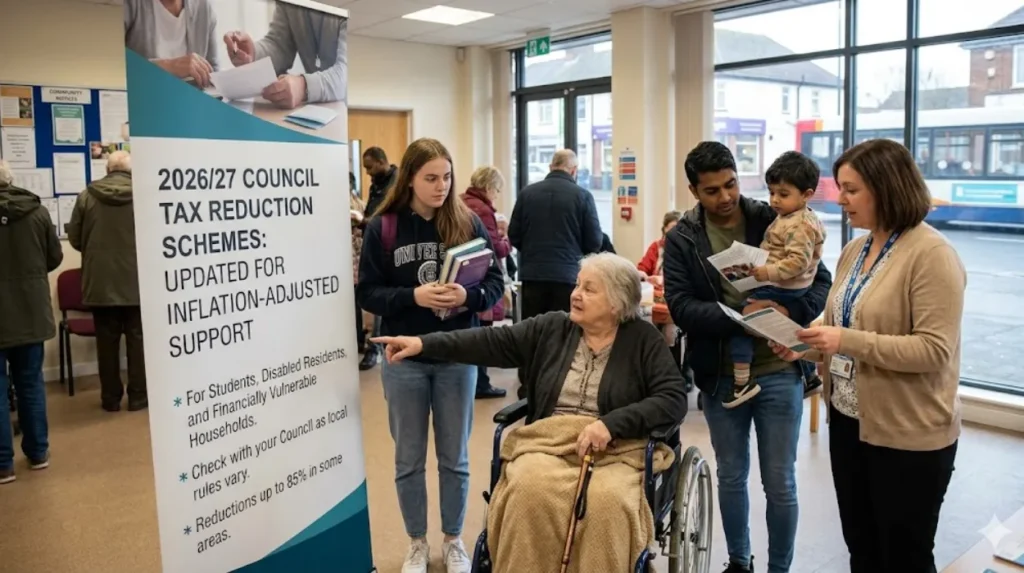
In some boroughs, these groups can qualify for up to 85% reduction even if they are under pension age, while others have tightened the bands or reduced the maximum percentage. That is part of what makes the 2026 schemes “inflation‑adjusted”: councils are adjusting how they allocate help within tighter budgets.
How Inflation Affects Your Council Tax Bill and Support
In 2026–27, the average Band D council tax in England is rising by 4.9%, which is above the rate of inflation and on top of similar increases in previous years. For example, a typical Band D bill will rise to around £2,392 per year, an increase of about £111 from the previous financial year.
Because your raw bill is higher, even if your percentage reduction stays the same, the actual amount you pay after support can still go up. For instance:
- If your reduction was 57% last year and your bill was £2,280, you paid £980.
- If your bill rises to £2,392 and your reduction is still 57%, you now pay £1,028.
Some councils offset this by tightening income bands (so more people get a smaller percentage) or by limiting the maximum reduction, while others add small hardship top‑ups or extra awards. Birmingham, for example, offered an automatic “2025–26 Additional Support Award” of up to £25 to households already receiving Council Tax Support, which is a type of inflation‑linked top‑up.
Whether your council has a similar 2026 “inflation‑adjusted” top‑up depends on local policy, which is why you must check your specific borough’s website rather than assuming a national rule.
Step‑by‑Step: How to Access 2026 Council Tax Support
Accessing the 2026 “inflation‑adjusted” Council Tax Support is not automatic. Even if you received help last year, you may need to update your details, reapply, or check your banding. The process is broadly similar across councils, although the exact form and wording can vary.
Step 1: Check your council’s 2026–27 Council Tax Reduction scheme
Start by visiting the official website of your local council and looking for:
- “Council Tax Reduction” or “Council Tax Support”
- “2026–27 scheme” or “2026–27 Council Tax Support”
Many councils publish a dedicated PDF or page setting out the 2026–27 rules, including income bands, maximum reductions, and any hardship schemes. For East London boroughs such as Tower Hamlets, Newham, Hackney, Waltham Forest, or Barking & Dagenham, you can usually find this under the “Council Tax” or “Benefits and Support” section of the council site.
Reading this page will tell you:
- What percentage reductions are available.
- The income thresholds for each band.
- Whether there is a separate hardship or discretionary fund.
Step 2: Confirm your personal circumstances
Next, gather up‑to‑date information about your situation, including:
- Your current council tax band and approximate annual bill.
- Your household income (including benefits, wages, pensions, and any partner’s income).
- Household details such as children, disabilities, carers, or anyone who receives certain benefits (Universal Credit, Pension Credit, Income Support, Jobseeker’s Allowance, Employment Support Allowance, etc.).
If you are on Universal Credit, Housing Benefit, or Pension Credit, your council will usually pick up some information automatically, but you still need to confirm that your address and household composition are correct.
Step 3: Use the council’s online calculator or application
Most councils now offer an online benefits calculator or an online application form for Council Tax Support. These tools ask for your postcode, council tax band, income, and household details, then estimate how much reduction you might receive under the 2026–27 scheme.
Using the calculator is a good first step, but it is only an estimate. To actually receive support, you must submit a formal application (usually online) and upload any required documents, such as:
- Proof of identity (passport, driving licence).
- Proof of income (bank statements, payslips, benefit letters).
- Proof of address (tenancy agreement, council tax bill, utilities bill in your name).
Step 4: Apply or update your application
If you’re applying for the first time, you would normally fill in the council’s online Council Tax Reduction application form, making sure you select the 2026–27 scheme year. If you already receive Council Tax Support, check whether your council:
- Requires you to reapply at the start of the new financial year (1 April 2026).
- Automatically carries your claim forward but asks you to update any changes.
Some councils will automatically adjust your reduction if they already hold enough information, but others will send you a renewal letter asking you to confirm or update your details. If you do not respond, your support may be reduced or stopped, leaving you paying more council tax than necessary.
Step 5: Check for discretionary or hardship help
Even if your council’s standard 2026–27 scheme has a minimum 15% payment or a cap on reductions, many boroughs maintain a Discretionary Council Tax Hardship Scheme (or similar fund). These funds are usually for people who:
- Have fallen behind on council tax payments.
- Are facing a sudden change in circumstances (job loss, illness, bereavement, or rent increase).
- Are in a vulnerable group but are not getting enough support under the main scheme.
Applications for hardship help are usually made separately and may require extra evidence, such as a letter from a doctor, social worker, or financial adviser. It is worth applying even if you think you might not qualify, because councils can sometimes grant small top‑ups or payment plans that ease the 2026 “inflation‑adjusted” hit.
Step 6: Monitor your bill and contact your council if needed
Once your application is processed, your council will send you a new Council Tax Reduction notice showing:
- Your revised annual bill.
- The percentage reduction you receive.
- The amount you must pay each month if you pay by instalments.
If the revised amount seems higher than you expected, or if your circumstances change (you lose a job, start earning more, or gain a dependent), you must contact your council to update your claim.
Most councils have a dedicated Council Tax or Benefits helpline, plus an online contact form, and you can also visit customer‑service centres in person. For East London residents, borough‑specific contact details are usually listed on each council’s “Council Tax” or “Help with Council Tax” page.
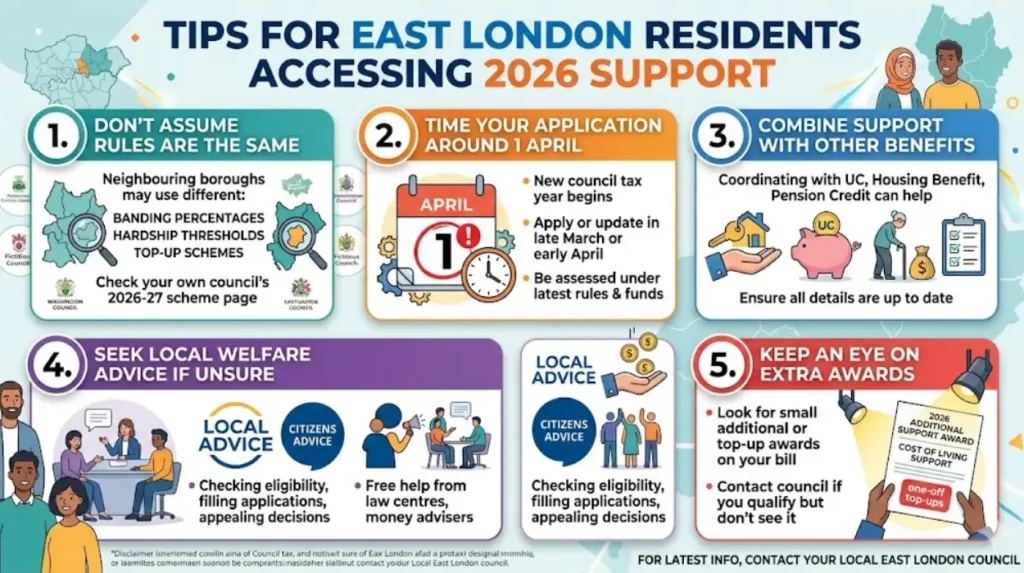
Tips for East London Residents Accessing 2026 Support
Residents in East London boroughs such as Tower Hamlets, Newham, Hackney, Redbridge, Waltham Forest, and Barking & Dagenham are already among the most affected by rising housing and living costs, so optimising Council Tax Support is especially important. Here are some practical tips tailored to East London:
1. Don’t assume your borough’s rules are the same
Neighbouring councils may use different banding percentages, hardship thresholds, and top‑up schemes. For example, the income band that gives you 57% support in one borough might correspond to 47% in another. Always check your own council’s 2026–27 scheme page rather than relying on word‑of‑mouth advice.
2. Time your application around 1 April
The new council tax year begins on 1 April, and many 2026–27 schemes come into force on that date. If you apply or update your claim in late March or early April, you are more likely to be assessed under the latest rules, including any inflation‑adjusted bandings or hardship funds.
3. Combine Council Tax Support with other benefits
If you receive, or are eligible for, Universal Credit, Housing Benefit, Pension Credit, or other means‑tested benefits, coordinating these with your Council Tax Support can help. Some councils may cross‑check your income via the benefits system, but it is still your responsibility to ensure all details are up to date.
4. Seek local welfare advice if you are unsure
Charities and advice organisations in East London, such as the Citizens Advice network, local law centres, and money‑advice charities, often provide free help with council tax and benefit forms. They can assist with checking your eligibility, filling in applications, and appealing if your council reduces your support.
5. Keep an eye on any extra “inflation‑linked” awards
Some councils have introduced small additional awards or one‑off top‑ups during the 2025–26 and 2026–27 years to help ease the impact of higher bills. These may appear on your bill as a line‑item such as “2026 Additional Support Award” or “Cost of Living Support.” If you do not see such an award but believe you qualify, contact your council to ask whether you have been correctly identified.
What If You’re on the Wrong Band or Get Less Support?
If you receive a 2026–27 Council Tax Reduction notice that shows a lower percentage reduction than you expected, you should first check:
- Whether your income is correctly reported.
- Whether changes in your household (children, partner, disability status) have been reflected.
If everything looks right but the reduction still seems too low, you can usually ask for a review or make a formal appeal. Most councils outline their local review and appeal process on the same page as the 2026–27 scheme details. Grounds for appeal might include:
- New income or household changes not reflected in your assessment.
- A claim that you belong to a financially vulnerable group entitled to a higher band.
Even if you ultimately do not get a higher percentage, the process can reveal whether you qualify for a discretionary hardship top‑up or an extended payment plan, which can still reduce the 2026 “inflation‑adjusted” burden.
Final Thoughts: Staying Ahead of 2026 Council Tax Changes
The 2026 “inflation‑adjusted” Council Tax Support system is not a one‑size‑fits‑all benefit, but a patchwork of local schemes shaped by national rules and rising council tax bills. For East London Times readers, the key takeaway is this: proactive checking and timely application can make a real difference to how much you actually pay each month.
If you live in East London or elsewhere in England, take the following concrete actions before or soon after 1 April 2026:
- Visit your council’s official website and read the 2026–27 Council Tax Reduction scheme.
- Use the online calculator or application form to check your estimated reduction.
- Update or submit your application, ensuring all income and household details are current.
- Ask about any discretionary hardship or additional support funds your council is offering.
By treating Council Tax Support as something you actively manage rather than passively receive, you are far more likely to minimise the impact of 2026’s inflation‑adjusted rises and keep more money in your household budget.