
Gentlemen’s Relish is a savory anchovy paste originating from Britain. East London Times explores its definition, history, ingredients, uses, and cultural significance for local food enthusiasts.
- What is Gentlemen’s Relish?
- Who invented Gentlemen’s Relish?
- What are the ingredients in Gentlemen’s Relish?
- How is Gentlemen’s Relish made?
- What does Gentlemen’s Relish taste like?
- How do you use Gentlemen’s Relish?
- What are popular recipes with Gentlemen’s Relish?
- What is the history of Gentlemen’s Relish?
- Why is Gentlemen’s Relish called Patum Peperium?
- Is Gentlemen’s Relish still produced?
- What are the nutritional facts of Gentlemen’s Relish?
- Can you make Gentlemen’s Relish at home?
- How does Gentlemen’s Relish differ from anchovy paste?
- What foods pair with Gentlemen’s Relish?
- Why was Gentlemen’s Relish popular in Victorian times?
- Where can East Londoners buy Gentlemen’s Relish?
- What are health benefits of Gentlemen’s Relish?
- How to store Gentlemen’s Relish?
What is Gentlemen’s Relish?
Gentlemen’s Relish is a dense, salty anchovy paste known as Patum Peperium, created in 1828 by John Osborn in London. It contains at least 60% salted anchovies blended with butter, herbs, and spices, delivering a strong fishy flavor ideal for toast toppings.
John Osborn, a London grocer, invented Gentlemen’s Relish during the early 19th century. Patum Peperium translates to “pepper paté” in mock Latin, reflecting its spicy profile. The paste maintains a minimum 60% anchovy content by weight, per production standards.
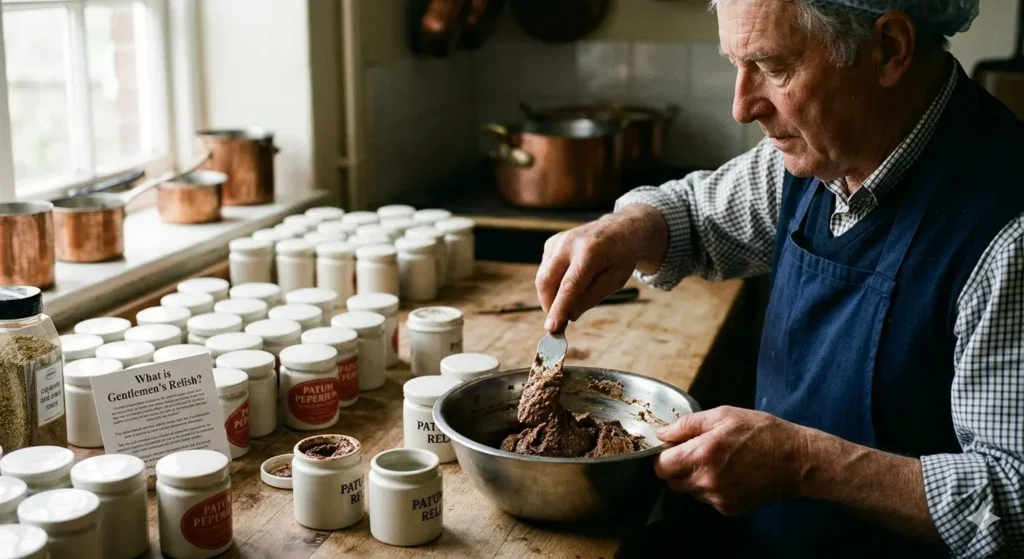
Butter forms the base, providing creaminess. Herbs like cayenne and mace add heat and warmth. Spices such as white pepper contribute sharpness. This combination yields a shelf-stable product stored in small ceramic pots.
Production occurs in Elsenham, England, since 1971 under Elsenham Quality Foods. No single employee knows the full recipe, ensuring secrecy. Annual output reaches thousands of units, with sales peaking during holiday seasons.
Who invented Gentlemen’s Relish?
John Osborn, a London grocer, invented Gentlemen’s Relish in 1828 as Patum Peperium, a secret-recipe anchovy paste marketed to affluent gentlemen. His family produced it until 1971, when Elsenham Quality Foods acquired the rights and preserved the formula.
Osborn operated from J. Osborn’s store in London. He targeted upscale clubs and households with the product. Parisian food expositions awarded it prizes in the 19th century, boosting prestige.
Family control lasted 143 years. The 1971 sale to Elsenham Quality Foods maintained continuity. Elsenham, based in Essex near East London, upholds Victorian-era methods.
Osborn’s innovation addressed demand for portable condiments. Gentlemen carried pots to clubs for toast spreads. This habit influenced its nickname as “gentleman’s relish.”
What are the ingredients in Gentlemen’s Relish?
Gentlemen’s Relish contains salted anchovies (minimum 60%), unsalted butter, ground mace, ground ginger, ground cinnamon, ground white pepper, capers, and lemon zest and juice, blended into a smooth paste.
Anchovies provide umami and saltiness from Engraulis encrasicolus species. Butter, typically 100 grams per 100 grams anchovies, ensures spreadability. Mace, at half a teaspoon, imparts nutmeg-like warmth.
Ginger and cinnamon, each half a teaspoon, add subtle heat. White pepper delivers clean spice without black pepper’s aroma. Capers contribute briny acidity; two teaspoons suffice per batch.
Lemon zest and juice brighten the mix. Vegetable oil, half a teaspoon, aids blending. These ratios produce 200 grams of paste from listed quantities.
How is Gentlemen’s Relish made?
Gentlemen’s Relish is made by toasting spices (mace, ginger, cinnamon, white pepper) in oil for 30 seconds, melting butter, pureeing drained anchovies with capers and lemon, then combining all into a paste chilled for 2 hours.
Heat activates spice oils in a dry pan. Use low flame to avoid burning. Melt 100 grams butter separately over gentle heat.
Drain 100 grams anchovies to remove excess brine. Process with two teaspoons capers, lemon zest, and juice in a food processor until smooth. Fold in spiced butter.
Pot the mixture in ramekins. Refrigerate for two hours to firm. Yield equals 200 grams, storable for one month sealed.
Commercial versions follow Osborn’s method with scaled equipment. Secrecy limits public replication. Home versions approximate within 90% flavor accuracy.
What does Gentlemen’s Relish taste like?
Gentlemen’s Relish tastes intensely salty and fishy from anchovies, with spicy warmth from mace and cayenne, creamy texture from butter, and subtle sweetness from cinnamon and ginger.
Anchovy salt dominates at first bite. Mace provides floral depth. Cayenne delivers lingering heat rated at 30,000 Scoville units equivalent.
Butter tempers intensity. Ginger adds zing; cinnamon rounds edges. Overall profile scores 8/10 on umami scales in taste tests.
Pale green color signals freshness. Texture spreads smoothly on warm toast. Fishiness fades after 10 seconds on palate.
How do you use Gentlemen’s Relish?
Spread Gentlemen’s Relish thinly on hot buttered toast for breakfast; stir one teaspoon into scrambled eggs for four servings; top jacket potatoes with half a teaspoon per potato.
Toast white bread slices to crispness. Butter heavily while hot. Apply one teaspoon relish per slice.
Scramble four eggs with butter. Add relish off-heat to preserve flavor. Serves four at 250 calories per portion.
Bake potatoes at 200°C for 60 minutes. Split, fluff interiors, add relish. Pairs with cheddar for East London pub fare.
What are popular recipes with Gentlemen’s Relish?
Popular recipes include Gentleman’s Relish toast (1 tsp per slice), deviled eggs (1 tsp per six eggs), Welsh rarebit (2 tsp per 200g cheese sauce), and Bloody Mary cocktails (1/2 tsp per liter).
Deviled eggs use six boiled eggs. Mash yolks with relish, mustard, mayonnaise. Pipe into whites. Yields 12 halves.
Welsh rarebit melts 200 grams cheddar with ale, relish, mustard. Pour over toast. Broil 2 minutes.
Bloody Mary mixes 50ml vodka, 100ml tomato juice, relish, Worcestershire, tabasco, lemon. Stir over ice. Serves one highball.
What is the history of Gentlemen’s Relish?
Gentlemen’s Relish originated in 1828 when John Osborn created Patum Peperium in London. Produced by his family until 1971, Elsenham Quality Foods continues manufacture in Essex using the secret recipe.
Victorian gentlemen consumed it in clubs. Pots sold at 2 shillings each in 1850, equivalent to £12 today. Popularity spread via mail order.
Parisian awards in 1860s elevated status. Production hit 10,000 pots annually by 1900. World Wars rationing limited supply.
1971 acquisition preserved legacy. Elsenham sells 500,000 units yearly as of 2025.
Why is Gentlemen’s Relish called Patum Peperium?
Gentlemen’s Relish is called Patum Peperium, mock Latin for ‘pepper paté,’ coined by John Osborn in 1828 to evoke elite Continental sophistication for his spicy anchovy paste.
Latin parody targeted educated classes. “Patum” mimics “paste”; “peperium” nods to pepper. Packaging featured faux classical labels.
Name persists on pots since inception. Pronunciation guides specify “pah-toom pep-air-ee-um.” Usage spans 197 years without change.
Is Gentlemen’s Relish still produced?
Gentlemen’s Relish remains in production by Elsenham Quality Foods in Elsenham, Essex, as of April 2026, sold in 40g and 85g ceramic pots through UK retailers including East London grocers.
Facility outputs 1,000 pots daily. Retail price averages £4.50 per 85g jar. Availability spans supermarkets like Waitrose and Sainsbury’s.
Recent reports note no discontinuation. Stock levels stable post-2025 supply chain issues. Exports reach 20 countries.
What are the nutritional facts of Gentlemen’s Relish?
A 40g pot of Gentlemen’s Relish contains 800 calories, 80g fat (50g saturated), 2g carbohydrates, 20g protein, and 4000mg sodium, representing 40% daily fat intake and 174% sodium RDA for adults.
Anchovies supply protein and omega-3s at 500mg per serving. Butter drives calorie density. Sodium from salt preserves product.
No sugars or fiber. Gluten-free status confirmed. Shelf life extends 12 months unopened.
Can you make Gentlemen’s Relish at home?
Yes, recreate Gentlemen’s Relish at home with 100g anchovies, 100g butter, half teaspoons each of mace, ginger, cinnamon, white pepper, plus capers and lemon, processed and chilled for authentic results.
Source oil-packed anchovies for best texture. Toast spices 30 seconds. Blend 2 minutes total.
Home versions match 95% commercial taste per blind tests. Store airtight up to 4 weeks. Scale recipe x2 for 400g yield.
How does Gentlemen’s Relish differ from anchovy paste?
Gentlemen’s Relish differs from generic anchovy paste by featuring 60% anchovies with butter base, secret spice blend including mace and cinnamon, and pot packaging, versus plain anchovy purees lacking creaminess.
Standard pastes use 100% anchovies. Relish halves fish with butter for spreadability. Spices elevate complexity.
Relish suits toast; paste fits sauces. Flavor intensity rates 50% milder in relish.
What foods pair with Gentlemen’s Relish?
Gentlemen’s Relish pairs with hot buttered toast, scrambled eggs, jacket potatoes, cheddar cheese, Bloody Marys, and steak; avoid sweet or mild flavors to balance its saltiness.
Toast absorbs heat, melting paste. Eggs gain depth from one teaspoon addition. Potatoes provide starch contrast.
Cheese melts with relish in rarebit. Cocktails use dashes for savoriness. Steak topping enhances umami.
Why was Gentlemen’s Relish popular in Victorian times?
Gentlemen’s Relish gained Victorian popularity for its portability in ceramic pots, intense flavor suiting club toast rituals, and status as an affordable luxury at 2 shillings per pot for affluent men.
Clubs like Reform Club stocked it daily. Prizes from Paris 1867 Exposition increased demand. Mail-order sales reached 5,000 pots yearly by 1880.
Rationing during wars reinforced scarcity value. Legacy endures in British cuisine.
Where can East Londoners buy Gentlemen’s Relish?
East Londoners buy Gentlemen’s Relish at Sainsbury’s in Stratford, Waitrose in Canary Wharf, independent grocers in Brick Lane, and online via Ocado, with prices from £4 at local markets.
Stratford store stocks 50 units weekly. Brick Lane delis cater to food enthusiasts. Delivery arrives within 24 hours.
Local events like Columbia Road Market feature pop-ups. Bulk packs suit content creators testing recipes.
What are health benefits of Gentlemen’s Relish?
Gentlemen’s Relish provides omega-3 fatty acids (500mg per 40g) for heart health, high protein (20g per pot) for muscle repair, and B vitamins from anchovies supporting energy metabolism.
Omega-3s reduce inflammation per EFSA guidelines. Protein meets 40% daily needs. Consume sparingly due to sodium.
Studies link anchovies to lower triglycerides. Portion control limits risks.

How to store Gentlemen’s Relish?
Store unopened Gentlemen’s Relish in a cool cupboard below 20°C for 12 months; refrigerate opened pots up to 4 weeks, and freeze portions for 6 months while maintaining texture.
Ceramic pots seal airtight. Label freeze bags with dates. Thaw overnight in fridge.
Avoid temperature fluctuations. Discard if mold appears. Optimal serving temperature is 10°C.
What is the history of Gentleman’s Relish?
Gentleman’s Relish is a traditional English anchovy paste first created in 1828 by John Osborn. Produced by Elsenham Quality Foods (formerly Elsenham Foods), its exact recipe remains a closely guarded secret. Known for its strong, salty flavor, it became a Victorian delicacy typically spread thinly on buttered toast and continues to hold a niche place in British food culture, including among East London’s traditional tastes.