
A wave of new renewable-energy projects is quietly transforming East London’s energy mix. Community owned solar on libraries and rooftop PV on council estates and public buildings are now generating on the order of 1,000–2,000 MWh/year locally, cutting hundreds of tonnes of CO₂ and saving tens of thousands of pounds annually. These initiatives – backed by borough councils and grassroots groups illustrate how inner city Londoners are beginning to close the gap on the Mayor’s 2030 target of 15% of London’s energy from local renewables.
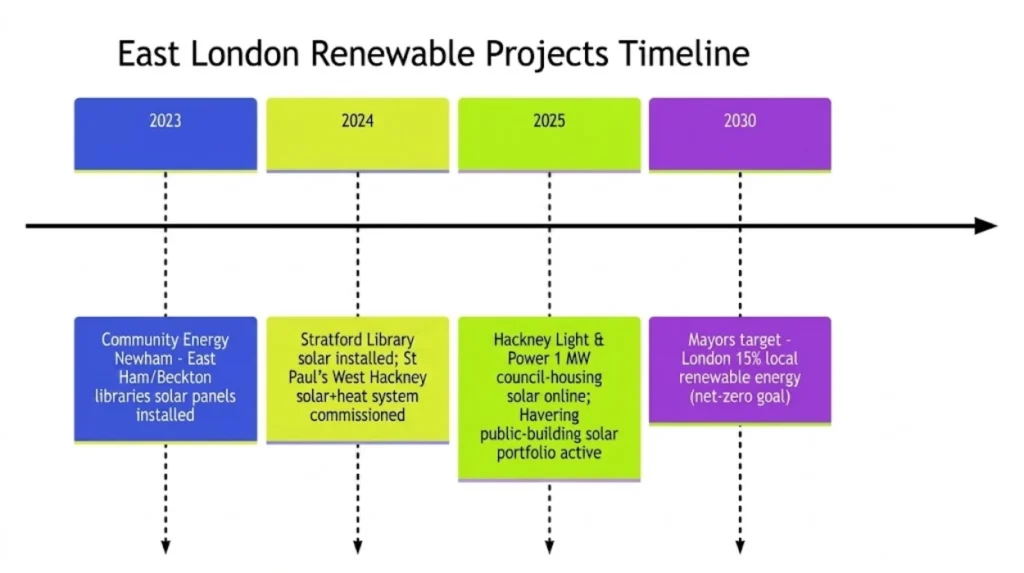
East London has historically lagged in homegrown power, but that is changing. In the past year alone, Newham Council teamed up with community group Repowering London to put solar panels on East Ham and Beckton Globe libraries with Stratford Library completed in 2025, while Hackney Council launched a pioneering 1 MW solar scheme for social housing. Meanwhile, St Paul’s West Hackney church installed a rooftop PV-and-heat-pump system, and Havering Council rolled out solar on nine public buildings (libraries, centres and its town hall). Altogether, these projects generate hundreds of MWh of electricity annually, powering hundreds of homes’ worth of demand – and set local examples for carbon-cutting.
“By investing in solar energy across our estate, we’re not only cutting emissions but also saving money,”
says Havering Cabinet member Natasha Summers, noting that the council’s nine-site solar portfolio (274 MWh/year) will save about 175 tCO₂ and £76k per year.
Projects in East London: Key schemes include:
Hackney Light & Power – Council Housing Solar (Hackney)
Hackney Council’s energy arm, Hackney Light & Power, retrofitted solar PV panels to 27 council blocks covering 400+ homes, creating a 1 MW community microgrid. This innovative scheme, delivered with Emergent Energy, supplies clean electricity directly to tenants, who can save up to 15% on bills. In full operation the system is expected to produce ≈800 MWh/year (≈200 tCO₂ avoided annually) and serve about 750 households. The £2 million project (installed in 2025) is selffunded via bill savings, and any surplus revenues go back into borough services.
“Hackney is at the forefront of the fight against climate change,”
says Cllr Sarah Young (Hackney’s cabinet member for climate), pledging to expand such schemes under the Council’s Climate Action Plan.
Community Energy Newham (Newham libraries)
A new cooperative (Community Energy Newham) has placed solar panels on municipal roofs – notably East Ham Library and Beckton Globe Library (2023), with Stratford Library completed in 2025. These community owned systems – backed by a Mayor’s London Community Energy Fund grant – are small individually but part of an ambitious plan to install up to 2 MW of PV on public buildings borough-wide. (At 2 MW the group estimates production would power ~620 homes.) Profits are reinvested locally. Newham’s Climate Action director Jacob Heitland says the council wants a “renewables-led” system and to ensure all residents
“participate in and benefit from our move to greener energy”.
He adds:
“We’re thrilled to be rolling out the Community Energy Newham project… ensuring residents can … benefit from our move to greener energy.”
St Paul’s Church, West Hackney
In late 2024 St Paul’s installed an energy hub of 104 solar panels (≈40 kW), four air-source heat pumps and three Tesla Powerwall batteries. This system generated 36.7 MWh of solar power in 2025 (meeting ~75% of the church’s electricity needs with 95% used on-site). Rector Brandon Fletcher-James notes the retrofit
“lowers our energy bills and reduces our reliance on fossil fuels,”
showing even a church can lead the way. The Diocese reports St Paul’s “is now primarily powered by the sun,” cutting its electricity costs and carbon footprint. Energy Minister Martin McCluskey MP lauded the project on a December 2025 visit, calling the church’s solar+heat setup a model for clean community buildings.
Havering Council Estate Solar
Havering has installed rooftop PV on nine council sites (libraries in Hornchurch, Rainham, Harold Hill, and the Romford Town Hall, plus youth/community centres and depots). With 274 MWh expected this year, the systems offset ~175 tCO₂ and about 100 homes’ annual electricity use. Ongoing upgrades (e.g. adding 90 kW to the Town Hall) will boost output. Councillor Summers frames this as “a fantastic step forward in our commitment to tackling climate change,” emphasizing that “local government can lead by example”. Across London, similar council schemes (HVAC retrofits and PV on civic roofs) are part of the London Energy Plan and borough climate action plans aimed at delivering on net-zero-by-2030 targets.
Other initiatives
Several East London boroughs are exploring low-carbon energy. For example, Hackney’s Fuel Poverty Solar Fund offers grants to estates (in addition to the L&P scheme). Waltham Forest and Tower Hamlets also support community solar grants. Newham’s Royal Docks Climate Agreement – a partnership of council, businesses and local organisations – explicitly targets London’s 2030 net-zero goal. And developers report that planned large schemes (e.g. the proposed 1,100 MW green energy data centre campus in Havering) could further boost local renewable capacity if approved.
| Project | Location | Operator | Technology | Capacity (MW) | Commissioned | Annual 1 Gen | Key Impacts |
|---|---|---|---|---|---|---|---|
| Hackney L&P Solar on Estates | Hackney | Hackney L&P (council) | Rooftop solar PV + microgrid | ~1.0 | 2025 | ~800 MWh (proj.) | ≈200 tCO₂/yr saved; supplies ~750 homes; lowers tenants’ bills |
| Community Energy Newham | Newham (East Ham, Beckton, Stratford) | Community Energy Newham (Repowering) | Rooftop solar PV (comm.-owned) Up to 2.0 (planned) | Up to 2.0 (planned) | 2023-24 (phased) | — (small project to date) | Builds local ownership of power; ~620 homes of demand potential; surplus reinvested locally. |
| St Paul’s West Hackney Church | Hackney (Stoke Newington) | St Paul’s Parish / Stokey Energy | Solar PV + heat pumps + batteries | 0.04 (104 panels) | Late 2024 | 36.7 MWh (2025) | Met 75% of site’s electricity; cuts bills and grid imports |
| Havering Council – Public roofs | Havering (Romford, Hornchurch, etc.) | Havering Council | Rooftop solar PV | 0.274 | 2024-25 | 274 MWh (2025 est.) | ≈175 tCO₂/yr saved; ~100 homes energy; ~£76k saved/yr, demonstrate s council leadership. |
Impacts to date
These projects are yielding measurable benefits. Together they produce roughly 1,100 MWh/year (over 1 GWh) of clean power, enough for hundreds of local homes. The Hackney and Havering schemes alone offset on the order of 350 tonnes CO₂ annually and save tens of thousands of pounds in bills or public funds. They have also created local green jobs – from PV installers to project coordinators – and opened up more rooftops for solar. Community Energy Newham’s share-offer raised local investment, empowering residents as co-owners. Fr Brandon of St Paul’s notes the new church system means
“we are taking our responsibility to be stewards of God’s creation seriously,”
while Martin McCluskey MP highlighted that the church’s panels and heat pumps
“are making the building cleaner and cheaper to run”.
“Every solar panel communities put up helps protect us from the rollercoaster of fossil-fuel markets,”
Deputy Mayor Mete Coban said this spring about London’s energy future. Local leaders echo this optimism. Newham’s Director of Climate Action, Jacob Heitland, says the borough is
“enabling an energy system that is renewables-led… ensuring residents can participate in and benefit from our move to greener energy”.
Likewise, Hackney’s Green champion Cllr Sarah Young notes the borough is “at the forefront of climate action” and will continue rolling out its pioneering Community Energy Fund projects. These voices signal strong political backing – and continued funding (e.g. through the Mayor’s London Community Energy Fund) – for more projects in the pipeline.
Challenges and limitations
Despite these successes, scaling up faces hurdles. Suitable roof or land space is scarce in dense East London, and projects often need complex planning approvals. Grid-connection constraints and the intermittency of solar also mean new installations must be carefully sited and sometimes paired with batteries or demand management. Financing remains a challenge: with most installations rely on grants or council funds and “split incentives” (when landlords, not tenants, own roofs) can limit uptake, as Hackney’s microgrid scheme itself noted. There are also bigger technical questions about how to integrate many distributed generators into the local distribution networks. Community groups warn that more support (streamlined planning, grid capacity, and affordable financing) is needed to unlock larger-scale systems.
Policy and outlook
East London projects plug into wider targets. The GLA has set a target of 15% of London’s energy from local renewables by 2030. The Royal Docks Climate Agreement (Newham-led) and borough climate plans commit to net-zero by 2030. London Community Energy Fund rounds (2017–25) have already helped install over 3.7 MW of solar citywide, and more funds are coming. Planned initiatives – for example a proposed Royal Docks floating solar array to power City Airport – hint at future possibilities.
Looking ahead, leaders recommend focusing on practical steps: allocate public budgets for solar on schools and estates; target street-by-street energy planning in partnership with communities; and retain locally generated revenues (through council “energy companies” or co-ops) to reinvest in neighbourhoods. In Havering, councillors point out that even a 60 kW depot roof or expansions at Romford Town Hall can have significant impact. With sustained policy support, East London’s example could inspire even broader change. As Cllr Summers puts it:
“These projects support our wider environmental aims and demonstrate how local government can lead by example in the transition to a low-carbon future.”
Visualization
The map below highlights London’s boroughs in the east (Hackney, Tower Hamlets, Newham, Barking & Dagenham, Havering), where the projects above are located, and the table summarizes their key features and outputs.
Sources: Borough council reports and announcements (Newham, Hackney, Havering) and industry press; GLA and government strategies; plus local media coverage. Where exact figures are unavailable we note this (e.g. small-generation estimates for early-stage projects) and base impacts on standard regional assumptions.