
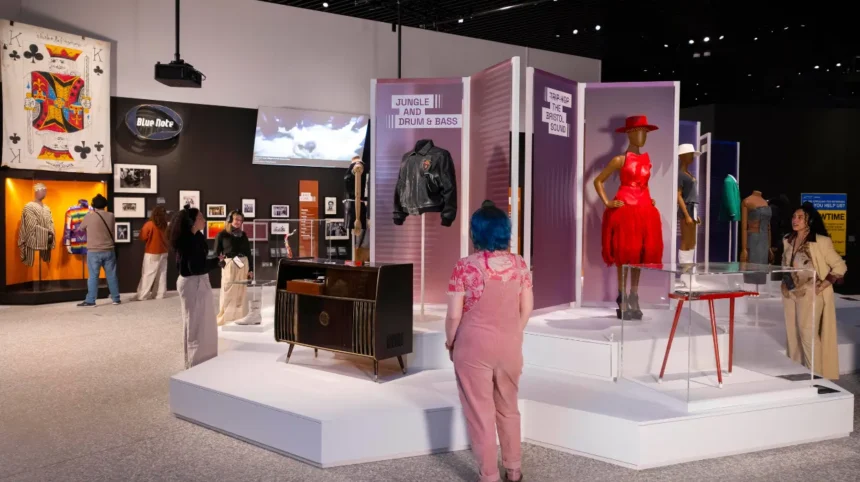
One of the things I love most about London is how it feels very distinct from the rest of the United Kingdom. I’ve been to other parts of the country such as Kent, and while it is nice, it definitely doesn’t have the exact same vibe as London, especially East London because there are so many extremely cool spots. One of them being the V&A East Museum which is located in Stratford. But this time the V&A has done something very different while they’ve had exhibitions previously. This exhibition is very different because it focuses on the impact that black music has had on the United Kingdom and I think that it needs to be checked out by everyone!
An immersive experience
Typically, when I have gone to exhibitions I have been put into a room where I have to explore the area myself going from piece to piece and reading the information taped onto the side. In contrast this exhibition is very immersive. Why? Because you are given an audio headset at the beginning of the exhibition and with this audio headset, you are able to listen to all different parts of the exhibition. Some areas of the exhibition are prompted by audio so if you tilted your headset down, you would be able to hear what music is being referred to in the art piece. A couple of times I’d turn my head and hear what is to come, which is a very entertaining spoiler!
I also love how colourful the exhibition is. When you first enter the exhibition the walls are painted black which draws your focus to the displays. Throughout the exhibition, the colours change going from a yellow to purple all the way into a white I’m very good way of showing how black British music has evolved over time.
The music!
Now, it wouldn’t be right to talk about an exhibition that involves black British music without talking about the music!
As many people know, genres such as rap and R&B have been imported from the USA to the United Kingdom. However, it came as a surprise to me that the exhibition went in depth with the effect that reggae has had on the UK with the genres such as Lover’s Rock and Two Tone being mentioned in the exhibition. It also touched on less talked about genres such as Jungle and Drum and Bass.
There was also a good amount of coverage on non-London artists. Many people may exclude the impact that Black non-Londoners have had on the music scene and I am glad the V&A included their contributions to the music scene.
Caroll Thompson, best known as the “Queen of Lovers Rock” was born in Hertfordshire but does not get enough recognition for her role in shaping the genre. The fur coat Thompson wore on the cover of Hopelessly in Love was displayed alongside information about the album. I was pleasantly surprised when I turned my head and heard the title track playing in my ears!
There is also a whole section dedicated to the genre of Trip-Hop which originated in Bristol.
The History of Black British Music!
The history of black British music has been shown extensively by the curators. From the effect of the slave trade, the impact of religion and how the exclusion of black people from musical institutions led to black people creating their own spaces.
One of the areas that I was the most surprised to learn about was how the Music of Black Origin, MOBOs formed and how it stemmed from Kanya King who wanted to highlight the impact that black British musicians have had and has now become an award as important as a Grammy or Tony.
So many important artists were referenced in the exhibition that might not be as well known to the average music listener in 2026. English R&B group, the Pasadenas, 2 tone ska revival band The Selecter and Hackney jungle duo The Ragga Twins. I think that all East Londoners should make the journey to the V&A, as it isn’t just an opportunity to reminisce but also to learn more about how Black British music formed and its place in the music industry today.
More information:
The Music is Black: A British Story is a paid exhibition located in the V&A East Museum. There are concessions that result in a decrease in ticket price. Entrances are step-free and wheelchair accessible. Accessible toilets are located on each floor, and baby changing facilities are available. Passenger lifts are located on each floor. The exhibition is all on one level.