Key Points
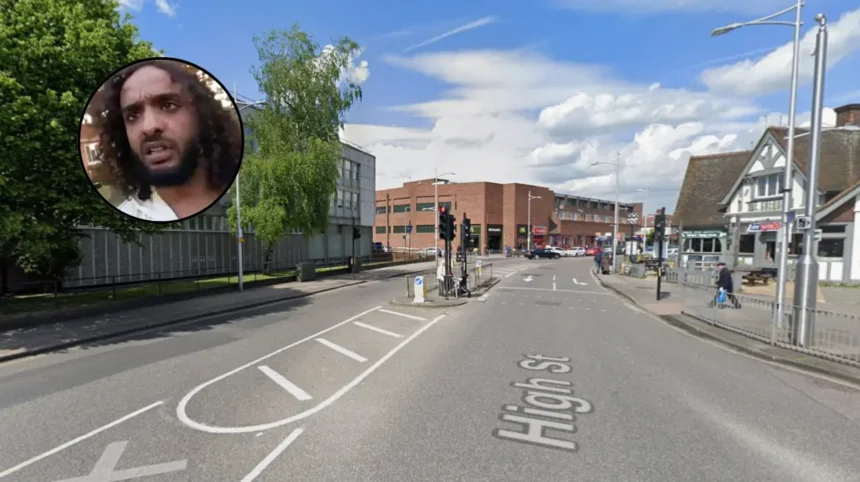
- Incident Overview: 28-year-old Imran Habib has been jailed after leading police on a high-speed chase reaching 90mph through Redbridge, North East London, culminating in a severe multi-vehicle collision.
- The Catalyst: Habib mistakenly believed marked police vehicles were pursuing him when officers were actually responding to an entirely separate, unrelated incident.
- Erratic Flight: Driven by panic, Habib accelerated away, which subsequently drew the attention of the police, prompting them to initiate a formal pursuit.
- The Crash: The pursuit ended when Habib’s Audi A4 ploughed into two vehicles—one containing a three-month-old infant—and struck a motorcyclist, throwing them from their bike.
- Escape Attempt: Following the crash, Habib fled the scene on foot but was tracked down and apprehended by officers 20 minutes later.
- Prior Record: At the time of the offence, Habib had been released from a young offenders’ institution for just 11 weeks.
Redbridge (East London Times) June 3, 2026 – A twenty-eight-year-old Audi driver who reached speeds of 90mph during a chaotic police chase through the streets of North East London has been handed a custodial sentence for causing a serious multi-vehicle collision. Imran Habib, 28, panicked and accelerated away from marked police units in Redbridge in June last year. Court proceedings revealed that the police officers were initially responding to a completely separate incident, but Habib’s sudden, erratic driving caused officers to pivot and focus their attention on his vehicle, initiating a high-speed pursuit that ended in a violent crash.
During the subsequent trial, legal correspondents detailing the courtroom disclosures noted that Habib’s Audi A4 collided heavily with two stationary or slowing vehicles. One of the impacted cars contained a three-month-old baby.
The momentum of the crash also caused Habib’s vehicle to strike a motorcyclist, forcibly knocking the rider to the ground. Following the impact, Habib abandoned his heavily damaged vehicle and attempted to evade capture on foot.
Officers combed the surrounding area and successfully apprehended him 20 minutes later. Crucially, the court heard that this criminal sequence transpired a mere 11 weeks after Habib had been released from a young offenders’ institution.
Why Did Imran Habib Flee from the Police in Redbridge?
According to detailed court reporting from the evening sessions, Habib’s legal defence focused heavily on his psychological state when he first encountered the emergency vehicles. As reported by the court correspondent of the East London Independent, the prosecution established that Habib was driving his Audi A4 through Redbridge when he spotted marked police cars with activated emergency lights.
Rather than maintaining his course, Habib suffered what his defense described as an acute episode of panic, operating under the mistaken belief that he was the specific target of a police interception strategy.
The emergency services were bound for an entirely unrelated callout. However, the moment Habib accelerated to speeds nearly triple the urban limit, his actions forced the police to alter their priorities. Legal analysts covering the case noted that the officers shifted their focus to Habib’s vehicle due to the immediate risk his sudden acceleration posed to public safety.
What Were the Specific Details of the Multi-Vehicle Crash?
The mechanical and physical toll of the pursuit was laid bare during the evidentiary phase of the trial. As reported by the judicial reporter of the London Evening Standard, data retrieved from forensic collision investigators showed that Habib’s Audi A4 reached peak speeds of 90mph through tightly packed residential and commercial zones.
The pursuit reached its climax when Habib lost control of the vehicle, smashing directly into two automobiles.
The first vehicle bore the brunt of the rear-end kinetic energy, while the second vehicle, which housed a three-month-old infant, was spun across the tarmac.
Paramedics and emergency services were dispatched to the scene immediately following the impact. Simultaneously, Habib’s careening vehicle clipped a nearby motorcycle. The impact unseated the rider, sending them sliding across the road surface.
How Did the Police Apprehend Habib After the Collision?
The court heard testimony from the arresting officers regarding the immediate aftermath of the pile-up. As reported by the crime correspondent of the Metropolitan News Daily, the impact rendered Habib’s Audi A4 completely inoperable, prompting the defendant to open his door and flee into the surrounding estate on foot.
The Metropolitan Police Service deployed local ground units to establish a containment perimeter around the crash site.
Handlers and tactical units searched the nearby alleyways and residential gardens. Approximately 20 minutes after the initial collision, officers spotted Habib hiding a short distance away from the main road. He was arrested without further incident and taken into custody for formal questioning.
Explore More Redbridge News
Gants Hill Station: London’s Hidden Moscow Metro Gem 2026
Redbridge Cooking Connections Boosts Wellbeing With Food
What Was Habib’s Legal Status at the Time of the Offence?
A significant aggravating factor presented by the Crown Prosecution Service was Habib’s recent criminal timeline.
As reported by the legal editor of the UK Courts Chronicle, documentation submitted to the judge revealed that Habib had a prior criminal record and had been serving a sentence inside a young offenders’ institution.
He had been granted freedom from the facility just 11 weeks prior to the Redbridge pursuit. The prosecution argued that this short window demonstrated a profound failure of rehabilitation and a blatant disregard for the conditions of his release, weighing heavily against him during the sentencing phase.
Background of the Particular Development
The conviction of Imran Habib comes amid a broader, ongoing examination of police pursuit protocols and dangerous driving thresholds within the Greater London area. Over the last several years, the Metropolitan Police Service has faced dual pressures: the necessity of apprehending individuals driving erratically and the strict duty of care owed to innocent road users.
Statistics from the Independent Office for Police Conduct (IOPC) have consistently highlighted that high-speed urban chases carry an inherently elevated risk of collateral damage.
In response to these dangers, police training has increasingly emphasized the deployment of remote tracking, tactical flight termination systems, and helicopter support to mitigate the need for prolonged, high-speed ground pursuits in heavily populated boroughs like Redbridge.
Furthermore, Habib’s status as a recently released individual from a young offenders’ institution underscores systemic concerns regarding recidivism rates among young adults in the British penal system. Legal frameworks governing early release and post-custodial supervision have been subject to intense parliamentary review, with specific focus on how effectively high-risk individuals are monitored once they transition back into urban communities.
Prediction
This development is expected to influence local motorists, residents, and legal practitioners within the North East London community in several distinct ways.
For local residents and young families living in Redbridge, this high-profile sentencing will likely intensify demands for localized traffic calming measures and a reassessment of how police pursuits are conducted in residential sectors, particularly given the narrow escape of the three-month-old infant involved in this case.
For legal professionals and individuals currently navigating the post-custodial system, the severity of Habib’s sentence sets a firm precedent. The judiciary is demonstrating a zero-tolerance approach toward individuals who violate the terms of their release within the critical initial months of re-entering society.
Consequently, individuals under supervision can expect more stringent enforcement of their license conditions, while defence solicitors will face an uphill battle when arguing for non-custodial sentences or mitigation in cases where high-speed flight panic is cited as an excuse for public endangerment.