Key Points
- West Ham United are reportedly evaluating a substantive investment of up to £350 million to redevelop their current home, the London Stadium.
- The exclusive revelation was delivered by former Everton Chief Executive Officer Keith Wyness during an industry briefing with sports media outlet Football Insider.
- The chief structural objective of the proposed multi-million-pound project is to bring the spectator stands closer to the pitch, addressing long-standing criticisms regarding the venue’s viewing distances. Green Street Hammers
- Club hierarchy intend to use the architectural overhaul to improve the matchday atmosphere and systematically “get the fans back onside” following years of tension regarding the stadium’s layout.
- Supporters have expressed continuous dissatisfaction with the former Olympic venue since the club completed its controversial relocation from the historic Boleyn Ground at Upton Park in 2016.
West Ham United (East London Times) June 8, 2026 — West Ham United are preparing to sanction a transformative structural redevelopment project at the London Stadium valued at up to £350 million. The major financial and architectural undertaking was disclosed by former Everton Chief Executive Officer Keith Wyness, who confirmed that the club’s leadership is actively planning behind the scenes to radically modify the stadium’s interior bowl. The ambitious capital project aims to definitively resolve decade-long spectator frustrations by physically shifting the seating tiers significantly closer to the playing surface. By executing these structural interventions, the club’s board is seeking to repair its fractured relationship with the fanbase, maximize the venue’s acoustic potential, and create an imposing, authentic football atmosphere that has been notably absent since the club departed Upton Park a decade ago.
- Key Points
- Why Is West Ham United Planning a £350 Million Structural Overhaul at the London Stadium?
- What Specific Architectural and Structural Challenges Are the Hammers Seeking to Correct?
- Background of the London Stadium Development
- Future Prediction: How This Redevelopment Will Affect West Ham United Supporters
Why Is West Ham United Planning a £350 Million Structural Overhaul at the London Stadium?
As detailed in an exclusive report published by sports media outlet Football Insider, the hierarchy at West Ham United are increasingly cognizant of the lingering disconnect between the club’s matchday operations and its core supporter base.
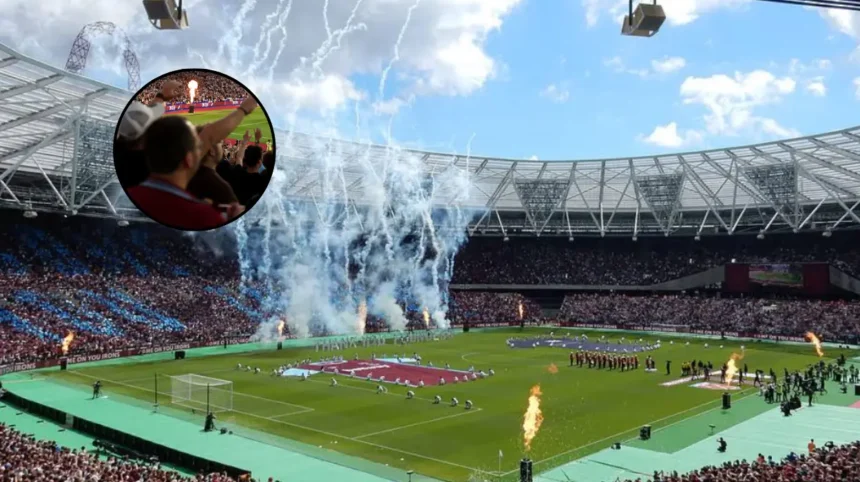
The London Stadium, originally designed and constructed as an athletics-first venue for the London 2012 Summer Olympic Games, has never truly resonated with the club’s traditional fanbase due to its sweeping structural curves, wide running-track margins, and the significant physical distance separating spectators from the field of play.
In an authoritative disclosure to Football Insider, the former Everton Chief Executive Officer Keith Wyness stated that:
“West Ham United are planning to splash up to £350 million on redevelopment work at their London Stadium home. The club hierarchy have plans behind the scenes to sanction work to bring the stands closer to the pitch and improve the atmosphere inside the ground.”
Green Street Hammers
Wyness further expanded on the strategic rationale driving this boardroom ambition, adding that the Hammers’ ownership will be prepared to deploy this massive capital expenditure specifically to
“get the fans back onside.”
The multi-million-pound initiative represents a direct acknowledgment from the club’s executive board that the compromises accepted during the initial 2013–2016 football conversion phase require further structural rectification if the stadium is to ever serve as a genuine football fortress.
What Specific Architectural and Structural Challenges Are the Hammers Seeking to Correct?
The core source of friction since West Ham United officially took up anchor tenancy at the East London venue in August 2016 has been the inherent geometry of the stadium’s bowl.
Because the infrastructure was engineered to support a regulation international running track and field facilities, the lower-tier seating tracks along an elongated ellipse rather than a tight, rectangular football configuration.
While subsequent minor refurbishments—including an £11.5 million summer makeover that squared off the Sir Trevor Brooking and Bobby Moore stands behind the goals—brought certain sections of fans up to four metres closer to the action, wide gaps remain along the East and West stands.
The proposed £350 million project is expected to involve a highly complex engineering intervention to rebuild or heavily reconfigure these lateral stands.
Industry analysts suggest that a project of this financial magnitude would go far beyond temporary scaffolding or standard modular seating adjustments, potentially indicating a permanent restructuring of the lower and mid-tier concrete bowls to create steeper, more intimate viewing sightlines common in modern bespoke football grounds like the Tottenham Hotspur Stadium or Everton’s new Bramley-Moore Dock arena.
Background of the London Stadium Development
The historical context surrounding West Ham United’s residency at the London Stadium is anchored in one of the most publicly debated infrastructure transitions in British sporting history. Constructed between 2008 and 2011 at an initial cost of £486 million to serve as the centerpiece of the London 2012 Olympic Games, the stadium faced an uncertain long-term legacy future until a competitive bidding process selected West Ham United as the anchor tenant.
To accommodate Premier League football, the venue underwent a massive, three-year conversion project between 2013 and 2016, costing an additional £274 million.
This conversion was largely funded by British taxpayers via the London Legacy Development Corporation (LLDC), with West Ham United contributing a minor £15 million share towards the initial transition costs alongside an ongoing, highly favorable 99-year lease agreement.
Despite the commercial benefits of expanding the club’s matchday capacity from the 35,000 seats of Upton Park to a regulated 62,500 capacity at Stratford, the physical realities of the stadium severely diluted the intense, intimidating home atmosphere that defined the club’s identity for generations.
For a decade, fans have vocally criticized the vast visual gaps, the echo-prone acoustic environment, and the bureaucratic restrictions imposed by the stadium landlords, which have historically limited the club’s direct control over naming rights and matching corporate hospitality infrastructure.
Future Prediction: How This Redevelopment Will Affect West Ham United Supporters
Should this £350 million engineering project receive full boardroom and planning approval, it will exert a profound, multi-layered impact on the matchday reality and cultural satisfaction of West Ham United match-going supporters.
In the immediate term, supporters occupying seats in the lower and middle tiers will experience a dramatic shift in spatial dynamics. Bringing the stands structurally closer to the pitch will fundamentally rectify the sightline deficiencies that have forced fans to view the action across wide, artificial gaps. This physical proximity will drastically alter the venue’s acoustic properties, preventing noise dissipation and allowing the home crowd to project an intense, unified wall of sound onto the pitch.
This shift could successfully restore the hostile, passionate environment that historical venues like the Boleyn Ground were famous for, thereby fulfilling the long-delayed promise of the stadium move.
However, a capital investment of this scale will inevitably alter the club’s economic relationship with its fans. While the stadium’s massive capacity has historically allowed West Ham to offer some of the most competitively priced season tickets in London, the amortization of a £350 million structural overhaul could exert upward pressure on ticket pricing, corporate hospitality rates, and food and beverage concessions inside the stadium.
Supporters may face a transitional period of disruption, including rolling block closures or temporary capacity restrictions while heavy engineering works are executed during successive off-seasons. Ultimately, if successful, the project will permanently transition the London Stadium from a compromised multi-use Olympic arena into a legitimate, intimidating football home, cementing the club’s elite status in English football without sacrificing its traditional supporter identity.