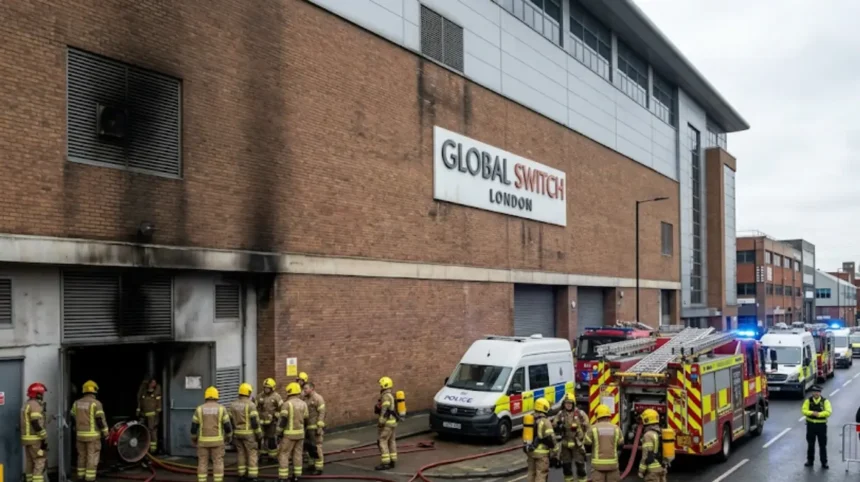
The Global Switch London data centre fire occurred on 24 January 2026 in a basement battery room at the Blackwall facility on Nutmeg Lane, East London. The London Fire Brigade deployed 60 firefighters and eight engines to extinguish a blaze involving approximately 200 lead-acid batteries. The fire was caused by the failure of one battery, was contained within the battery room, and resulted in no injuries or service disruption.
- What was the Global Switch London data centre fire incident?
- When and where did the fire occur?
- What caused the battery room fire?
- How did firefighters respond to the blaze?
- What damage resulted from the fire?
- Did the fire disrupt data centre services?
- How does this incident compare to other data centre fires?
- What are the safety implications for data centre operators?
- What is Global Switch’s data centre infrastructure in London?
- What lessons can be learned from this incident?
What was the Global Switch London data centre fire incident?
The Global Switch London data centre fire was an accidental battery room fire that occurred in the early hours of Saturday 24 January 2026 at the company’s Docklands facility in Blackwall, East London. The incident involved a string of lead-acid batteries in a basement room operated by a subcontractor and was extinguished within two hours.
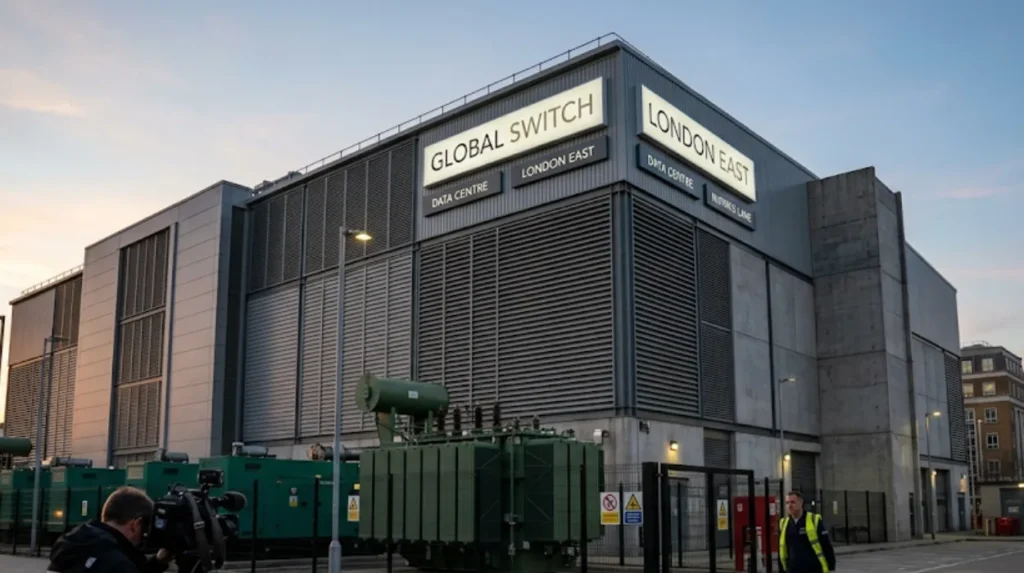
Global Switch operates critical data centre infrastructure in London’s Docklands area. The company maintains two primary sites in the Docklands region: London East and London North. The facility involved in the January 2026 incident is located on Nutmeg Lane in Blackwall within the Tower Hamlets borough of East London.
The building housing the data centre is a 13-storey tower structure. The fire originated in the basement level of this tower. Local press identified the incident location as a commercial building containing data centre operations. The London Fire Brigade classified the incident as a “small fire” despite the substantial emergency response.
Global Switch’s Docklands data centre represents significant infrastructure capacity. The facility offers 224MVA of available power. The site hosts H100 and H200 graphics processing units for CoreWeave, constituting what Global Switch describes as Europe’s largest deployment of this Nvidia hardware. The company announced plans for a third facility called London South in 2024, which will provide 40MW across 27,000 square metres.
When and where did the fire occur?
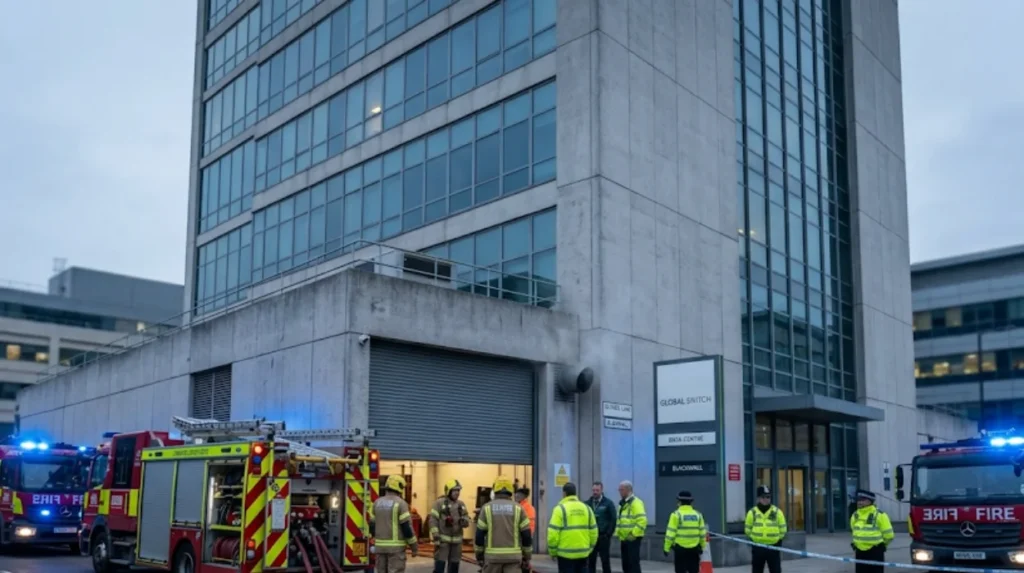
The fire occurred at 04:52am on Saturday 24 January 2026 at Global Switch’s data centre on Nutmeg Lane in Blackwall, East London. Fire crews extinguished the blaze by 06:43am, containing the incident to approximately two hours of active firefighting operations.
The London Fire Brigade received the initial emergency call at 04:52am on 24 January 2026. This timestamp marks when the Brigade’s 999 Control officers logged the fire incident. Crews arrived at the Nutmeg Lane location shortly after the emergency call. The fire was reported as “quickly extinguished” by 06:43am on the same morning.
The geographic location places the incident in Blackwall, which forms part of the Tower Hamlets borough in East London. Nutmeg Lane runs through the Blackwall area near the River Thames. The specific address is a commercial building housing data centre infrastructure operated by Global Switch.
Fire crews mobilized from six different London Fire Brigade stations. These stations included Poplar, Millwall, Plaistow, Stratford, East Ham, and East Greenwich. The multi-station response reflected the high-rise nature of the building and the specialized risk associated with data centre infrastructure fires.
The date of 24 January 2026 falls within the winter period in the United Kingdom. This timing carried implications for emergency response conditions and potential impacts on surrounding infrastructure. The early morning timing minimized potential disruption to business operations and reduced public exposure to the incident.
What caused the battery room fire?
The London Fire Brigade determined the fire was accidental and caused by the failure of one of the lead-acid batteries in the basement battery room. The initial battery failure triggered a chain reaction affecting a string of batteries within the room.
Lead-acid batteries represent mature energy storage technology used in data centre backup power systems. These batteries contain lead plates suspended in sulphuric acid electrolyte solution. Battery failure can occur through multiple mechanisms including thermal runaway, internal short circuits, or electrolyte leakage. The failure of a single battery can propagate to adjacent batteries in a string configuration.
The London Fire Brigade spokesperson stated the fire “is believed to have been accidental and caused by the failure of one of the lead acid batteries.” This determination indicates the investigation found no evidence of deliberate ignition or external factors causing the fire. The accidental classification reflects typical battery failure patterns in data centre environments.
The battery room involved in the incident was operated by a subcontractor rather than Global Switch directly. This operational arrangement is common in data centre facilities where specialized maintenance contractors manage specific infrastructure components. The room contained approximately 200 lead-acid batteries at the time of the incident.
Investigation into the cause remained ongoing after the incident was extinguished. The London Fire Brigade indicated the cause was not fully determined at the time of initial reporting. Standard investigative procedures include examination of battery maintenance records, electrical system logs, and physical evidence from the fire scene.
How did firefighters respond to the blaze?
The London Fire Brigade deployed eight fire engines and approximately 60 firefighters to the Blackwall data centre fire. Fire crews contained the blaze to the battery room and extinguished it using handheld extinguisher equipment.
The scale of the emergency response reflected the high-risk nature of data centre fires. Eight fire engines responded to the Nutmeg Lane address. Around 60 firefighters participated in the incident response operations. The London Fire Brigade mobilized crews from six stations across East London to ensure adequate resources.
Firefighters encountered a fire confined to a string of lead-acid batteries within the basement battery room. The fire was reportedly extinguished by a single firefighter using a handheld fire extinguisher. This containment level prevented the fire from spreading to other building areas or critical data centre infrastructure.
The London Fire Brigade’s 999 Control officers received the initial incident report at 04:52am. Crews arrived at the scene and commenced firefighting operations immediately. The fire was brought under control and fully extinguished by 06:43am, representing approximately two hours of active incident response.
The response scale appeared disproportionate to the actual fire size due to the high-rise building classification. Data centre fires carry elevated risk profiles due to electrical infrastructure, backup power systems, and potential business continuity impacts. The London Fire Brigade maintains specialized protocols for commercial and industrial facility fires in high-rise structures.
What damage resulted from the fire?
The fire caused damage limited to a string of lead-acid batteries within the basement battery room. No further damage occurred to the building structure, data centre infrastructure, or customer equipment, and there were no reports of injuries.
The physical damage remained confined to the battery room in the basement level. The fire destroyed part of the basement battery room containing approximately 200 lead-acid batteries. The London Fire Brigade confirmed the fire was “limited to a string of lead-acid batteries” with no extension to other building areas.
Building structure sustained no damage from the fire incident. The 13-storey tower housing the data centre remained structurally sound throughout the incident. Fire damage did not extend beyond the immediate battery room area. This containment prevented potential cascading damage to floors above the basement level.
Data centre infrastructure and customer equipment experienced no fire damage. The incident resulted in no disruption to customer services according to initial reports. Global Switch maintained operational continuity throughout the fire incident and subsequent investigation period. Customer systems and housed equipment remained functional during and after the incident.
No injuries were reported among firefighters, building occupants, or subcontractor personnel. The London Fire Brigade confirmed zero casualty reports from the incident. Firefighters successfully contained the fire without requiring evacuation of other building areas. The absence of injuries reflects effective emergency response protocols and fire containment.
Did the fire disrupt data centre services?
The Global Switch London data centre fire caused no disruption to customer services. All data centre operations continued normally throughout the incident, and customer systems remained online without interruption.
Global Switch confirmed there was reportedly no disruption to customer services during or after the fire incident. The company maintained full operational capability throughout the emergency response period. Customer equipment housed in the facility experienced no service interruption from the basement battery room fire.
The battery room affected by the fire was operated by a subcontractor. This operational separation likely contributed to the containment of service impacts. The fire remained isolated to the basement battery storage area without affecting critical data centre infrastructure on other floors.
Global Switch’s Docklands facility hosts significant computing infrastructure including H100 and H200 GPUs for CoreWeave. The absence of service disruption indicates these critical systems remained operational throughout the incident. The facility’s 224MVA power capacity and supporting infrastructure were unaffected by the battery room fire.
The incident contrasts with a 2023 fire at Global Switch’s Paris facility that caused widespread service outages. The Paris incident involved a water leak that triggered a battery fire affecting all of Google’s European operations. The London incident demonstrated improved fire containment and service continuity compared to the earlier Paris event.
How does this incident compare to other data centre fires?
The Global Switch London fire was a contained battery room incident with minimal impact, contrasting with the 2023 Paris facility fire that caused major European outages affecting Google’s operations. Data centre fires vary significantly in scale and consequences depending on containment and infrastructure design.
The January 2026 London incident followed a 2023 fire at Global Switch’s Paris facility. The Paris incident began with a water leak that triggered a battery fire. That fire caused all of Google’s European operations to suffer an outage, representing a significantly more severe service disruption than the London event.
Global Switch experienced a power outage at its London GS2 data centre in July 2017. That incident involved a brief power interruption on the tenth floor of the facility. The 2017 outage affected customers including EX Networks, Claranet, Tagadab, and Interoute, with service restoration occurring within approximately one hour.
The London January 2026 fire was one of two UK data centre-related fires that weekend. A BT/Openreach telephone exchange in Scotland also suffered a fire on the same Saturday. The cause of the Scottish incident remained unknown with an investigation underway at the time of reporting.
Data centre fires typically involve electrical infrastructure, backup power systems, or cooling equipment. Battery rooms present particular fire risks due to the chemical energy stored in lead-acid or lithium-ion battery systems. The Global Switch London incident demonstrates the importance of battery room fire suppression systems and containment protocols.
What are the safety implications for data centre operators?
The Global Switch London fire highlights the need for robust battery room fire suppression systems, regular maintenance protocols, and clear operational responsibility for subcontractor-managed infrastructure to prevent cascading failures.
Battery room fires represent a recognized risk category in data centre operations. Lead-acid batteries contain significant chemical energy that can release rapidly during failure events. The failure of one battery can propagate through connected strings, creating thermal runaway conditions. Data centre operators must implement appropriate fire detection and suppression systems in battery storage areas.
The incident underscored the importance of clear operational responsibility for subcontractor-managed infrastructure. The battery room involved was operated by a subcontractor rather than Global Switch directly. This arrangement requires clear accountability for maintenance, inspection, and emergency response protocols to ensure comprehensive safety coverage.
The London Fire Brigade’s substantial response reflected the elevated risk profile of data centre facilities. Eight fire engines and 60 firefighters responded to what was classified as a “small fire.” This response scale demonstrates the importance of early detection and rapid containment to minimize emergency service deployment and potential business disruption.
Data centre operators must maintain comprehensive insurance coverage for fire-related incidents. The industry has seen increased insurance coverage levels in response to growing fire risks. Aon increased data centre insurance coverage to $3.5 billion reflecting the expanding risk profile of the sector.
Explore More Help & Resources
Things to Do in Hackney This Weekend Locals Favourite Picks
Valentines Park Lido Ilford When Will It Reopen in 2026
What is Global Switch’s data centre infrastructure in London?
Global Switch operates two data centre sites in London’s Docklands area called London East and London North, with a third facility London South planned for 2024. The company’s Docklands infrastructure includes 224MVA of available power and hosts advanced GPU computing systems.
Global Switch maintains two operational sites in the Docklands area. The London East and London North facilities provide colocation and infrastructure services to enterprise customers. The January 2026 fire occurred at one of these Docklands facilities on Nutmeg Lane in Blackwall.
The Docklands data centre offers 224MVA of available electrical power capacity. This substantial power availability supports high-density computing workloads including artificial intelligence and machine learning applications. The facility hosts H100 and H200 graphics processing units manufactured by Nvidia for CoreWeave.
Global Switch announced plans for a third facility called London South in 2024. The London South facility will provide 40MW of power capacity across 27,000 square metres of floor space. This expansion reflects growing demand for data centre capacity in the London region.
The company launched a showcase of liquid cooling technologies at the Docklands site in June 2025. Liquid cooling systems reduce fire risk compared to traditional air cooling by eliminating electrical fans and reducing heat accumulation. This technology deployment demonstrates Global Switch’s commitment to advanced infrastructure safety and efficiency.
What lessons can be learned from this incident?
The Global Switch London fire demonstrates that early detection, rapid response, and effective containment protocols can prevent battery room fires from escalating into major service disruptions. Clear operational accountability and regular maintenance are essential for preventing battery failures.
Early fire detection proved critical in limiting the incident’s impact. The London Fire Brigade received the emergency call at 04:52am and extinguished the fire by 06:43am. This rapid response prevented fire spread beyond the battery room and avoided damage to critical data centre infrastructure.
Effective containment protocols prevented service disruption. The fire remained isolated to the basement battery room without affecting customer equipment or building systems. This containment reflects appropriate fire suppression system design and operational procedures for battery storage areas.
Clear operational responsibility for subcontractor-managed infrastructure requires ongoing attention. The battery room was operated by a subcontractor, creating potential accountability gaps. Data centre operators must ensure subcontractors maintain equivalent safety standards and maintenance protocols to prevent infrastructure failures.
Regular battery maintenance and inspection can identify potential failure points before incidents occur. Lead-acid batteries require periodic testing and replacement to prevent thermal runaway conditions. The accidental nature of the battery failure suggests maintenance protocols may require enhancement to identify degradation patterns.
The incident reinforces the importance of comprehensive emergency response planning. The London Fire Brigade’s substantial response demonstrated the value of coordinated emergency services protocols for data centre facilities. Regular fire drills and coordination with local fire services ensure effective incident response when emergencies occur.
What happened at the Global Switch London data centre?
A fire broke out in a basement battery room at the Global Switch data centre on Nutmeg Lane, Blackwall, in East London during the early hours of 24 January 2026. The incident involved a string of lead-acid backup batteries, was contained within the battery room, and caused no injuries or disruption to customer services.