Key Points
- Czech billionaire Daniel Kretinsky has agreed to purchase an additional stake in West Ham United from the Gold family, increasing his total holdings from 27% to approximately 43%.
- The transaction positions Kretinsky’s investment vehicle, 1890 Holdings (part of the EP Group), as the single largest shareholder of the East London football club, surpassing the 38.8% stake held by David Sullivan.
- This ownership shift follows the immediate resignation of long-serving co-chairman David Sullivan from his directorial roles, triggered by a joint investigation by BBC Panorama and The Times alleging historic misconduct. Sullivan categorically denies all accusations.
- The board restructuring coincides with severe financial strain and organizational instability following West Ham United’s recent relegation from the Premier League to the EFL Championship.
- Kretinsky and joint-chair Vanessa Gold have committed to an aligned voting strategy and capital injection designed to stabilise the club, retain key squad members, and target immediate promotion under manager Nuno Espirito Santo.
Stratford (East London Times) July 4, 2026 –As reported by Jacob Steinberg of The Guardian, Czech billionaire Daniel Kretinsky is set to overtake David Sullivan as West Ham United’s largest shareholder after reaching an agreement to buy a substantial portion of shares from the Gold family. Through his investment group, 1890 Holdings—part of the broader EP Group—Kretinsky will elevate his stake from 27% to approximately 43%.
- Key Points
- Why did co-chairman David Sullivan resign from the West Ham United board?
- How did the remaining West Ham board members react to the sudden revelations?
- What safeguarding measures were hidden from external club shareholders?
- What financial and structural crisis does the new ownership coalition face?
- How do the majority owners plan to stabilise the club in the Championship?
- Background of West Ham United Ownership and Governance Developments
- Prediction: How This Development Can Affect West Ham United Supporters and Season Ticket Holders
This transactional surge moves him past the 38.8% minority stake maintained by Sullivan, effectively reshaping the hierarchy of the East London club.
The transition comes immediately after Sullivan stepped down from his position as joint-chairman and resigned as a director of both WH Holding Limited and West Ham United Football Club.
Why did co-chairman David Sullivan resign from the West Ham United board?
According to reporting by Rishabh Jaiswal for Reuters, Sullivan resigned with immediate effect last month after a joint media investigation by the BBC’s Panorama documentary series and The Times newspaper published accounts from seven women accusing him of “sexually exploitative and predatory behaviour” stretching back several decades.
In a formal statement addressing the departure, Sullivan stated that
“the false allegations levelled against me have been sensationalised by the media,”
firmly maintaining his total denial of the claims. The publication of the investigation prompted an emergency reconfiguration of the boardroom to address corporate liability and preserve commercial partnerships.
How did the remaining West Ham board members react to the sudden revelations?
As detailed by Tashan Deniran-Alleyne of the Evening Standard, a joint statement issued by Vanessa Gold and Daniel Kretinsky made their stance regarding the allegations explicit. Gold and Kretinsky stated:
“We were deeply concerned by the revelations made by The Times and Panorama this week and our thoughts go out to those women who have fought so hard to make their voices heard. Any abuse of power is abhorrent, and it takes great courage and determination to speak up against it.”
The publication further clarified the timeline of internal awareness. A club source confirmed that it was not until 21 May that Sullivan formally informed the full board that an investigative story concerning his personal conduct might be published, leaving other directors unaware of the specific allegations until they entered the public domain on 8 June.
What safeguarding measures were hidden from external club shareholders?
Reporting from Sky Sports highlighted significant internal friction regarding historical internal protocols at the club’s Chadwell Heath and Rush Green facilities.
The joint statement from Kretinsky and Gold revealed that board representatives of shareholders other than Sullivan were only made aware post-publication of specific safeguarding measures that had been quietly implemented since 2023.
These measures included strictly enforced restrictions regarding Sullivan’s direct contact with West Ham United’s women’s team and youth academy squads during an active assessment by the Football Association (FA).
What financial and structural crisis does the new ownership coalition face?
As outlined by Tariq Saleh of Sportcal, this dramatic ownership shake-up transpires during one of the most volatile periods in the club’s modern history.
West Ham United were relegated from the Premier League on the final day of last season, meaning they will compete in the second-tier EFL Championship for the first time since the 2011-12 campaign.
The relegation has severely impacted broadcast distributions and triggered acute financial difficulties. Structurally, the backroom operation remains highly unstable; the club is operating without an active sporting director, and head of technical recruitment Max Hahn has handed in his resignation, leaving a vacuum in the recruitment department.
How do the majority owners plan to stabilise the club in the Championship?
Despite the organizational turbulence, Kretinsky and Gold have confirmed their intention to back the current managerial staff to maintain sporting continuity.
As reported by Sky Sports, the ownership group has chosen to retain Nuno Espirito Santo as manager to oversee the transition. Gold and Kretinsky announced:
“Our goal is to stabilise West Ham United, retain as many of our key players as possible and, under the management of Nuno Espírito Santo, secure an immediate return to the Premier League. As the largest shareholder, group EP will be able to provide the additional financing the club needs.”
The remaining minority shareholders, including Tripp Smith, Daniel Harris, and Terry Brown, are reported to be fully aligned with this strategy to inject emergency equity, ease debt obligations, and protect the first-team roster from an aggressive summer transfer window clear-out.
Background of West Ham United Ownership and Governance Developments
The modern corporate structure of West Ham United dates back to January 2010, when David Sullivan and the late David Gold acquired a joint 50% controlling stake in the club, valued at approximately £105 million, from the Icelandic consortium CB Holding.
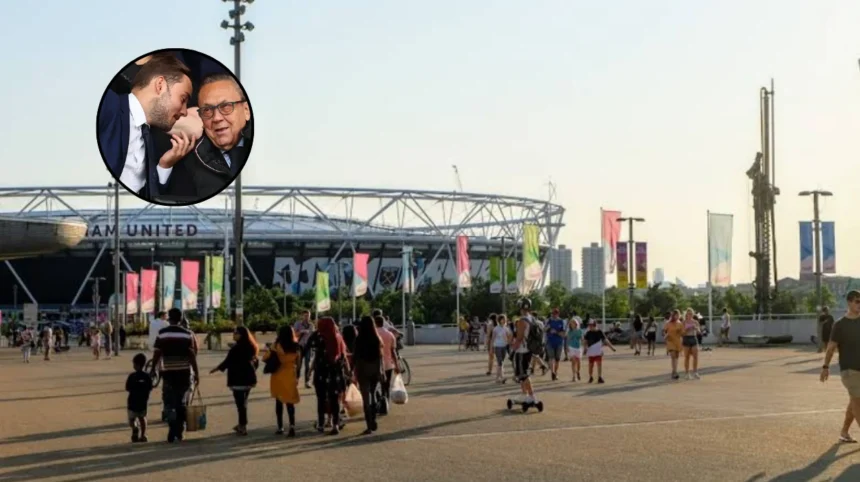
Over the subsequent decade, Sullivan acted as the primary operational authority, overseeing the club’s highly controversial relocation from the Boleyn Ground in Upton Park to the London Stadium in Stratford in 2016.
Daniel Kretinsky, who also owns the Czech top-flight football team Sparta Prague and holds a controlling interest in International Distributions Services (the parent company of Royal Mail), entered the West Ham boardroom in November 2021.
Through 1890 Holdings, Kretinsky initially paid an estimated £150 million to acquire a 27% stake, an agreement that included a specific option for a full future takeover.
Following the death of David Gold in January 2023, his daughter Vanessa Gold inherited his 25% shareholding, subsequently assuming the role of joint-chair. Prior to the June 2026 restructuring, Sullivan remained the single most powerful figure at the club with a 38.8% stake, but his executive influence has collapsed following his resignation amid mounting pressure from footballing authorities.
Prediction: How This Development Can Affect West Ham United Supporters and Season Ticket Holders
The transition of Daniel Kretinsky to the position of largest shareholder is poised to fundamentally alter the operational environment for West Ham United supporters and the wider community in East London.
In the immediate term, the injection of capital from Kretinsky’s EP Group mitigates the threat of an uncontrolled fire sale of marquee players, giving fans greater assurance that a competitive squad can be maintained in the EFL Championship.
This financial cushion directly protects season ticket holders from witnessing a complete degradation of the on-pitch product.
Furthermore, the shift in control away from David Sullivan could radically change the long-term relationship between the club’s board and its fanbase.
The Sullivan era was frequently marked by mass supporter protests, independent fan coalition marches, and deep-seated frustration regarding the matchday experience at the rented London Stadium.
With Kretinsky and Vanessa Gold committing to a unified voting bloc, supporters may anticipate a more corporate, transparent style of governance.
Crucially, Sullivan’s future involvement remains subject to the incoming Independent Football Regulator (IFR). Should the IFR’s ongoing inquiries determine that Sullivan fails to meet the updated statutory standards of honesty, integrity, and sound governance required to own a domestic sporting institution, the regulator possesses the legal mechanism to mandate the complete divestment of his remaining 38.8% shareholding.
For the fans, this could finally bring a definitive end to a divisive chapter in the club’s history, paving the way for complete institutional modernization.