New bilingual theatre piece turns autistic masking and self-correction into an audience experience
Forest Hill writer-performer Maks Marzec is crowdfunding £33,500 towards at least three free London development previews in late 2026.
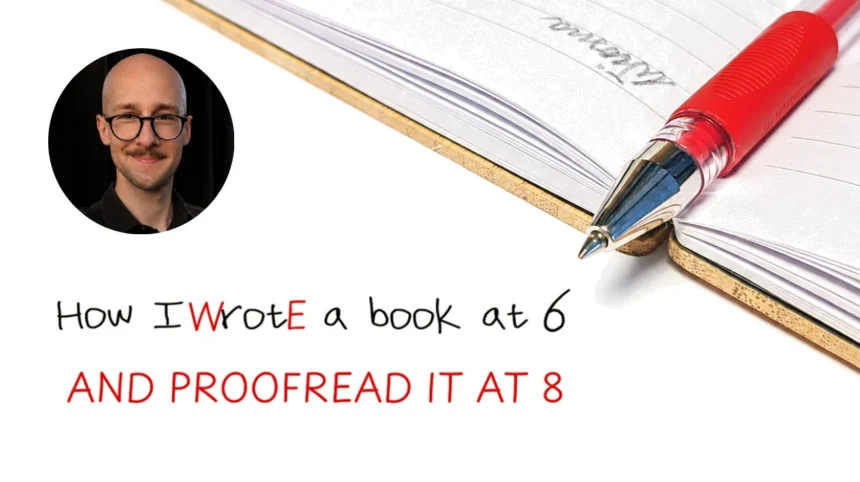
Polish-British autistic writer-performer Maks Marzec, based in Forest Hill, London, is crowdfunding £33,500 to develop How I WrotE a book at 6 AND PROOFREAD IT AT 8, a new 60-minute bilingual Polish-English theatre piece being created with an autistic and neurodivergent team. The work asks what changes when autistic perception begins to shape the form of theatre itself.
Conceived as a one-person story carried by two bodies in an intimate black-box space, the production moves between the playful, sensory logic of childhood and the increasingly controlled world of the masked adult. Clouds, ants, language slips and sudden physical humour sit beside moments of sensory and emotional pressure. Through Polish, English, movement, sound, light, bells, applause, silence and the quiet journey of a red pen, the piece stages the process by which a person learns to pre-correct themselves before anyone else can.
Maks Marzec said:
“The starting point is a small childhood story that changed meaning after my diagnosis. At six, I wrote a book. At seven, I started primary school, as you did in Poland back then. At eight, I went back through my book with a red pen and meticulously corrected every spelling and punctuation mistake. What had always seemed like a funny memory became a very precise image of masking: joy first, then correction, then the habit of editing yourself before anyone else can.
A lot of autistic masking gets mistaken for ease. From the outside, you may look fluent, capable and calm. Inside, you are constantly calculating what is safe to say, how to move, how quickly to recover and how much of yourself can enter the room. For me, that has also been shaped by language and migration. Moving between Polish, English, German and Mandarin Chinese, and learning to pass as almost native in Britain despite moving here at eighteen, taught me how easily belonging can become a performance.
The question is no longer simply how autism can be represented on stage, but what theatre becomes when its structures, pressures and rules grow out of autistic ways of attending to the world. The piece is built from language, rhythm, numbers, pressure, humour, silence and the body. We are crowdfunding because this kind of work needs proper time, proper care and a team who can build it from the inside.”
At a time when more neurodivergent stories are reaching stages and screens, the project asks whether representation alone is enough. Rather than simply explaining autism on stage, it places the audience inside systems of attention, correction and pressure. Bells condition the space, applause shifts from praise to demand, silence becomes active, and spectators are gradually made aware of their own habits of looking. At its heart, the piece asks who is still expected to mask, who gets called difficult and why the work of adjustment so often falls on the person already doing the most invisible work.
Running underneath the spoken story is an alternative score made of numbers, repetitions, bells, letter-counts, slips and near-patterns. It is designed to be felt by everyone, while offering a particular private joy to viewers who notice patterns, count instinctively or find meaning in structure. The maths is not homework and not a puzzle to solve. It is another sensory language in the room, making autistic attention, pattern-recognition and almost-correctness theatrical.
The project began without institutional backing or a pre-existing producing structure. Returning to theatre after years working across language, teaching and interpreting, Maks sent the script directly to theatre-makers who openly identify as autistic or neurodivergent, none of whom he had previously met. The script resonated, bringing together an experienced group of practitioners, including award-winning and award-nominated artists working across direction, performance, choreography, sound, lighting, access and stage management. The framework has been built patiently through direct conversations, trust and shared artistic recognition.
The campaign will fund rehearsal R&D, sensory dramaturgy and access work, technical development, documentation and at least three free London development previews, held by invitation, in 2026. The previews will allow the team to test and calibrate the work with autistic viewers alongside wider audiences, document the process and prepare the piece for future festival and touring conversations in 2027.
The budget is designed around fair professional pay. Around 75% goes directly to professional fees at Equity rates. The remaining funds support rehearsal and preview space, technical development, props, costumes, audience materials, insurance and essential running costs.
Megan Brewer, Co-Artistic Director of Halfpace Theatre and the project’s Associate Director, said:
“Making this kind of work is a radical act in a world determined to push disabled and neurodivergent communities to the margins. This show is, as all good theatre should be, simultaneously entertaining and urgent.”
Daisy Simmons, lighting designer, said:
“I think there is a very big misconception around autism that it is always external and ‘loud’. With this piece, it is the power of patterns and subtleties that means the most to me.”
Abi Turner, working on sensory dramaturgy and access, said:
“There aren’t many projects that show the autistic experience in a way that is so real and honest, while also intending to stay responsible when it comes to the sensory experience of the play for audiences.”
Edalia Day, creator of the Crowdfunder animation, said:
“The script is a fascinatingly woven piece of art, exploring the interplay of numbers and storytelling in a way I’ve never encountered before. It’s a poetically rich tapestry of patterns and play and I’m really excited to see how it grows into a fully fledged show.”
Maks grew up in Lublin, an eastern Polish city shaped by theatre, music and festival culture that will be one of the two European Capitals of Culture in 2029. After studying Chinese Studies with German in Sheffield, he built a career across interpreting, language and teaching. He is now a Forest Hill-based Polish-British writer-performer, linguist and late-returning theatre-maker. His professional background includes mental health interpreting between English, Polish and Mandarin Chinese. Neurodivergent and gay, out in most spaces, his work explores language, borders, systems, foreignness, masking and the social labour of belonging.
How I WrotE a book at 6 AND PROOFREAD IT AT 8 is a compact, tourable piece designed for black-box and studio spaces. It may resonate particularly with autistic and ADHD adults, including people identified later in life or who have spent years masking, as well as disabled and neurodivergent artists, Polish, migrant and bilingual communities, LGBTQ+ audiences, and people interested in language, cognition and experimental performance. As a grassroots project being built from Forest Hill outward, it also hopes to involve South London residents who want to support ambitious new work made outside established institutional structures.
Through its live systems of repetition, self-monitoring, prediction, bilingual processing, conditioned response and audience interpretation, the work also creates entry points for conversations across cognitive science, psycholinguistics, communication, memory, learning, perception and social cognition, without presenting the performance itself as a formal research study.
The Crowdfunder campaign is live now. Supporters can make a pledge of any size, share the project or help it reach relevant communities and professional networks. People interested in attending a development preview or discussing the work from an artistic, community or interdisciplinary perspective are warmly invited to contact Maks at [email protected].
Campaign link: https://www.crowdfunder.co.uk/p/how-i-wrote-a-book-at-6-and-proofread-it-at-8