Key Points
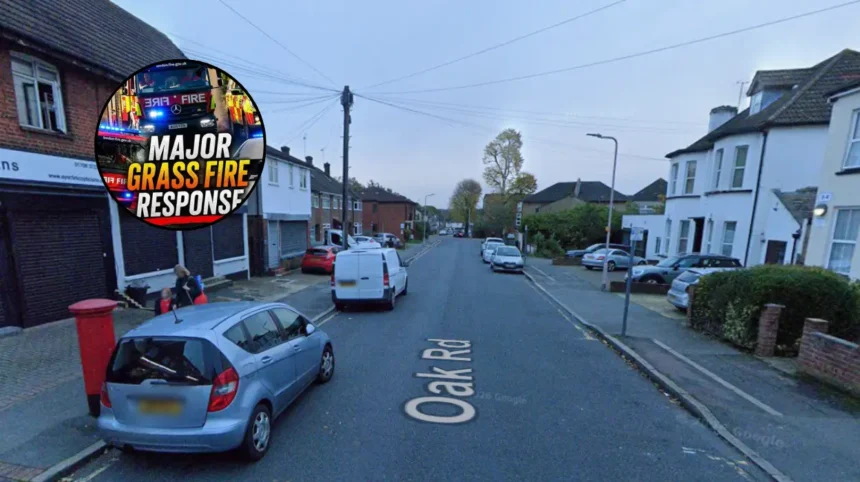
- Emergency Response: Eight fire engines and 60 or so firefighters have been dispatched to combat a serious grass fire close to Oak Road, Romford.
- Location & Environment: This fire was in a field belonging to a local farmer and produced dense columns of smoke that could be seen in the vicinity.
- Effect on Transport: Heavy smoke from this fire drifted to the nearby A12 carriageway, posing a hazard to motorists.
- Safety Message: London Fire Brigade suggested to nearby residents to close their doors and windows to prevent inhalation of the smoke and requested the public to steer clear of the area.
- Overall Context: This comes amidst an unprecedented increase in grass fires in the London Borough of Havering owing to high summer temperatures.
Romford (East London Times) August 6, 2026 – Eight fire engines and around 60 firefighters are currently tackling a major grass fire near Oak Road in Romford. As reported by journalist Francesca Lilleystone of The Havering Daily, the blaze is believed to have originated in a farmer’s field, producing dense plumes of smoke that quickly drifted across surrounding neighborhoods and major road networks. Emergency services were alerted as smoke conditions rapidly deteriorated in the vicinity.
- Key Points
- What Caused the Grass Fire Near Oak Road in Romford?
- How Are Firefighters Tackling the Blaze in Romford?
- What Safety Guidance Has the London Fire Brigade Issued to the Local Community?
- What Is the Background of Outdoor Grass Fires in the Havering Area?
- How Will This Development Affect Local Residents, Motorists, and Emergency Services?
Motorists travelling along the adjacent A12 carriageway reported seeing thick smoke rising from the open field, prompting immediate concern among local drivers and nearby residents. The London Fire Brigade (LFB) dispatched multiple crews to the scene to establish containment lines and prevent the fire from spreading toward adjacent properties or further along the roadway.
To ensure public safety while containment operations continue, emergency officials have issued operational guidance to the local community. Residents living near Oak Road and downwind of the blaze are strongly advised to keep all windows and doors closed to minimize smoke exposure. Furthermore, members of the public have been urged to avoid the immediate area to enable fire engines and emergency personnel to navigate local routes safely and carry out suppression efforts without obstruction.
What Caused the Grass Fire Near Oak Road in Romford?
As reported by Francesca Lilleystone of The Havering Daily, the fire broke out within agricultural land near Oak Road, where dried summer vegetation provided ample fuel for rapid ignition. Prolonged dry spells and elevated seasonal temperatures across East London left fields particularly susceptible to surface fires. While official investigations into the exact ignition source remain ongoing, fire officers note that even minor thermal triggers—such as discarded glass, unextinguished smoking materials, or hot agricultural machinery—can quickly ignite parched grassland under current weather conditions.
According to updates issued by the London Fire Brigade, emergency control rooms received multiple 999 calls from both local occupants and commuters on the A12 as smoke became visible from a considerable distance. Fire crews deployed hose reels, ground beaters, and specialized water distribution equipment to surround the perimeter of the field fire.
How Are Firefighters Tackling the Blaze in Romford?
According to statements released by the London Fire Brigade, around 60 firefighters utilizing eight fire engines were assigned to the Oak Road incident to establish control over the advancing fire front. Response teams were drawn from surrounding stations across Havering and neighboring East London districts to provide continuous suppression capacity.
Field fires present distinct operational challenges for emergency crews due to changing wind patterns, which can alter the direction of flame spread rapidly across open ground. Firefighters focused on creating defensive firebreaks around the boundary of the agricultural plot to prevent flames from encroaching onto nearby residential boundaries or transport infrastructure.
Explore More Romford News
Romford’s Most Expensive and Cheapest Streets Revealed for Romford 2026
Ofsted Warns Children at Risk at Good Shepherd Nursery, East London 2026
What Safety Guidance Has the London Fire Brigade Issued to the Local Community?
In official statements published by the London Fire Brigade, public safety officers highlighted essential precautions for residents living close to the incident site:
- Keep Windows and Doors Closed: Nearby households affected by smoke drift should seal external ventilation to protect indoor air quality.
- Avoid the Immediate Area: Drivers and pedestrians are instructed to stay clear of Oak Road and adjacent access routes to keep emergency lanes open for incoming fire appliances.
- Report New Sightings Promptly: Members of the public who discover uncontained outdoor fires should move to safety immediately and contact 999, utilizing location tools such as what3words to assist emergency dispatchers.
- Observe Fire Prevention Rules: The Brigade reiterates that disposable barbecues must not be used in open green spaces, cigarettes must be fully extinguished, and glass litter should be removed from open fields.
What Is the Background of Outdoor Grass Fires in the Havering Area?
As reported by Francesca Lilleystone of The Havering Daily, the incident near Oak Road comes during an unprecedented period of wildfire activity across the London Borough of Havering. Official figures published by the London Fire Brigade confirm that Havering has recorded the highest number of grass fires among all London boroughs during recent summer heatwaves. In a single week preceding this event, Havering experienced 47 distinct grass fire incidents, while neighboring Barking and Dagenham logged 16 incidents.
During the busiest 24-hour operational period for the Brigade, Control Officers answered more than 1,300 emergency calls across London, responding to over 218 calls specifically related to grass fires. Major incidents across Havering included a 15-engine fire in Rainham that destroyed four hectares of grassland, multiple blazes on Ingrebourne Hill damaging nearly five hectares, and separate major fires along Eastern Avenue, Southern Way, and London Road in Romford.
As reported by The Havering Daily, Assistant Commissioner Andy Pennick stated:
“The last 24 hours have been incredibly challenging for our firefighters, Control Officers and support staff, who have worked tirelessly in demanding conditions to keep Londoners safe. While we’ve been fully prepared to respond, the public has an important role to play in preventing fires from starting in the first place. In these hot, dry conditions, grass fires can spread incredibly quickly, threatening homes, wildlife and the environment, while tying up vital emergency resources.”
In response to the surge in incidents, Margaret Mullane, Member of Parliament for Dagenham and Rainham, publicly called for the establishment of an urgent multi-agency task force to address the growing threat of wildfires across Havering and coordinate local land management and emergency preparedness.
How Will This Development Affect Local Residents, Motorists, and Emergency Services?
The grass fire near Oak Road and the broader pattern of wildfire activity across Romford will have direct operational and practical impacts across several key stakeholder groups:
Impact on Local Residents
Nearby residents face immediate localized air quality deterioration from heavy smoke, requiring precautions for individuals with respiratory conditions such as asthma. In the longer term, the high frequency of grass fires in Havering heightens community concern over property safety along urban-rural boundaries, potentially influencing local council policies regarding land maintenance, perimeter clearing, and public space regulations.
Impact on Motorists and Transport Networks
Smoke reduction on key arterial routes such as the A12 creates sudden visibility hazards, leading to localized traffic congestion and potential speed restrictions imposed by transport authorities. Driver vigilance along rural-adjacent corridors will remain critical during dry periods to prevent secondary accidents caused by reduced visibility.
Impact on Emergency Services and Local Authorities
Responding to large-scale open land fires requires significant commitment of personnel and specialized equipment, including Terrain Support Vehicles. High incident volumes place extended operational strain on the London Fire Brigade’s regional capacity, reinforcing calls from local representatives like MP Margaret Mullane for dedicated task forces, stricter enforcement of open-fire bans, and improved agricultural boundary management across East London.