Key Points
- A Conservative councillor, David Taylor, filmed six individuals forcing their way through ticket barriers at Romford Elizabeth line station within a two-minute window.
- The footage, shared by Mr Taylor on Facebook, highlights the ongoing issue of fare evasion at transport hubs across East London.
- Mr Taylor called for the implementation of advanced camera technology capable of auto-detecting fare dodgers to alert police to their precise location.
- The councillor explicitly noted that the individuals he observed were diverse in age, gender, and ethnicity, countering potential assumptions about the demographic of fare evaders.
- This incident adds to a broader, ongoing public and political conversation regarding the frequency of fare dodging at London transport network stations.
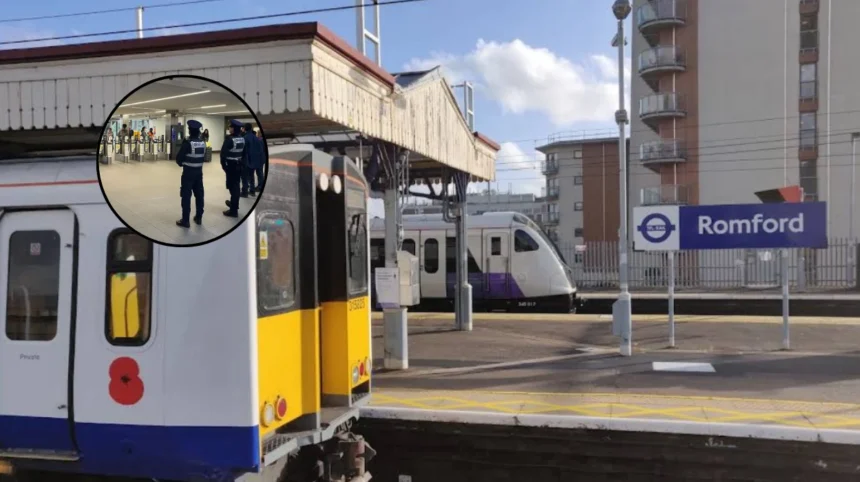
Romford (East London Times) May 5, 2026 Councillor David Taylor observed six individuals forcing their way through ticket barriers at the Romford Elizabeth line railway station in a two-minute period on Wednesday, April 29, 2026, while waiting for a friend.
As reported by David Taylor on his personal Facebook page, the councillor captured video footage of the individuals bypassing the station’s wide ticket gate to avoid paying the required fare. In his social media commentary accompanying the footage, Mr Taylor stated,
“Six people in just two minutes, everyone obvious as anything and not bothering to hide their faces”.
Why is the issue of fare evasion a growing concern for local representatives?
Mr Taylor, who serves as a councillor for Havering Council, expressed significant frustration regarding the ease with which individuals were able to bypass the payment system.
“Our area should not be allowed to be a safe space for criminals,”
Mr Taylor wrote in his Facebook post. He advocated for the deployment of advanced surveillance technology, specifically calling for “cameras that auto detect this stuff” to notify the police of an offender’s location in real-time.
Addressing the potential for public misinterpretation of his video, Mr Taylor stated that he had “thought more than twice before sharing, given the ethnicities of those on the video, and the high likelihood of it attracting racists to comment”. He maintained that it was vital not to “censor ourselves out of fear”. To provide context on the scope of the behavior, he clarified that his observations were not limited to one group; he noted witnessing similar gate-jumping actions by
“white, black, mixed, Asian… men and women, younger and older”.
Furthermore, he observed this behavior occurring across various groups, including
How does this incident compare to wider trends of fare evasion in London?
The issue of fare evasion on London’s rail and underground network has been a subject of significant political and operational debate for several years. In May 2025, as reported by the Telegraph, Shadow Justice Secretary Robert Jenrick garnered national attention after he filmed himself confronting fare dodgers at Stratford station to highlight what he described as “out of control” lawbreaking.
During that event, Mr Jenrick challenged individuals forcing their way through barriers and expressed dissatisfaction with the response of enforcement staff at the scene, referring to the situation as a
Transport for London (TfL) has previously advised staff not to intervene in such incidents if it is not safe to do so, emphasizing that staff are trained to assist customers in ensuring they pay the correct fare and to encourage appropriate “tap in and out” behaviors.
In separate reports, TfL has highlighted instances where long-term evasion resulted in significant unpaid balances, such as an individual who was found to owe over £3,500 due to persistent payment failures.
Meanwhile, rail operators like c2c, which operates services passing through stations in East London such as West Ham, have actively targeted fare evasion to recover lost revenue.
According to c2c’s own reports from early 2025, the operator successfully recovered nearly £600,000 from fare evaders over a record year. Their enforcement efforts have frequently targeted “short ticketing”—where passengers travel beyond the station their ticket is valid for—with several individuals caught owing thousands of pounds in evaded fares.
What is the background of this development?
Fare evasion in the London transport network remains a persistent operational challenge, particularly at high-traffic stations in the East London corridor. The configuration of some stations, which allow for interchanges between national rail services and the London Underground, has historically made them hotspots for evasion due to the absence of consistent gating.
Operators and transport authorities have frequently adjusted their revenue protection strategies, ranging from the deployment of physical barriers to increased checks by rail enforcement officers and the pursuit of repayments for persistent offenders. The intersection of these operational realities with public discourse—often led by local representatives—has kept the topic of barrier security and fare enforcement at the forefront of public transport management in the capital.
How could this development affect commuters and station operations?
The increased public visibility of barrier-jumping incidents, underscored by the actions of figures like Councillor David Taylor and Robert Jenrick, is likely to apply sustained pressure on transport operators and local government to invest in more robust anti-evasion infrastructure. For the average commuter, this may result in a more visible presence of revenue protection officers and potentially stricter enforcement of gate protocols, which could slow down passenger flow during peak hours.
If authorities adopt the suggested auto-detection camera technology, it could lead to more frequent automated fines or notifications sent to passengers who fail to tap in or out correctly. However, such measures also raise ongoing questions regarding the balance between security, privacy, and the operational costs of maintaining and monitoring these automated systems, particularly as TfL and rail operators balance revenue collection against the safety of station staff.