
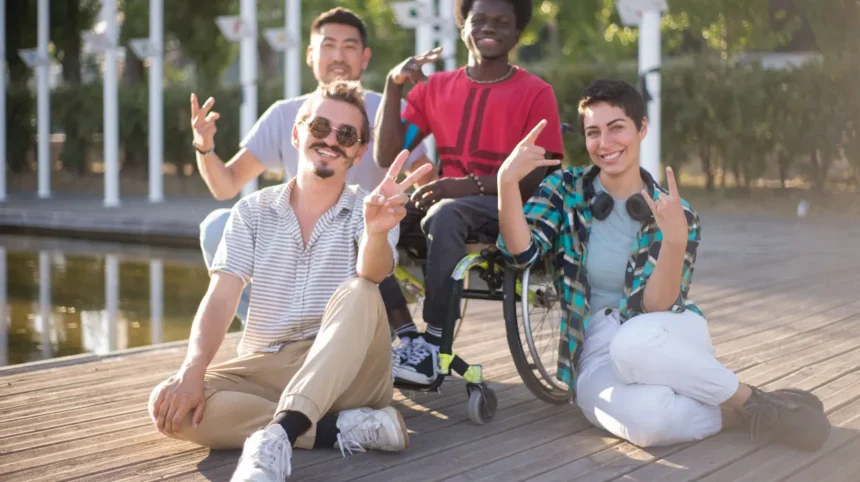
For years, diversity has been celebrated as one of the defining features of modern societies. Our cities are becoming more multicultural, workplaces bring together people from different backgrounds, and migration has connected communities across borders.
But there is a question that deserves more attention: Is diversity alone enough?
A society can bring together people of different nationalities, cultures and religions and still leave some of them feeling excluded. People may live in the same neighbourhoods, study in the same schools and work in the same companies without necessarily feeling that they share the same opportunities or the same sense of belonging.
This is why the next stage of the global conversation should move beyond diversity and focus on belonging.
The distinction is important.
Diversity describes the people who make up a society. Inclusion asks whether they are able to participate. Belonging goes one step further: do people feel that they genuinely have a place in the society and a stake in its future?
The scale of the challenge is global.
According to the United Nations’ 2026 Sustainable Development Goals reporting, nearly one in five people worldwide report experiencing discrimination within the previous 12 months. Race, colour, ethnicity and socioeconomic status are among the most commonly reported grounds. People with disabilities face particularly high levels of discrimination, with reported rates up to two or three times those of the population as a whole.
These numbers should concern policymakers not only because discrimination is a human-rights issue, but because exclusion also has economic consequences.
When people cannot access education, employment or opportunities on equal terms, societies risk wasting part of their human potential.
The economic question behind inclusion
The debate about migration and diversity is often framed in political terms. Yet there is another question that deserves equal attention:
Are economies making full use of the people who already live and work within them?
The OECD reported that in 2024 almost 77% of immigrants in OECD countries were economically active, while about 70.9% were employed. The employment rate for the native-born population was 72.1%.
These figures show that immigrants are already an important part of the labour force.
But employment alone does not necessarily mean economic integration.
A person can have a job while working well below their qualifications. A skilled professional may spend years unable to use the education and experience they gained before moving to another country.
That is where the economic cost of exclusion becomes more visible.
An OECD study covering 15 countries found that immigrants entering the labour market earned, on average, 34% less than native-born workers of the same age and sex. About two-thirds of that gap was linked to immigrants working in lower-paying sectors and firms. After five years, the gap fell to around 21%.
The numbers suggest something important: integration is not simply about getting people into work. It is also about whether they can progress.
Recognition of qualifications, language skills, professional networks and fair access to career opportunities can determine whether a person’s potential is fully used.
Belonging is a two-way process
There is sometimes an assumption that integration is mainly the responsibility of newcomers.
Learning the language, respecting the law and participating in society are clearly important. But integration cannot succeed if institutions and communities do not also create genuine opportunities for participation.
Can a foreign qualification be recognised?
Can an applicant with an unfamiliar name receive the same opportunity as another applicant?
Can young people from immigrant families see themselves represented in professional and civic life?
Can someone maintain elements of their cultural identity while still feeling completely part of the country in which they live?
These are not questions that governments can answer through immigration policy alone.
They involve schools, employers, local authorities, communities and individuals.
The OECD increasingly treats integration as a broad process involving employment, education and skills, living conditions, civic engagement and social integration.
That approach reflects a simple reality: integration happens in everyday life.
The next generation will be the real test
Perhaps the most important measure of successful integration will be the experience of the children of immigrants.
For many of them, the country where they were born or educated is simply home. Their family may have roots elsewhere, but their friendships, education and ambitions are connected to the society around them.
If they have equal access to opportunity, they can become bridges between communities and generations.
If they repeatedly encounter barriers, however, the consequences may extend beyond individual disappointment. Persistent exclusion can weaken trust in institutions and make social divisions harder to overcome.
That is why integration should be considered a long-term investment.
It is not only about responding to migration today. It is about deciding what kind of society future generations will inherit.
Diversity without division
There is no reason why a diverse society should require everyone to have the same culture, language, religion or traditions.
The goal should not be uniformity.
A strong society can accommodate differences while maintaining shared principles: equality before the law, respect for others, freedom, responsibility and the opportunity to build a future.
This balance is particularly important in an era when debates about migration and identity can quickly become polarised.
If diversity is presented as a threat, communities may become defensive.
If diversity is presented as automatically beneficial, policymakers may ignore the real challenges of housing, education, employment and social cohesion.
A more mature approach lies somewhere between the two.
Diversity brings possibilities, but institutions determine whether those possibilities become reality.
From diversity to belonging
The world is not becoming less diverse.
Migration, education, international business and technology will continue to connect people across borders. The question is therefore not whether diverse societies will exist.
They already do.
The real question is whether they can build systems in which different groups have a fair opportunity to participate, contribute and progress.
This requires governments to protect rights, employers to recognise talent, schools to create opportunity and communities to build trust.
It also requires individuals to accept that integration comes with responsibilities as well as rights.
Perhaps the most useful way to think about the issue is this:
Diversity tells us who lives together. Inclusion tells us who gets to participate. But belonging tells us whether people believe they truly have a place in the future.
That may ultimately be the real test for modern societies.
Not whether people are different.
But whether those differences can exist alongside a shared belief that everyone has a fair chance to contribute to — and benefit from — the society they call home.