Key Points
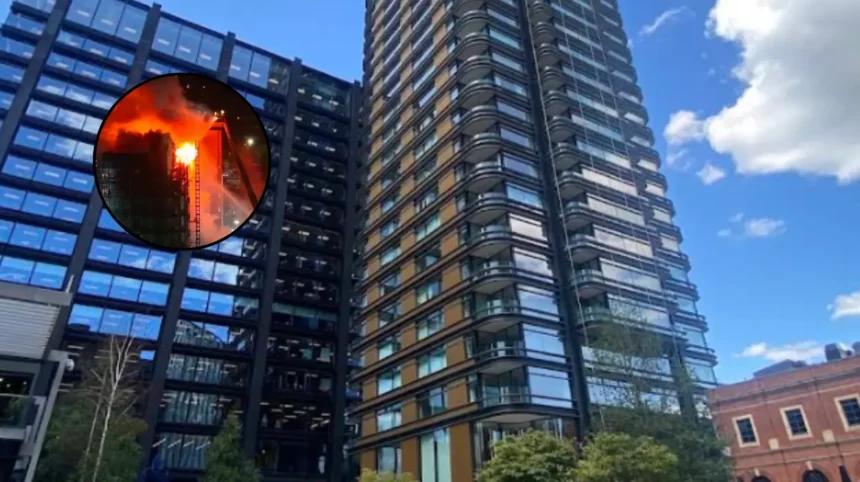
- Fire erupted on the eighteenth floor of a tower in Poplar, east London.
- There were 10 fire engines and about 70 firefighters sent to deal with the blaze.
- The fire was successfully limited to the particular flat on the eighteenth floor of the building, and no other units caught fire.
- Residents of the upper levels of the building were evacuated safely by emergency services.
- Teams of medics from the London Ambulance Service arrived at the scene to examine the health condition of residents and provide treatment if necessary.
- So far there have been no casualties due to the fire according to emergency services.
- An investigation has been launched in order to find out what caused the fire.
East London (East London Times) September 12, 2026 – Emergency services were called to a high-rise residential structure in Poplar early this morning after a fire erupted on the eighteenth floor. Approximately 70 firefighters using 10 specialized appliances responded to the scene, quickly surrounding the property to mitigate the spread of smoke and flames. London Fire Brigade crews executed targeted interior search-and-rescue protocols, bringing the fire under control and preventing it from extending to neighboring flats within the high-rise complex.
- Key Points
- What Triggered the Early-Morning Poplar Tower Fire Emergency?
- Were Any Residents Injured During the High-Rise Evacuation?
- What Measures Are Authorities Taking to Investigate the Cause?
- Background of the East London Residential Tower Incident
- Prediction: How Will This Incident Affect Tower Block Residents and Property Safety Standards?
What Triggered the Early-Morning Poplar Tower Fire Emergency?
The incident began in the early morning hours when emergency dispatch centers received multiple 999 calls from occupants and surrounding neighbors reporting heavy smoke issuing from the upper levels of the residential block in Poplar. Operational response teams dispatched units from neighboring stations across east London, setting up a perimeter around the building to manage both access and safety.
First-responding crews faced dense smoke logging on the upper levels as they ascended the interior stairwells with equipment. Firefighters established a bridgehead several floors below the incident floor to coordinate the hose line deployment and monitor breathing apparatus entry. The fire was successfully contained to the single eighteenth-floor flat where the outbreak originated, avoiding structural compromise to the exterior cladding or adjacent units.
Were Any Residents Injured During the High-Rise Evacuation?
During the height of the response, firefighters guided multiple residents from the affected floor and upper levels to safety using established high-rise evacuation procedures. Ground-level triage areas were immediately set up by the London Ambulance Service, with Hazardous Area Response Teams deployed to support the operation.
Paramedics evaluated several individuals at the scene, primarily for mild smoke inhalation resulting from transit through smoke-filled corridors. Reports confirmed that no individuals sustained life-threatening injuries, and no fatalities occurred as a result of the incident. Medical crews cleared the majority of residents at the scene without requiring emergency hospital transport.
What Measures Are Authorities Taking to Investigate the Cause?
With the main body of the fire fully extinguished, fire crews remained on site to damp down hot spots and carry out thermal imaging assessments across surrounding walls and ventilation shafts. Specialised fire investigation officers have entered the premises to conduct a systematic analysis of the point of origin within the eighteenth-floor flat.
Local council representatives and housing managers arrived on scene to assist displaced residents with immediate welfare needs, including temporary shelter and access to essential supplies. The local authority confirmed that building safety checks, including structural integrity and utility safety inspections, are being conducted before allowing residents to return to their homes.
Background of the East London Residential Tower Incident
High-rise residential safety remains a critical priority for emergency services and local councils across London. Following regulatory overhauls across the United Kingdom, fire brigades employ updated operational tactics specifically designed for fires above the seventh floor. These procedures emphasize rapid containment, designated staging areas within fire-protected stairwells, and specialized high-reach aerial appliances.
Poplar, situated within the London Borough of Tower Hamlets, features a dense concentration of modern and refurbished residential towers. Incidents in high-density developments require immediate deployment of large-scale resources to ensure compartmentation—the structural design feature intended to keep fires contained within the flat of origin—remains intact while evacuations take place.
Prediction: How Will This Incident Affect Tower Block Residents and Property Safety Standards?
This incident is expected to prompt an immediate review of building management protocols and safety compliance for high-rise properties across the borough. Tenants and owner-occupiers within the affected complex and neighboring developments will likely press for transparent safety reports detailing the operational status of internal fire suppression systems, compartmentation barriers, and alarm systems.
For the broader audience of high-rise residents across east London, the event will reinforce calls for rigorous inspection regimes regarding fire doors, communal area clearance, and evacuation guidance. Local housing authorities and private developers may face heightened scrutiny to provide updated safety documentation, while emergency services will use data gathered from this response to refine tactical approaches for high-rise incidents in dense urban areas.