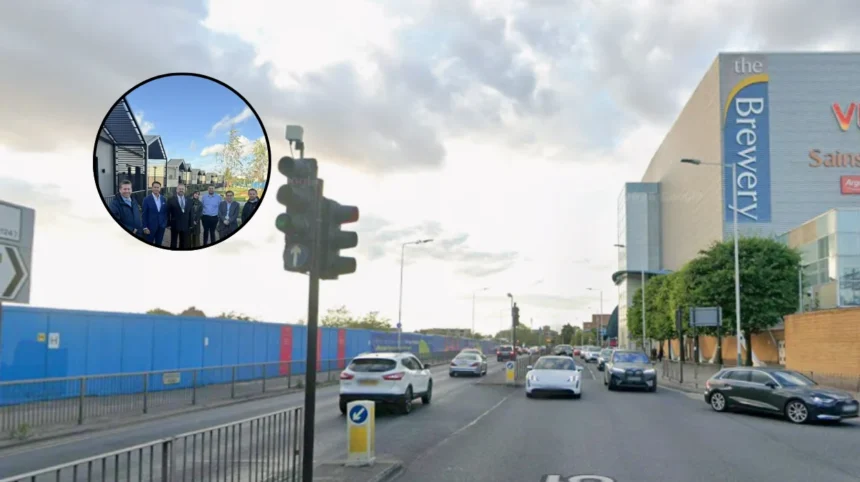
Key Points
- Cabinet Members for Havering Council conducted an official site visit to newly completed modular homes situated at the Waterloo Road and Queen Street development.
- Councillor Robert Whitton and Councillor Martin Lardner inspected the properties alongside Joint Venture Partner Wates Residential representatives Joe Arthur and Paul Nicholls, together with council regeneration officers.
- The development offers immediate accommodation for local Havering families currently experiencing homelessness, allowing them to remain within the borough.
- The project forms a central part of Havering Council’s strategy to diminish reliance on costly hostel and temporary housing options.
- Construction across the broader site continues, with progress reported on the development of Blocks 9 and 10.
Romford (East London Times) September 12, 2026 – Councillors from Havering Council recently conducted a formal site inspection of the newly completed modular accommodation located at Waterloo Road and Queen Street to inspect the facilities before local residents begin moving into the properties over the coming weeks. The visiting delegation included Councillor Robert Whitton, Cabinet Member for Regeneration, and Councillor Martin Lardner, Cabinet Member for Housing Need. They were joined on-site by Joe Arthur and Paul Nicholls, representing Havering Council’s Joint Venture Partner, Wates Residential, alongside dedicated regeneration officers from the local authority.
The primary objective of the residential project is to provide high-quality accommodation for Havering families currently facing homelessness. By bringing these modular units into service, the local authority aims to ensure that vulnerable residents gain immediate access to safe, secure, and modern housing during periods of critical need.
Beyond addressing immediate emergency housing demands, the modular build initiative forms part of a broader strategy by Havering Council to reduce financial expenditure associated with temporary accommodation. The council has actively sought to curb its reliance on expensive private hostel arrangements and short-term placements, which place a significant burden on municipal budgets.
How Do the New Modular Homes Benefit the Local Havering Community?
The implementation of the modular homes allows displaced families to remain within the boundaries of the borough rather than being relocated outside their familiar municipal areas. Staying localized ensures that residents maintain direct proximity to their established support networks, local community hubs, and employment opportunities, whilst children can continue attending their current schools without interruption.
From a design and construction perspective, the modular units have been engineered to deliver comfortable and contemporary living environments. The off-site construction method provides a more sustainable, energy-efficient, and cost-effective solution to long-term housing requirements compared to traditional build methods or emergency commercial lets.
During the visit, municipal leaders and project directors also reviewed the general progression of the wider Waterloo Road and Queen Street master project. Official updates confirmed that construction activities on the adjacent Blocks 9 and 10 are advancing according to plan.
What is the Background of the Waterloo Road and Queen Street Development?
The delivery of modular housing at Waterloo Road and Queen Street represents a specific phase within Havering Council’s long-term borough-wide regeneration program. Over recent years, local authorities across Greater London have faced mounting pressure regarding the availability of affordable housing and the escalating costs of temporary emergency placements for families in distress.
To address these systemic housing shortages, Havering Council formed a strategic Joint Venture partnership with Wates Residential. This partnership was established to redevelop existing municipal land and deliver mixed-tenure housing, modern community spaces, and affordable accommodation options across multiple urban sites. The Waterloo Road and Queen Street location forms a key component of this multi-million-pound urban renewal framework, replacing outdated housing stock with modern, high-density residential structures.
The introduction of modular construction techniques within this master plan reflects a shift toward modern methods of construction (MMC). Modular housing involves constructing structural units within a controlled factory environment before transporting and assembling them on-site. This technique reduces overall construction timelines, minimizes local disruption, and lowers initial capital costs compared to conventional brick-and-mortar builds, enabling local authorities to bring emergency housing online more rapidly.
What is the Future Prediction for Havering Council and Local Residents?
The completion and upcoming occupation of the modular homes at Waterloo Road and Queen Street are likely to yield measurable impacts for both Havering Council and the surrounding community.
Financial Consequences for Municipal Budgets
For Havering Council, the integration of council-owned modular units will lead to an immediate reduction in revenue outflow directed toward third-party temporary accommodation providers and hotel operators. By transitioning families into managed modular stock, the local authority will retain greater control over housing management expenditure, potentially freeing up capital resources for other public services and future regeneration projects across the borough.
Social Impact on Local Families and Services
For local residents and families experiencing housing disruption, the development provides enhanced residential stability. Remaining in Havering prevents the educational fragmentation often experienced by children who are displaced to alternative local authorities. Furthermore, local health services, social care teams, and community organisations will be able to maintain uninterrupted support to vulnerable households, reducing the secondary social costs associated with homelessness and displacement. As work on Blocks 9 and 10 continues to progress, the completed site is expected to set a operational precedent for how Havering manages housing shortages over the coming decade.