Brent is above $100 again, petrol is at a four-year high, and the biggest IPO in history is sprinting to price before 3 November. Fifty days out, most of the market is being quietly arranged around one American date.
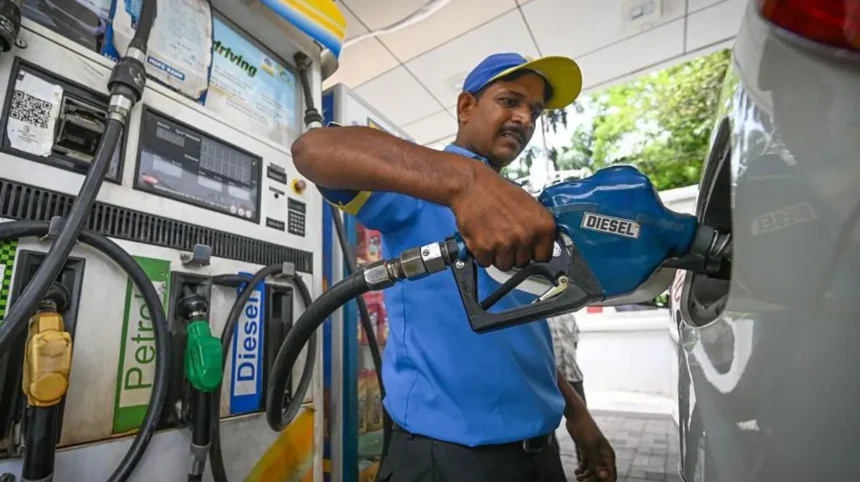
Term started this week, which meant driving to campus, which meant my first proper look at the forecourt in a while. 174p a litre. Yes, you read that correctly. I filled up anyway, because petrol is the textbook case of inelastic demand: you can hate the price and you still need to be in Birmingham by nine.
The national average is 169.5p. London runs above it, because of course it does. The slope is the real story, though: up 4.9p in a week, 8.3p in a month. Diesel has cleared 191p. Petrol is now at its highest level since September 2022, a year this country remembers the way you remember a bad landlord.
Proximate cause, straightforward enough. Brent has pushed above $100 as the US-Iran conflict flared again and Hormuz traffic thinned. The RAC wants the Chancellor to freeze fuel duty rather than let it rise in January from 52.95p a litre. The Bank of England has flagged upside inflation risk, which is central-bank for we would rather not.
The less obvious cause is an American election in seven weeks.
What Midterms Actually Do to Markets
Less than you’d think, and not in the direction you’d guess.
Since 1974, the S&P 500 has returned an average of 1.7% between 1 August and midterm election day. Then it rallies: 5.7% in the three months after, positive in 11 of the last 13 cycles. Since 1950 the average one-year return following a midterm is 15.4%, roughly double a normal year.
The mechanism isn’t partisan. Markets don’t reward a winner, they reward an answer, and they’ll take a disappointing answer over an open question every time.
The setup looks clear enough: Democrats modestly favoured for the House, Republicans with an edge in the Senate, pointing to a divided government. The old line is that markets love gridlock, which may be the only functional relationship in Washington.
Morgan Stanley makes the better point. The executive branch drives what actually matters to investors now, trade policy, tariffs, sanctions, Iran. Congress flipping changes the oversight hearings. It doesn’t change who decides whether to hit Kharg Island.
What’s odd this year is the gap between the claim surface and the nerves underneath. The St. Louis Fed’s Economic Policy Uncertainty Index ran at more than eight times its long-term average earlier this year. Equities have shrugged it off, which is either resilience or complacency. Ask me in a quarter.
The Bit Worth Being Suspicious About
Cheap petrol is the most politically sensitive number in American life. It’s printed in metre-high digits on every corner, and unlike wages or rents, it updates daily. No incumbent wants it climbing in October.
Which produces a contradiction. The administration has been escalating with Iran, and escalation spikes crude. It has also insisted, repeatedly, that prices will fall and there’s a glut. Both messages have moved the market inside the same news cycle more than once this summer. Buy the rumour, sell the ceasefire, then buy the rumour again on Thursday.
Not a conspiracy, I don’t think. Just a president with two incompatible objectives and seven weeks to reconcile them, which is a far more ordinary and more forecastable thing. My expectation: louder de-escalation noise going into November whether or not anything actually de-esculates. Talks announced. Waivers hinted at. Something to put on a forecourt sign.
The oil majors, meanwhile, are having a marvellous year. Funny how that keeps happening.
Dealmaking Has Split in Two
Global M&A value in Q1 was up nearly 10% on 2025, the strongest first quarter since 2021. Volume was flat. Fewer deals, bigger tickets.
The split underneath is the interesting bit. Corporate M&A volume surged 22% year on year while, private equity volume fell 11%. PwC calls it two lanes: large thesis-driven transactions surging, the middle market waiting for a catalyst. Their analysts name the culprits directly, volatile input costs from the Iran war and uncertainty around Hormuz, on top of inflation keeping rates high.
Makes sense. M&A is fundamentally an act of modelling, and you cannot build a five-year model when your energy input moves 20% on a headline. Corporates with balance sheets and a strategic imperative press on. Sponsors, who need cheap debt and a visible exit, sit on their hands. All that dry powder is doing an awful lot of sitting.
One dealmaker described the current market as a rebound with discipline, a long way from the loose standards of 2021. Having seen what 2021-vintage deals did to returns, discipline sounds fine.
Expect a Q4 unclog. 63% of dealmakers already expect activity to rise in the second half, and the clarity effect applies to boardrooms as much as trading floors. The deals being quietly papered now get announced in the fortnight after 3 November.
And the Trillion-Dollar Sprint
Yesterday, Business Insider reported that Anthropic has picked Nasdaq for a listing it hopes to complete in October. Morgan Stanley and Goldman lead, JPMorgan and reportedly Citi in the syndicate. Last priced round was a $65 billion Series H in May at a $965 billion post-money valuation. The number now being briefed is $2 trillion, which would need another doubling, and which the reporting is careful to note isn’t finalised.
Watch the calendar. Prospectus last September, marketing mid-October, pricing potentially days before the vote. Prediction markets put roughly 60% on a listing by Halloween.
That timing isn’t an accident. You want the largest IPO in history landing in post-summer liquidity and pre-election optimism, not in whatever the first week of November serves up. Nothing says conviction like scheduling your trillion-dollar debut before anyone has to find out what happens next.
It’s also a bet that the AI trade survives an oil shock, an inflation scare and a contested election simultaneously. I’ve argued we’re not in an AI bubble in the 2000 or 2008 sense. This is where that view gets marked to market.
The Climate Contradiction
Every pound of that 174p is an argument for electrification. An electron doesn’t need a visa, a tanker or safe passage through a strait. The case for the transition, stripped of the moralising, is simply that it removes a chokepoint from your economy, and Hormuz is demonstrating the point free of charge.
Yet the political response to expensive petrol is always to make petrol cheaper. The RAC wants duty frozen. The chancellor will probably oblige, because raising it in January with prices at four-year highs would be electoral self-harm. A duty freeze is, in substance, a fossil-fuel subsidy. We’ve had them near-continuously since 2011, which makes this the longest-running temporary measure since income tax.
So the crisis that best proves why we should electrify reliably produces the policy that makes electrification less attractive. The transition is measured in decades. The electoral cycle is measured in Tuesdays. Nobody designed this, and I don’t have a clear answer, but noticing it is probably a prerequisite for anyone finding one.
From Here
East London feels this first. A lot of people here drive for a living, and the margin between a shift being worth doing and not is a few pence per litre. The Newham delivery driver has no hedge against the Strait of Hormuz, and the pass-through from crude to pump takes about a fortnight.
Predictions, held loosely. Louder de-escalation signalling from Washington into November, substantive or not. Crude drifting back into the eighties by late October. UK pump prices lag, so 170p-plus persists into November. Duty frozen at the Budget. The M&A pipeline stays jammed until the vote, then releases hard. Anthropic lists in October rather than waiting, and prices below the $2 trillion being briefed.
Then the usual pattern: a dull, twitchy six weeks, followed by a relief rally the moment there’s an answer.
None of which has much to do with whether the underlying economy is sound. It has to do with when a few hundred thousand people in five or six American states decide who they’re annoyed with. I paid 174p this morning because of a waterway I’ll never see and an election I can’t even vote in. Not a complaint. Just worth knowing what you’re buying.