Tower Hamlets is one of East London’s most historically layered boroughs. It combines the Tower of London, Spitalfields, Brick Lane, Whitechapel, Victoria Park, the Docklands, Canary Wharf and the River Thames within one compact area. A well-planned day can combine heritage, food, markets, museums, parks and riverside walking without leaving the borough.
- What makes Tower Hamlets worth exploring for a full day?
- Where should you begin a Tower Hamlets sightseeing day?
- How should you explore Spitalfields and Brick Lane in the morning?
- What historical places should you see around Spitalfields?
- Where can you have lunch in Tower Hamlets?
- What should you see in Whitechapel and Stepney?
- When should you visit London Museum Docklands?
- How can you explore the historic docks around Limehouse and Canary Wharf?
- Should you include Victoria Park on a one-day Tower Hamlets itinerary?
- How can you organise the afternoon around your interests?
- What is the best way to travel around Tower Hamlets during one day?
- What should you see if you only have one day in Tower Hamlets?
- What makes Tower Hamlets different from central London sightseeing?
- How can you finish a Tower Hamlets day without rushing?
- What is the most practical one-day Tower Hamlets itinerary?
What makes Tower Hamlets worth exploring for a full day?
Tower Hamlets combines medieval heritage, East End culture, historic markets, museums, parks, docklands and modern architecture, making it possible to build a varied sightseeing day around walking, food, shopping and cultural attractions.
Tower Hamlets occupies a strategically important part of East London between the City of London and the eastern Docklands. Its southern boundary follows the River Thames, while areas such as Whitechapel, Stepney, Spitalfields, Bethnal Green, Bow, Poplar, Limehouse, Wapping and the Isle of Dogs create distinct urban environments.
The borough takes its name from the Tower of London and the hamlets historically associated with the Tower. Tower Hamlets Council describes the area as the heart of London’s East End and highlights its combination of historic and modern places.
The area has evidence of human activity stretching back thousands of years. Roman roads and burial grounds developed around the eastern edge of Londinium, while medieval settlement expanded around Stepney and other communities. Later, docks, factories, markets, railways and dense housing transformed the landscape.
For visitors, this history creates a practical advantage. Different periods of London’s development appear within short distances. A morning can focus on medieval and early-modern heritage, midday can centre on East End food and markets, and the afternoon can move towards the historic docks and Canary Wharf.
The best approach is to organise the day geographically rather than attempting to visit every attraction.
Where should you begin a Tower Hamlets sightseeing day?
Begin in the western part of Tower Hamlets around the Tower of London, Whitechapel or Spitalfields, then travel east towards the docks, Canary Wharf or Victoria Park according to your interests and available time.
The starting point should match your transport arrival point and the type of sightseeing you want to prioritise.
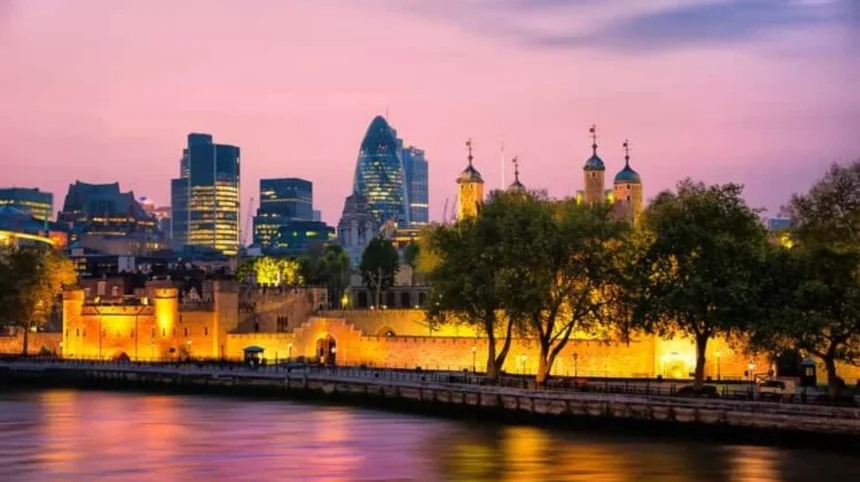
The Tower of London provides the strongest historical starting point. The medieval fortress developed after the Norman Conquest and became one of England’s most significant royal fortifications. Historic England identifies the Tower as a major listed historic site within Tower Hamlets.
Whitechapel provides a different introduction. It connects historic streets, religious buildings, markets, cultural institutions and the former London Hospital. Historic England records the London Hospital as a Grade II-listed building, with the original hospital building begun in 1751.
Spitalfields is another efficient starting point because several attractions sit close together. Christ Church Spitalfields, Old Spitalfields Market, Brick Lane and historic streets can be combined into a walking route.
Visitors arriving through Liverpool Street can also walk east into Spitalfields before continuing towards Brick Lane and Whitechapel. This creates a natural progression from the City fringe into the East End.
How should you explore Spitalfields and Brick Lane in the morning?
Spend the morning walking through Spitalfields and Brick Lane, combining Christ Church Spitalfields, historic streets, Old Spitalfields Market and Brick Lane Market before stopping for breakfast, coffee or an early lunch.
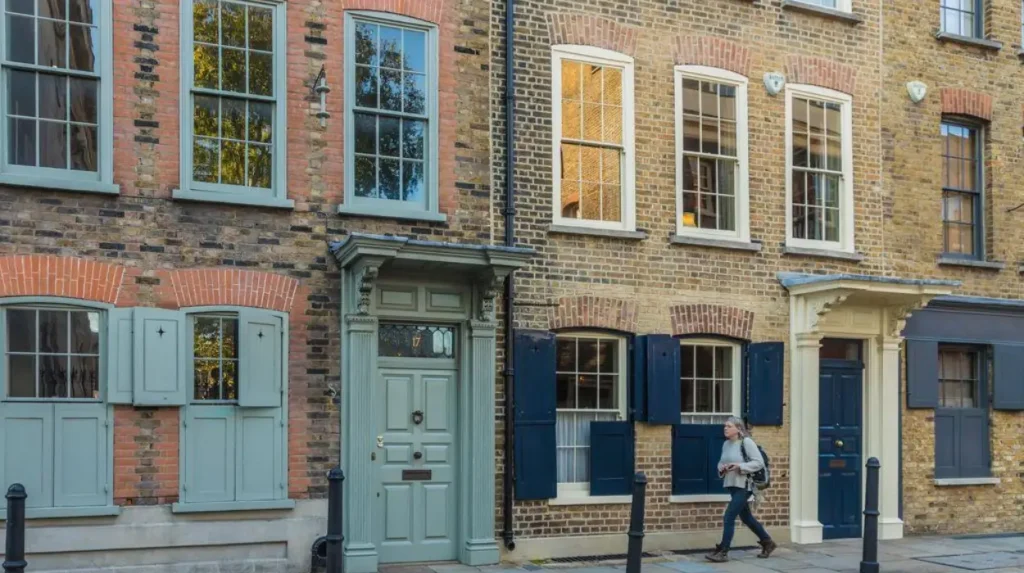
Spitalfields provides one of the clearest examples of Tower Hamlets’ layered social and architectural history.
Christ Church Spitalfields was designed by Nicholas Hawksmoor and built between 1723 and 1729. Its tower and spire remain prominent landmarks within the district. Historic England records the church as a listed building of architectural and historic interest.
The surrounding streets contain surviving Georgian buildings associated with the development of Spitalfields. The district also has important connections with Huguenot weavers and later Jewish and other immigrant communities. Historic England identifies archaeological evidence from Roman activity, medieval religious foundations, industrialisation and later urban development.
Brick Lane then provides a contrasting experience. The street is associated with markets, food businesses, independent shops, street art and the former Truman Brewery complex.
Visit London describes Brick Lane as a collection of markets operating during the week, with stalls and shops selling items including antiques, fabrics and collectables. The Old Truman Brewery now contains markets, restaurants, galleries, shops and food venues.
This area is particularly useful for travellers who want breakfast or coffee before beginning a longer walking route. Food choices reflect the district’s international history, while the streets themselves provide an accessible introduction to East London’s urban culture.
As you explore the modern streets, you are crossing land shaped by centuries of migration, trade and industry. Read about the full to understand its origins.
What historical places should you see around Spitalfields?
Prioritise Christ Church Spitalfields, Fournier Street, historic commercial buildings and the surrounding conservation area because they reveal how eighteenth-century development, immigration, religious communities and textile production shaped modern East London.
Fournier Street is particularly important for understanding eighteenth-century Spitalfields. Its architecture reflects the wealth created by textile production and the presence of skilled Huguenot weavers.
The district also demonstrates how London’s population expanded beyond the medieval City. Historic England notes that Spitalfields remained outside the Roman city and later developed through residential, religious and industrial activity.
The former Truman Brewery adds another industrial layer. Brick Lane itself originated partly through quarrying and brickmaking before later industries developed around the street. Historic England records the area as having archaeological potential associated with Roman, medieval, industrial and modern development.
The area also illustrates religious change. Brick Lane Jamme Masjid occupies a building that previously served as a French Protestant chapel and later a synagogue before becoming a mosque. Historic England records these successive uses as part of the building’s history.
This makes Spitalfields particularly suitable for a walking-based morning. Visitors do not need to rely entirely on ticketed attractions. Much of the historical character is visible in streets, façades, churches, markets and public spaces.
Where can you have lunch in Tower Hamlets?
Have lunch in Spitalfields, Brick Lane, Whitechapel or around the Docklands, where established restaurants, cafés, food stalls and international cuisines provide convenient choices between sightseeing stops.
Food is an important part of the Tower Hamlets experience because the borough’s East End identity developed through migration, trade and working communities.
Brick Lane is particularly associated with South Asian food businesses, while Spitalfields contains restaurants and cafés serving a wide range of cuisines. Visit London lists restaurants, pubs, cafés and food-related activities across Spitalfields.
Visitors with limited time should choose lunch close to the next attraction rather than travelling across the borough solely for a meal.
For a morning based around Spitalfields and Brick Lane, staying locally keeps the itinerary compact. After lunch, Whitechapel provides an easy continuation towards the historic docks or the eastern part of the borough.
A different option is to continue towards Canary Wharf and eat around West India Quay. This works particularly well for visitors who want to combine industrial heritage with modern architecture.
The important planning principle is to treat lunch as part of the route. Tower Hamlets is large enough that unnecessary cross-borough travel reduces sightseeing time.

What should you see in Whitechapel and Stepney?
Explore Whitechapel and Stepney for historic streets, religious heritage, cultural institutions and architectural landmarks that explain the development of the East End beyond the better-known tourist sites around the Tower of London.
Whitechapel has long functioned as an important gateway between the City and the East End.
The former London Hospital is one of its major historic buildings. The Grade II-listed structure began in 1751 and underwent later alterations and additions.
Whitechapel also connects with the wider history of immigration, religious communities, medicine, manufacturing and working-class neighbourhoods.
Stepney adds an older layer. The Church of St Dunstan and All Saints is one of the borough’s historic landmarks, with elements dating across several centuries. Historic England identifies it as a significant listed building.
The area works particularly well for visitors who prefer urban history to conventional tourist attractions.
Transport also makes Whitechapel useful as a mid-route location. Transport for London lists Whitechapel as an interchange between the District and Hammersmith & City lines, Elizabeth line and London Overground services.
This makes Whitechapel a practical place to shorten or extend an itinerary.
When should you visit London Museum Docklands?
Visit London Museum Docklands in the afternoon if you want to understand the history of London’s river, port and trade, particularly after exploring Spitalfields, Whitechapel or the historic East End.
London Museum Docklands occupies a historic warehouse at West India Quay.
The museum’s permanent galleries cover 400 years of Docklands history, including London’s river, port, trade and communities. Entry to the museum is free.
The museum provides important context for understanding why Tower Hamlets developed such a strong relationship with the River Thames.
The enclosed docks transformed London’s commercial geography. Tower Hamlets’ conservation documentation identifies the development of West India Docks and St Katharine Docks as major nineteenth-century changes. These docks improved the handling of cargo and supported the expansion of riverside trade.
The museum is therefore more than a standalone attraction. It explains the physical landscape visible around the Docklands.
Its location also makes it convenient for visitors continuing towards Canary Wharf. West India Quay sits close to Canary Wharf and is served by Docklands transport connections.
Check opening arrangements before travelling because museum hours and temporary exhibitions change.
How can you explore the historic docks around Limehouse and Canary Wharf?
Walk through the Docklands to see the relationship between historic warehouses, canals, dock basins and modern towers, using Limehouse, West India Quay and Canary Wharf as connected stages of Tower Hamlets’ waterfront history.
The Docklands reveal one of the most dramatic transformations in Tower Hamlets.
Limehouse and the surrounding waterfront developed through maritime trade, canals and industrial activity. The opening of the Limehouse Cut in 1770 created an important canal connection, while the nineteenth-century docks expanded the area’s role in international shipping.
The Regent’s Canal and Limehouse Basin also connected the Thames with the wider canal network. Tower Hamlets’ conservation strategy identifies the canal and dock infrastructure as important elements in the borough’s industrial development.
Canary Wharf represents a later transformation.
The historic dock system declined as shipping technology changed. Containerisation and larger vessels altered the requirements of London’s port infrastructure, contributing to the closure of traditional East London docks.
The former docklands subsequently became a major financial and commercial district.
Today, Canary Wharf provides a contrasting urban landscape of high-rise offices, public spaces, waterside routes, restaurants and transport infrastructure. The contrast between preserved dock structures and modern towers is one of the defining features of a Tower Hamlets itinerary.
Should you include Victoria Park on a one-day Tower Hamlets itinerary?
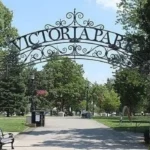
Include Victoria Park if you want open space, gardens, walking routes and a quieter break from dense urban sightseeing, especially when your itinerary includes Bow, Bethnal Green or the northern part of Tower Hamlets.
Victoria Park opened in 1845 and was designed as a public space for East London’s working population.
The park now contains gardens, sports areas, play facilities, a lake and landscaped spaces. Visit London identifies the Old English Garden, Floral Sunken Garden, Orchard Meadows and Burdett-Coutts Fountain Garden among its features.
The park is also historically significant. Historic England includes Victoria Park among Tower Hamlets’ important heritage sites.
For a one-day itinerary, Victoria Park is best treated as an alternative to the Docklands rather than an additional compulsory stop.
A visitor interested in architecture, maritime history and modern London should continue towards Limehouse and Canary Wharf.
A visitor seeking greenery, walking and community spaces should choose Victoria Park instead.
This choice prevents the itinerary from becoming overpacked.
How can you organise the afternoon around your interests?
Use the afternoon to select one major theme rather than attempting every attraction: choose Docklands for maritime history and modern architecture, Victoria Park for green space, or additional Spitalfields and Whitechapel stops for culture and heritage.
Tower Hamlets contains enough attractions for several days, so a one-day schedule requires prioritisation.
A history-focused itinerary can move from the Tower of London towards Spitalfields and then to London Museum Docklands.
A food-and-culture itinerary can spend more time around Spitalfields, Brick Lane and Whitechapel before continuing to the docks.
A green-space itinerary can combine East End streets with Victoria Park and the surrounding Bow area.
A modern London itinerary can focus on West India Quay and Canary Wharf after visiting one historic district.
This approach also benefits digital nomads and business travellers. Spitalfields, Canary Wharf and other commercial districts contain cafés, restaurants and public spaces that provide natural breaks between meetings or work periods.
However, sightseeing time should remain the priority. A one-day visitor gains more from selecting a coherent geographical route than repeatedly crossing the borough.
What is the best way to travel around Tower Hamlets during one day?
Use the Underground, Elizabeth line, Overground, DLR, buses and walking together because Tower Hamlets has a dense transport network that connects Whitechapel, Mile End, Bow, West India Quay, Canary Wharf and other districts.
Walking is the most useful transport method inside compact heritage areas such as Spitalfields and Brick Lane.
Public transport becomes more useful when moving between districts.
Transport for London lists District, Hammersmith & City, Central, Jubilee, Elizabeth line, DLR, Overground and bus connections serving different parts of the borough.
Whitechapel is particularly useful because it connects the District and Hammersmith & City lines with the Elizabeth line and London Overground.
Mile End provides connections between the Central and District lines, while West Ham connects District, Jubilee, DLR and National Rail services.
For a day trip, use walking for neighbourhood exploration and public transport for longer transitions.
Check Transport for London before departure for planned engineering works, temporary closures and live service conditions.
What should you see if you only have one day in Tower Hamlets?
Prioritise one western heritage cluster, one East End food or market area, and one waterfront or green-space destination to experience Tower Hamlets without spending the day travelling between disconnected attractions.
A balanced itinerary can begin around the Tower of London or Whitechapel.
Continue towards Spitalfields and Brick Lane during the morning. Explore Christ Church Spitalfields, historic streets and market areas before stopping for lunch.
After lunch, travel towards West India Quay and visit London Museum Docklands. The museum provides free permanent galleries covering the history of London’s port, river and Docklands.
Finish around Canary Wharf and the waterfront, or replace this section with Victoria Park if green space is more important to your plans.
This route provides several different aspects of Tower Hamlets without attempting to cover every neighbourhood.
Visitors with a strong interest in royal history can allocate more time to the Tower of London. Visitors focused on East End culture can extend their time in Spitalfields and Brick Lane. Visitors interested in industrial history can prioritise the Docklands.
What makes Tower Hamlets different from central London sightseeing?
Tower Hamlets provides a concentrated view of London’s transition from medieval fortress and historic East End communities to industrial docks, multicultural neighbourhoods, regenerated waterfronts and a global financial district.
The borough’s significance comes from the relationship between these different periods.
The Tower of London represents royal and military power.
Spitalfields represents migration, textile production, religion and eighteenth-century urban development.
Whitechapel represents medicine, migration, commerce and East End social history.
Brick Lane demonstrates the continuing influence of migration, food, markets and independent businesses.
The Docklands represent London’s international trading infrastructure.
Canary Wharf represents the later redevelopment of former dockland into a major business district.
Victoria Park represents the nineteenth-century expansion of public green space.
Historic England’s Tower Hamlets heritage resources document listed buildings and archaeological areas across these periods, from medieval sites to twentieth-century architecture.
This historical continuity gives the borough a clear identity within East London.
Explore More Area Guide
Tower Hamlets Travel Guide: East London Attractions Beyond Central London
East London Break Guide: Explore Tower Hamlets
How can you finish a Tower Hamlets day without rushing?
Finish near your final transport connection rather than returning across the borough, allowing time for an evening meal, riverside walk or final market visit before travelling back to central London or onward to another destination.
The final stop should depend on the direction of your journey home.
Canary Wharf is suitable for visitors ending around the Docklands because it has extensive transport connections and a large concentration of restaurants and public spaces.
Spitalfields is practical for travellers returning towards Liverpool Street and the City.
Whitechapel works well for connections towards central London and East London.
Victoria Park is better suited to visitors staying in or travelling through Bow and Bethnal Green.
Avoid adding another distant attraction late in the day. Tower Hamlets rewards slower neighbourhood exploration because its streets, buildings, markets and waterfront spaces provide much of the experience.
A successful one-day visit therefore depends less on the number of attractions visited and more on arranging them in a logical geographical sequence.
What is the most practical one-day Tower Hamlets itinerary?
A practical route starts with Tower of London or Whitechapel, continues through Spitalfields and Brick Lane for heritage and food, then moves towards London Museum Docklands and Canary Wharf, with Victoria Park as an alternative final destination.
A structured day can follow this sequence:
Morning: Begin at the Tower of London or Whitechapel. Continue into Spitalfields and visit Christ Church Spitalfields before exploring surrounding streets.
Late morning: Walk towards Old Spitalfields Market and Brick Lane. Explore market stalls, independent businesses and the former Truman Brewery area.
Lunch: Eat in Spitalfields, Brick Lane or Whitechapel, depending on your next destination.
Early afternoon: Travel towards West India Quay and visit London Museum Docklands. Its permanent galleries provide context for the river, port and Docklands.
Late afternoon: Walk around West India Docks and Canary Wharf, focusing on the contrast between historic dock infrastructure and modern commercial development.
Alternative: Replace the Docklands section with Victoria Park for gardens, walking and open space. Victoria Park has welcomed visitors since 1845.
Evening: Finish with dinner near your final transport connection rather than returning to the morning starting point.
This itinerary gives visitors a coherent introduction to Tower Hamlets while leaving enough flexibility for museums, markets, meals and walking.
What are the best places to visit in Tower Hamlets in one day?
The Tower of London, Spitalfields, Brick Lane, Whitechapel, London Museum Docklands, West India Quay and Canary Wharf are key places to include. Victoria Park is a useful alternative for visitors who prefer green space.