Key Points
- Eleven arrested in connection with Millwall supporters in Stratford: The Metropolitan Police has arrested eleven suspects, thought to be fans of Millwall Football Club, on suspicion of conspiring to cause criminal damage.
- Arrests take place before match at West Ham pub: The arrest occurred at around 19:15 BST on Friday, 18 September, near a notorious pub that is frequented by West Ham fans.
- Large scale police operation put in place: Some 400 officers from the Metropolitan Police, including horse-mounted teams, dog units and live facial recognition systems, have been deployed for the fixture.
- Special powers activated by police force: A Section 35 dispersal order covering an area of five miles around London, from Tower Bridge to Greenwich and Blackheath has been implemented.
- Fixture after gap of 14 years: The derby returns to The Den for the 100th fixture between the two clubs, their first competitive meeting since 2012.
Stratford (East London Times) September 19, 2026 – Eleven men, believed by police to be Millwall supporters, remain in custody following their arrest on suspicion of conspiracy to commit criminal damage near a pub frequented by West Ham United fans in Stratford. The arrests occurred on Friday evening ahead of the highly anticipated football derby between the two East London rivals.
Why were 11 suspected Millwall fans arrested in Stratford?
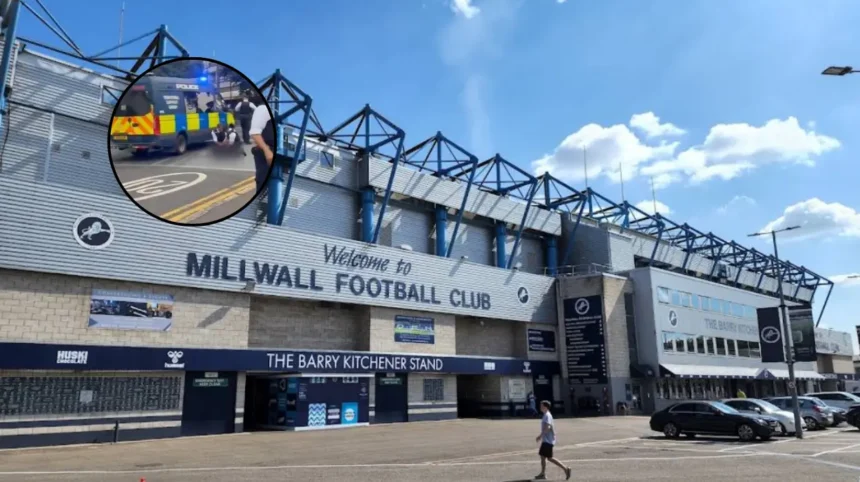
As reported by Ayokunle Oluwalana of London Now, the Metropolitan Police arrested eleven men at approximately 19:15 BST on Friday, 18 September, near a West Ham supporters’ public house in Stratford. The individual men, who are believed to be Millwall followers, were taken into custody under suspicion of conspiracy to commit criminal damage.
A spokesperson for the Metropolitan Police confirmed the detention, stating:
“Eleven men remain in police custody after they were arrested on suspicion of conspiracy to commit criminal damage at around 19:15hrs on Friday, 18 September.”
The pre-match arrests occurred in the build-up to the Saturday lunchtime kick-off at The Den, representing the first competitive fixture between the two sides in 14 years.
What security and policing measures are in place for the derby?
As reported by Lawrence Ostlere of The Independent, the Metropolitan Police have launched a large-scale policing operation involving around 400 officers deployed in public areas and transport hubs. The security setup features specialist assets, including mounted units, police dog units, and live facial recognition camera systems.
A comprehensive Section 35 dispersal order has been implemented by the authorities to prevent football-related disorder. The dispersal zone spans across multiple London boroughs, covering a five-mile area from Tower Bridge in the west to past Greenwich Park and Blackheath in the east, and dropping south towards Ladywell. Under the order, police officers hold explicit powers to direct individuals or groups to leave the area if they are suspected of causing anti-social behaviour or public disorder.
Transport routes have been strictly segregated to prevent opposing fan bases from clashing. As reported by Matt Home of the Evening Standard, visiting West Ham United supporters have been instructed by authorities and club officials to travel exclusively via London Bridge to South Bermondsey station, where a dedicated, enclosed walkway leads away fans directly into the visiting turnstiles at The Den. Away supporters attempting to use alternative railway stations near the ground are being turned away by police stewards. Furthermore, authorities noted that under the Sporting Events Act 1985, strict enforcement regarding alcohol intake will be maintained, prohibiting anyone under the influence of alcohol from entering the stadium.
In a public statement released on X, the Metropolitan Police outlined their matchday objective:
“On Saturday, 19 September at 12:30hrs, Millwall face West Ham at the Den – the first time the two clubs have met since 2012. We want fans to enjoy the match safely and have worked with both clubs to help this happen.”
Background of the particular development
The fixture between West Ham United and Millwall represents one of the longest-standing and most fiercely contested rivalries in English football, dating back to their origins as competing ironworks and dockland worker teams in East and South East London during the late 19th century.
Over the decades, encounters between the two clubs have been subject to heightened police scrutiny due to historical incidents of crowd disturbance and fan clashes outside and inside stadiums. Prior to this weekend’s match, the teams had not met since February 2012, when West Ham secured a 2–1 victory at Upton Park during a Championship campaign.
Significant safety concerns previously emerged during a Carling Cup fixture at Upton Park in August 2009, which was marred by pitch invasions, violent disorder outside the stadium, and multiple arrests. Following those events, football governing bodies and the Metropolitan Police instituted enhanced safety protocols for subsequent fixtures. The 14-year hiatus in competitive meetings ended following West Ham’s relegation from the Premier League, setting up their 100th historic competitive clash at The Den.
Prediction: How this development can affect matchday supporters and local residents
The arrest of eleven suspects alongside the implementation of an extensive policing framework will directly impact matchday spectators, local businesses, and commuters across South East and East London.
For attending matchday supporters, strict transport segregation will mean longer travel times and mandatory designated routes, particularly for visiting West Ham fans navigating through the restricted corridor at South Bermondsey. The deployment of live facial recognition technology and high-density officer presences will result in strict ticket checks, thorough searches, and minimal tolerance for public intoxication or anti-social behaviour near the ground.
For local residents and business owners within the five-mile Section 35 dispersal zone—stretching across Southwark, Lewisham, and Greenwich—the operational footprint will cause localized pedestrian diversions, altered public transport schedules, and restricted access around commercial areas near Stratford and Bermondsey. Pub owners in surrounding areas may experience operational constraints, including mandatory door security, temporary closures, or restricted entry guidelines enforced by local licensing authorities to prevent opportunistic disorder.