Key Points
- Leyton Orient Football Club has formally entered into a Development Performance Agreement (DPA) with the London Borough of Waltham Forest Council to advance plans for a new stadium and multi-sport campus.
- The proposed project aims to deliver a state-of-the-art stadium in time for the club’s landmark 150th anniversary in 2031.
- World-renowned architectural firm Populous has been appointed to oversee the master planning and design of the stadium and wider complex.
- The multi-sport campus is intended to host Leyton Orient’s men’s and women’s teams, alongside a London-based American football franchise competing in the European League of Football (ELF).
- The development is planned as a year-round destination featuring integrated retail, hospitality, leisure facilities, and potential housing redevelopment at the existing Brisbane Road site.
Leyton Orient (East London Times) September 25, 2026 — Leyton Orient Football Club has reached a vital procedural milestone in its pursuit of a new home after signing a formal Development Performance Agreement (DPA) with the London Borough of Waltham Forest Council.
The agreement establishes an operational framework allowing both the League One club and council technical teams to rigorously test, refine, and assess planning proposals for a multi-sport destination within the borough. As reported by sports infrastructure journalists across national media, the consensus between municipal officers and club executives builds directly upon the foundational Memorandum of Understanding signed by both parties in late 2025. Under the terms of the DPA, Waltham Forest Council officers will provide direct feedback on technical feasibility, transport links, environmental considerations, and community amenities to ensure the project aligns with broader local regeneration strategies.
Who Has Been Appointed to Lead the Architectural Design?
Global sports and entertainment architectural practice Populous has been officially selected to design the multi-sport venue and masterplan the surrounding development. Known internationally for designing world-class arenas such as Tottenham Hotspur Stadium, Wembley Stadium, and the Sphere in Las Vegas, Populous will guide the project through its initial feasibility and public consultation phases.
As reported by Populous’s project communications team, Senior Principal and Global Director Declan Sharkey stated that the firm aims to “design a unique stadium and mixed-use development that celebrates the club’s heritage while embracing the future, blending world-class sporting architecture and digital innovation with a vibrant, community-driven neighbourhood.”
What Facilities Are Included in the Proposed Multi-Sport Campus?
The prospective project is designed as an all-year sports and entertainment venue rather than a single-use football ground. Beyond providing a modern home for Leyton Orient’s men’s and women’s senior teams, the venue is slated to host a newly formed London American football franchise set to compete in the European League of Football (ELF).
According to public statements issued by Leyton Orient Majority Shareholder David Gandler, the venture represents a transformative commitment to the local sports ecosystem. Gandler noted that the club is aiming to construct “a world-class, multi-sport campus that honours Leyton Orient’s heritage while creating a vibrant, affordable, technology-driven destination for our fans and our community.” The surrounding precinct is programmed to include extensive retail spaces, hospitality venues, and public leisure areas intended to generate non-matchday commercial revenue to support the club’s long-term push toward financial sustainability in the EFL Championship.
What Is the Timeline for Completion?
Leyton Orient executives have set a firm target for the completion and handover of the new stadium complex by 2031. This milestone coincides directly with the 150th anniversary of the club’s founding in 1881.
Over the coming months, Leyton Orient and Populous are scheduled to launch public consultation events to present emerging masterplan designs to local residents, supporters, and key municipal stakeholders before submitting formal planning applications.
Background of the Particular Development
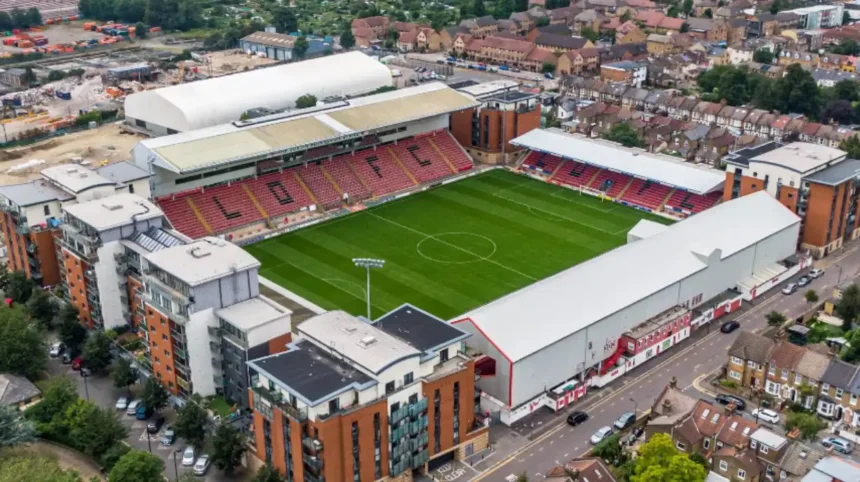
Leyton Orient’s stadium quest stems from structural limitations inherent to their current home, Brisbane Road (currently known commercially as the BetWright Stadium). Grounded in the heart of Leyton since 1937, the stadium currently holds a capacity of just under 9,300 spectators. Extensive technical due diligence undertaken by club leadership revealed that expanding the existing site is physically and economically unfeasible due to dense surrounding residential builds and tightly bounded perimeter real estate.
In late 2025, the club’s leadership initiated formal discussions with Waltham Forest Council to examine alternative sites within the borough. The partnership focuses on unlocking land for a modern venue while simultaneously creating opportunities for urban regeneration. Relocating to a new site within Waltham Forest would also allow for the potential residential redevelopment of the current Brisbane Road footprint, providing much-needed housing for East London while supporting the capital requirements of the new multi-sport complex.
Future Outlook and Impact on Key Stakeholders
The advancement of Leyton Orient’s stadium plans presents widespread implications for local residents, supporters, and the local economy across East London:
- Impact on Football Supporters: Fans stand to gain a modern, technology-enabled matchday experience featuring improved sightlines, enhanced accessibility, and upgraded food and beverage services. The higher stadium capacity will accommodate growing fanbases and generate vital non-matchday revenue streams, helping the club compete more sustainably at higher divisions in the English Football League.
- Impact on the Local Community and Economy: For the residents of Waltham Forest and Leyton, the multi-sport campus promises year-round economic activity rather than bi-weekly matchday traffic. Integrated retail, leisure, and hospitality facilities are expected to generate permanent local employment opportunities and improved public realm infrastructure. Furthermore, the future redevelopment of Brisbane Road could offer significant housing relief.
- Impact on the Regional Sports Ecosystem: By hosting a European League of Football franchise alongside women’s and men’s professional football, East London will reinforce its position as a major regional hub for international and domestic sporting events.