Key Points
- Controversial Proposal: Hackney Council, controlled by the Green Party, is considering using taxpayer resources to fund a public information campaign advising undocumented workers on how to resist Home Office immigration raids.
- JCWI Partnership: Seema Syeda of the Joint Council for the Welfare of Immigrants confirmed the organisation is actively collaborating with Hackney Council on the initiative.
- Escalating Home Office Friction: Several Green-led London councils have pledged to reduce or end co-operation with immigration enforcement teams, directly challenging central government policy.
- Surge in Enforcement Activity: The dispute coincides with a Home Office crackdown on illegal working, which saw an 83 per cent increase in arrests and a 77 per cent rise in enforcement raids late last year.
- National Ambitions: Similar anti-raid motions are being prepared beyond London, including plans by Green councillors in Brighton to revisit local enforcement policy following upcoming council elections.
- Broader Conference Tensions: The debate highlights broader ideological friction within the Green Party under leader Zack Polanski, alongside controversial conference motions regarding DBS criminal record disclosures and Middle Eastern policy.
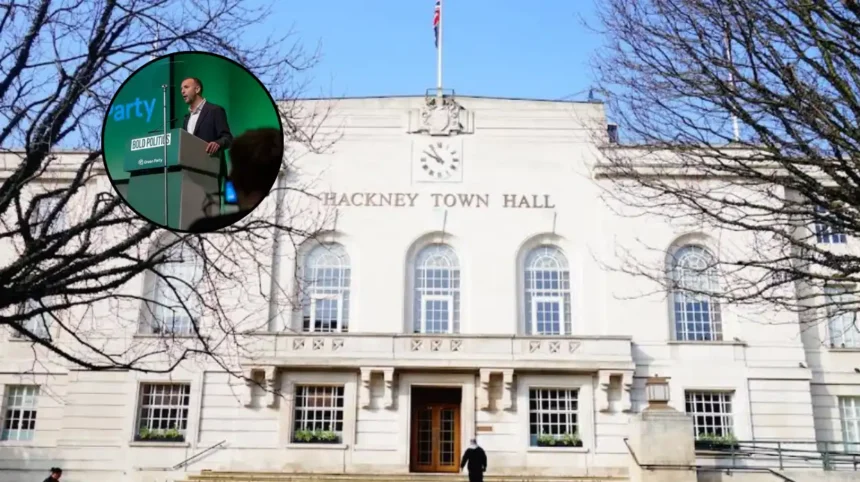
Hackney Council (East London Times) October 3, 2026 – Hackney Council, a Green-controlled local authority in North London, is considering the deployment of taxpayer-funded resources to launch a public information campaign aimed at helping individuals working illegally understand how to resist Home Office immigration raids. The prospective initiative represents a sharp escalation in the political confrontation between Green-led local council administrations and central government authorities over national immigration enforcement. The proposal, revealed during discussions at the Green Party national conference in Brighton, underscores a growing strategy among Green councillors to utilise municipal authority powers to actively counter federal immigration operations within their local jurisdictions.
The formal collaboration was disclosed on stage at the party conference by Seema Syeda, representing the Joint Council for the Welfare of Immigrants. Addresssing attendees, Syeda confirmed that the migrant rights organisation is currently working in partnership with Hackney Council to explore a coordinated public outreach strategy. Syeda explained that the campaign would focus on providing targeted legal and practical advice to impacted residents. Syeda stated that the campaign could “share information to people about their rights and how they can resist raids,” marking a direct intervention by a municipal authority into national border control operations.
The potential deployment of public funds for this purpose places the Green-run local authority at direct loggerheads with the Home Office. Central government officials have consistently maintained that enforcement operations are essential for maintaining the integrity of the nation’s labour market and legal framework. Responding to local council resistance, a spokesperson for the Home Office defended the actions of enforcement officers, emphasising that operations are “vital to root out unscrupulous employers and disrupt illegal workers abusing the system.”
This latest clash forms part of a broader, systemic movement among Green-led municipal authorities across the capital. Several Green-run London councils have already committed to reducing or entirely ending their administrative and operational co-operation with Home Office teams when immigration enforcement officers conduct raids within their local boroughs. Addressing the refusal of certain local authorities to assist federal officers, the Home Office clarified that while the department “always wants to join forces with local authorities, their decisions won’t hinder our operations when fighting immigration crime.”
The escalating confrontation comes as the government significantly intensifies its nation-wide crackdown on illegal employment practices. Official Home Office figures demonstrate a marked acceleration in enforcement metrics, revealing an 83 per cent increase in arrests for illegal working alongside a 77 per cent rise in targeted raids between July 2024 and the end of last year. Despite this heightened federal focus, efforts by local politicians to actively support individuals facing raids are expanding outside the capital. In Brighton, Green councillor Nadia Barton Ahmad proposed a council motion over the summer aimed at protecting migrant-run businesses and individuals subject to enforcement operations. Although Labour councillors ultimately voted down the measure, Barton Ahmad expressed confidence that the party would revisit the policy following the next local elections, stating:
“We have local elections here in May, and so we are hoping that within a year we will be able to pass something similar.”
How Are Conference Debates Exposing Deeper Fractures Within the Green Party?
The contentious debate surrounding immigration enforcement highlights the rapidly expanding policy ambitions of the Green Party under the leadership of Zack Polanski. Taking to the conference platform, Polanski launched a sharp critique of central government legislation, publicly condemning what he characterised as “anti-migrant laws” that he argued serve to “carve up our communities.” However, the immigration dispute represents only one aspect of a wider conference agenda that has exposed deep-seated internal tensions over whether the party should maintain its primary focus on environmental stewardship or expand aggressively into radical social and legal reform.
Among the most controversial items submitted for member consideration is a proposal seeking to restrict the disclosure of certain criminal convictions after a five-year period. Under the terms of the submitted motion, convictions for offences including theft, assault, and drug possession would eventually be concealed from standard Disclosure and Barring Service checks, provided the offender served a prison sentence of less than two years or received a suspended sentence. The proposal drew immediate, scathing criticism from opposition politicians. Alicia Kearns, the shadow safeguarding minister, attacked the policy initiative, stating that the Greens now “appear to be criminal apologists.” In response to the growing public backlash, a Green Party spokesperson sought to clarify the legal standing of the proposal, stressing that individual conference submissions do not reflect established party policy and noting:
“These do not become policy until they are debated and voted on at conference.”
Simultaneously, the conference has been severely fractured by a highly sensitive debate over a motion proposing to formally declare that “Zionism is racism.” The resolution has drawn vocal opposition from senior figures within the party hierarchy. Speaking to the BBC, Caroline Lucas, the former leader and the party’s first elected Member of Parliament, forcefully rejected the proposal, stating:
“There is no single definition of Zionism, and irrespective of the intentions of the people who put that motion forward, I think there is a real risk that it’ll be divisive and could be seen as a sign that Jewish people aren’t welcome in the party. I will not be supporting it for that reason.”
Former Green co-leader Adrian Ramsay similarly voiced strong opposition to the measure, arguing that it would be entirely “wrong to adopt a policy that could be seen as not supporting the rights of both Israelis and Palestinians to statehood.” The motion has also generated profound alarm among Jewish members of the party, particularly following public backing from Friends of Al-Aqsa, an organisation that critics have repeatedly accused of endorsing positions hostile to Israel and Jewish communities. Expressing deep personal dismay, one Jewish Green Party member remarked:
“I’m deeply troubled that my party, a party with its roots in anti-discrimination and non-violence, is getting support for a divisive motion from outside groups and individuals with a problematic history of hatred towards Jews.”
Background of the Particular Development
The political friction between local authorities and central government over immigration enforcement reflects a long-standing structural tension within British governance regarding the boundaries of municipal power. Over the past decade, the Home Office has increasingly relied on civil penalty regimes, workplace intelligence, and targeted enforcement visits to combat illegal working. In response, several urban councils—particularly those in metropolitan areas with high migrant populations—have sought to establish “sanctuary” principles or adopt policies designed to minimise local government involvement in immigration checks.
The Green Party’s electoral gains in local government have accelerated this trend. As Green councillors have assumed cabinet positions and committee chairmanships in urban boroughs, local policy agendas have expanded beyond traditional environmental sustainability to encompass controversial aspects of criminal justice, international affairs, and civil liberties. The proposal by Hackney Council represents the furthest iteration of this strategy to date, moving beyond passive non-cooperation toward the active distribution of public information aimed at frustrating central government enforcement operations.
Prediction: How This Development Can Affect Local Communities, Taxpayers, and Municipal Governance
The decision by Green-controlled local authorities to actively challenge Home Office operations carries significant implications for various key stakeholders across local governance, legal compliance, and community relations.
1. Impact on Taxpayers and Local Services
For local taxpayers, the allocation of municipal funds toward public campaigns resisting Home Office enforcement presents potential legal and financial risks. If central government authorities determine that local council spending falls outside the statutory powers permitted under local government legislation, councils could face judicial reviews or formal challenges from district auditors. Taxpayers could ultimately bear the financial burden of costly legal disputes between local authorities and the Home Office, alongside potential reductions in core municipal service funding if central government chooses to ring-fence or review discretionary central grants to uncooperative councils.
2. Impact on Local Businesses and the Economy
For small businesses and employers operating within Green-led boroughs, the contrasting approaches of local and national authorities create an uncertain regulatory environment. While public information campaigns may inform workers of their statutory rights, employers remain subject to federal law and strict legal penalties—including civil fines up to £60,000 per illegal worker and criminal liability. Conflicting advice from local council officials and federal immigration enforcement officers could cause confusion regarding legal compliance, employment verification obligations, and liability during workplace inspections.
3. Impact on Community Cohesion and Public Order
For local residents and community groups, municipal resistance to immigration raids could deepen political polarization. Proponents argue that resisting raids protects vulnerable residents, maintains trust between communities and local council services, and prevents social disruption. Conversely, critics contend that municipal interference in national law enforcement undermines the rule of law, creates geographic disparities in legal enforcement, and fosters friction between local law enforcement, federal officers, and neighborhood residents.