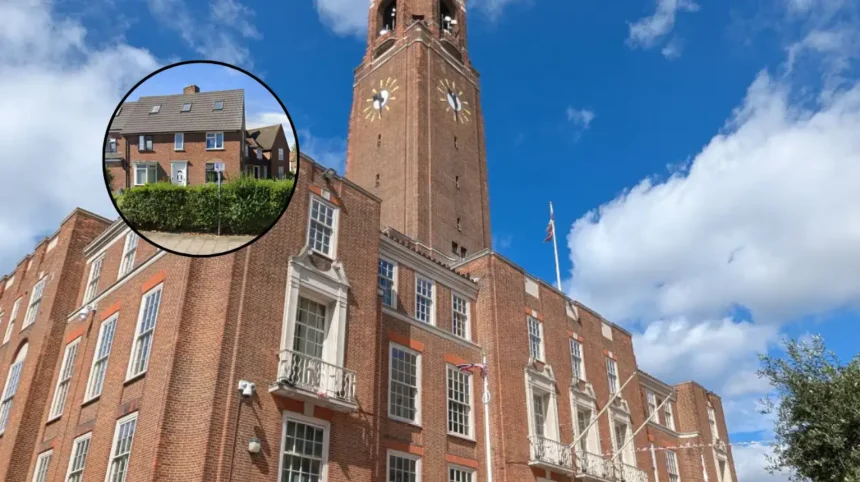
Key Points
- Barking and Dagenham Council has officially rejected a third planning application to convert a four-bedroom residential property located at 671 Heathway into a six-bedroom House in Multiple Occupation (HMO).
- The proposed transformation aimed to accommodate up to seven individual tenants, alongside provisions for dedicated cycle storage and waste refuse facilities, with no external alterations planned for the building structure.
- Planning officers concluded that losing a dedicated single-family home would prove “detrimental” to the area’s shrinking supply of traditional family housing stock.
- Local authority decision-makers cited persistent concerns regarding heightened noise levels, severe loss of residential amenity, and general disruption to neighbouring occupiers in their final refusal notice.
- The formal decision notice issued by the local authority explicitly confirms that while a fresh application remains possible, any future proposal would require “substantial” structural and operational changes to address fundamental planning objections.
Dagenham (East London Times) October 9, 2026 — As reported by Gianni Cirillo of the Barking and Dagenham Post, Barking and Dagenham Council has formally turned down a planning proposal to convert a standard family home on Dagenham Heathway into a high-density House in Multiple Occupation (HMO) for the third time.
- Key Points
- Why Has Barking and Dagenham Council Blocked the Heathway HMO Conversion?
- What Specific Modifications Were Included in the Rejected Planning Proposal?
- How Have Local Authority Decision-Makers Responded to Repeated Applications?
- Background of the Development
- Prediction: How This Development Can Affect Local Residents and Property Owners
The formal planning submission, which was initially validated by the local authority in August, outlined a full change-of-use application for 671 Heathway. Under the submitted design, the existing four-bedroom single-family dwelling was slated to undergo internal reconfiguration to create a six-bedroom HMO capable of housing up to seven individual residents. Although the submission incorporated provisions for dedicated refuse storage, cycle racks, and a car-free parking agreement, officers firmly concluded that the overarching scheme remains fundamentally unacceptable in terms of community impact and housing balance.
Why Has Barking and Dagenham Council Blocked the Heathway HMO Conversion?
According to reporting published by Gianni Cirillo in the Barking and Dagenham Post, local planning authorities determined that approving the conversion of 671 Heathway would result in an unacceptable reduction in the local inventory of traditional family accommodation. Municipal officers underlined that converting functional four-bedroom residential properties into high-occupancy units erodes the character of established residential neighbourhoods and directly contradicts the borough’s overarching strategy to preserve long-term family housing.
In detailed planning documentation highlighted by Gianni Cirillo in the Romford Recorder, council officers noted that the applicant failed to prove a compelling, evidence-based local demand for additional HMO accommodation at this specific geographical location. Furthermore, municipal assessment reports highlighted that intensifying human activity on the site would inevitably lead to an unacceptable increase in noise, ambient disturbance, and residential friction for nearby neighbours, thereby significantly degrading the overall standard of living and peace enjoyed by adjacent occupants.
What Specific Modifications Were Included in the Rejected Planning Proposal?
As detailed by reporter Gianni Cirillo in local coverage for the Barking and Dagenham Post, the applicant sought full planning consent purely for an internal change of use under Class C4, confirming that no external structural building alterations or extensions were proposed for the exterior of the property. The floor plan layouts sought to optimise existing interior volume to fit six separate letting bedrooms meant for up to seven adult occupants.
To mitigate wider infrastructure and parking pressures along the busy urban artery, the submission integrated an explicit car-free agreement alongside layout space dedicated to secure cycle storage and managed refuse units. As highlighted by Gianni Cirillo in the Barking and Dagenham Post, while highway and waste management elements of the scheme—such as cycle storage and car-free commitments—were technically accepted by reviewing officers, these operational compromises were insufficient to override the main policy objections regarding overdevelopment and loss of family housing.
How Have Local Authority Decision-Makers Responded to Repeated Applications?
As reported by Gianni Cirillo in the Romford Recorder, the rejection marks the third separate instance where planning proposals targeting the conversion of 671 Heathway into an HMO have been turned down by local planning authorities. Municipal leaders and committee members have repeatedly reaffirmed their commitment to protecting quiet residential zones from over-intensification and inappropriate commercial landlord conversions.
In official correspondence quoted by Gianni Cirillo of the Barking and Dagenham Post, the council’s formal decision notice explicitly outlines that while the applicant retains the legal right to submit a revised application in the future, any acceptable submission would require “substantial” alterations. Officers explicitly warned that minor tweaks would not suffice, as the necessary adjustments required to satisfy municipal housing policies would materially alter the overall nature and scope of the development proposal.
Background of the Development
The ongoing planning conflict surrounding 671 Heathway forms part of a much broader, borough-wide debate across Barking and Dagenham regarding the proliferation of Houses in Multiple Occupation (HMOs). Over recent years, East London local authorities have faced severe pressure to balance affordable short-term housing demand against the urgent necessity of retaining stable stock for families.
Prior to this latest rejection, 671 Heathway had already been the subject of multiple planning applications and enforcement scrutinies aimed at expanding or altering its usage class. Local councils across Outer London have increasingly implemented Article 4 Directions and strict planning restrictions to prevent single-family homes from being converted into multi-let units without explicit oversight. Municipalities argue that uncontrolled HMO conversions reduce family housing stock, increase pressure on street parking, inflate local refuse demands, and generate heightened noise pollution in traditionally quiet residential avenues. Consequently, decision-makers in Barking and Dagenham have consistently enforced stringent criteria when assessing change-of-use schemes, leading to a high rate of refusal for properties where high-density occupation threatens established neighbourhood dynamics.
Prediction: How This Development Can Affect Local Residents and Property Owners
This third consecutive planning refusal carries significant consequences for multiple groups across the local community:
- Local Families and Long-Term Residents: Nearby residents along Heathway and surrounding residential streets stand to gain immediate relief from the prevention of increased noise, elevated refuse collection demands, and localized foot-traffic congestion. More broadly, the firm stance taken by the council signals strong protection for the remaining single-family housing supply, helping to preserve the core residential community character and prevent surrounding properties from being surrounded by high-turnover rental units.
- Private Property Developers and Landlords: For real estate investors and prospective landlords targeting Barking and Dagenham, this repeated rejection underscores a clear regulatory warning. Property developers will need to re-evaluate investment strategies that rely heavily on converting traditional family homes into high-density HMOs. Landlords intending to apply for similar change-of-use permissions in the borough must now anticipate rigorous council scrutiny, higher financial risks, and the necessity of demonstrating explicit local demand alongside extensive architectural compromises before submitting plans.
- Prospective Renters and House-Seekers: While the decision restricts the immediate expansion of lower-cost, single-room rental accommodation along a primary transport artery, it simultaneously safeguards four-bedroom properties for families seeking complete long-term homes in the borough. The ruling reflects the council’s priority to steer single-room housing proposals toward purpose-built developments rather than existing family-oriented residential streets.