Key Points
- Petition Presented to Local Authority: Campaigners Abul Khair, Guljar Khan, and Yasmin Haque formally presented a petition to Tower Hamlets Council on October 7, demanding immediate council intervention regarding abandoned dockless bicycles.
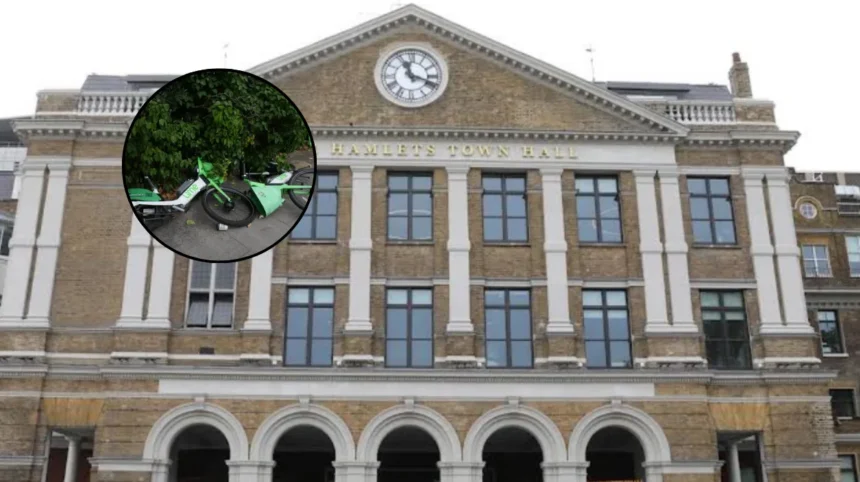
- Hazardous Conditions for Pedestrians: Indiscriminately parked dockless bikes are obstructing narrow and congested pavements, creating significant hazards for pedestrians, wheelchair users, and parents with pushchairs.
- Focus on High-Density Neighbourhoods: The problem is particularly acute across busy commercial and cultural hubs including Brick Lane, Spitalfields, and Shoreditch.
- Proposed Infrastructure Measures: Tower Hamlets Council is considering the implementation of mandatory designated parking zones to regulate dockless bike parking across the borough.
- Pro-Cycling Stance: Campaigners emphasized that the local community supports sustainable transport and cycling, but insists on clear boundaries to prevent anti-social parking and safeguard public walkways.
Tower Hamlets (East London Times) October 14, 2026 – Residents in an east London borough have formally petitioned local authorities to implement immediate regulatory measures to resolve an escalating dockless bike crisis that is leaving public pavements dangerously obstructed. Tower Hamlets Council is currently evaluating the introduction of mandatory designated parking bays after community campaigners presented a petition during a council meeting on October 7. The submission highlighted the growing safety risks posed to pedestrians, particularly in high-footfall areas such as Brick Lane, Spitalfields, and Shoreditch, where abandoned bicycles frequently block narrow footways.
- Key Points
- Why Are Tower Hamlets Residents Calling for Immediate Council Action?
- Which Neighbourhoods Are Most Affected by Abandoned Dockless Bicycles?
- How Does the Dockless Bike Crisis Impact Pedestrian Safety and Accessibility?
- What Solutions Is Tower Hamlets Council Considering to Resolve the Crisis?
- Are Local Campaigners Opposed to Cycling and Sustainable Transport?
- Background of the Particular Development
- Prediction: How This Development Can Affect Local Residents, Businesses, and Commuters
Why Are Tower Hamlets Residents Calling for Immediate Council Action?
The petition presented to Tower Hamlets Council represents a formal escalation of long-standing frustration among local inhabitants regarding the management of dockless hire schemes. As presented by campaigners Abul Khair, Guljar Khan, and Yasmin Haque, the uncontrolled distribution and abandonment of dockless bicycles have reached a threshold that directly compromises pedestrian safety.
According to the campaigners, the current operational model allows users to terminate rentals on footpaths without adequate regard for public access. In busy thoroughfares and historic market zones, street space is inherently limited. When dockless bikes are left lying across footways or piled near street corners, footpaths become hazardous corridors. The campaigners noted that this issue has persisted unchecked for far too long, prompting community leaders to step forward and request binding regulatory interventions from local elected officials.
Which Neighbourhoods Are Most Affected by Abandoned Dockless Bicycles?
While the challenge of dockless bike management affects urban centres across the capital, the problem is especially concentrated within the western and central sectors of the Borough of Tower Hamlets. Historic and highly frequented destinations such as Brick Lane, Spitalfields, and Shoreditch host a dense mix of residential properties, independent retail shops, restaurants, and street markets.
The pavements in these historic areas were not originally constructed to accommodate large volumes of commercial dockless vehicles alongside high volumes of pedestrian traffic. As a result, when hire bikes are deposited on narrow footways outside commercial establishments or transport interchanges, the available walking space is drastically reduced. Campaigners pointed out that these specific neighbourhoods require targeted spatial management due to the unique combination of narrow street layouts and exceptionally high daily footfall.
How Does the Dockless Bike Crisis Impact Pedestrian Safety and Accessibility?
The obstruction of public footpaths creates immediate safety concerns for all pedestrians, but the impact is felt most severely by vulnerable road users. When bicycles are left lying horizontally across pavements or grouped haphazardly near kerbs, individuals with visual impairments face severe trip hazards. Similarly, residents utilizing mobility scooters, wheelchairs, or pushing double pushchairs are frequently forced off the footway and onto active carriageways to bypass the blockages.
Campaigners Abul Khair, Guljar Khan, and Yasmin Haque made clear during their presentation that community concern is centered squarely on accessibility and basic safety standards. By leaving narrow pathways fully or partially impassable, the unregulated parking of dockless bikes deprives residents of the right to navigate their local neighbourhood safely and without unnecessary physical barriers.
What Solutions Is Tower Hamlets Council Considering to Resolve the Crisis?
In response to the petition and mounting public feedback, Tower Hamlets Council is evaluating policy mechanisms to enforce stricter controls over commercial dockless bike operators. Principal among the proposed solutions is the creation of designated, marked parking zones across the borough.
Under a designated parking framework, dockless bike operators would be required to configure their geo-fencing technology so that journeys can only be concluded—and billing stopped—when the vehicle is placed within an authorized parking bay. Bicycles left outside these pre-approved physical boundaries would continue to accrue charges for the user, thereby creating a financial incentive for responsible parking. Tower Hamlets Council is reviewing how such spaces can be allocated on carriageways or underutilized street bays to avoid reducing pedestrian footway capacity further.
Are Local Campaigners Opposed to Cycling and Sustainable Transport?
Throughout their address to councillors, the petition leaders emphasized that the local movement is not anti-cycling nor opposed to green transport initiatives. Campaigners Abul Khair, Guljar Khan, and Yasmin Haque explicitly clarified that the community recognizes the environmental and health benefits of cycling as a alternative to private motor vehicle travel.
The core objective of the petition is not to ban hire bikes from operating within Tower Hamlets, but rather to establish order, accountability, and regulatory oversight. The organizers stressed that sustainable transport infrastructure must not come at the expense of basic pedestrian access, demanding that operators take greater responsibility for how their fleet is deployed and managed in public spaces.
Background of the Particular Development
Dockless bicycle hire services initially expanded rapidly across London local authorities as part of broader initiatives to encourage active travel and reduce urban carbon emissions. Unlike traditional docked schemes, such as Santander Cycles, which require vehicles to be locked into physical docking stations, dockless schemes rely on built-in GPS locks. This design allows users to pick up and drop off bicycles at virtually any location, offering high flexibility for commuters.
However, this flexibility has repeatedly led to widespread friction in high-density urban environments. Local councils across London hold varying degrees of regulatory authority over street space, creating a fragmented regulatory landscape. While some London boroughs have previously negotiated individual memoranda of understanding or contractual agreements with commercial operators—mandating designated parking bays and enforcement penalties—others have struggled with unauthorized fleet deployments.
In boroughs with narrow, historic street networks like Tower Hamlets, the lack of fixed physical infrastructure has consistently resulted in street clutter. Over recent years, public frustration across London has led multiple local authorities to seize improperly parked bicycles, issue fines to operating companies, or threaten complete operational bans unless operators enforce strict geo-fenced parking controls. The petition presented to Tower Hamlets Council on October 7 represents the latest chapter in this ongoing effort by local communities to balance sustainable micro-mobility with basic urban accessibility standards.
Prediction: How This Development Can Affect Local Residents, Businesses, and Commuters
If Tower Hamlets Council successfully institutes mandatory designated parking zones and stricter operator oversight, the resulting policy shift will significantly alter the daily environment for several key groups within the borough.
- For Pedestrians and Vulnerable Road Users: The introduction of regulated parking will lead to clearer, safer footways across high-footfall zones like Brick Lane and Shoreditch. Vulnerable residents—including elderly pedestrians, visually impaired individuals, wheelchair users, and parents with pushchairs—will experience a notable reduction in trip hazards and street obstacles, restoring confidence in navigating local footpaths safely.
- For Commuters and Cyclists: Users of dockless bike services will likely experience a transition away from “door-to-door” convenience toward a structured “bay-to-bay” system. While this may require riders to walk short distances from an authorized parking bay to their final destination, it will provide greater certainty regarding vehicle availability, as bikes will be concentrated in predictable, designated hubs rather than scattered randomly across footways.
- For Local Businesses and Retailers: Merchants along congested corridors can expect reduced obstruction in front of shopfronts, outdoor seating areas, and delivery access points. Removing haphazardly parked bikes will improve storefront visibility and prevent footway bottlenecks, facilitating smoother foot traffic for shoppers and visitors.
- For Dockless Bike Operators: Commercial providers will face heightened operational obligations and potential infrastructure costs. Operators will need to update their geo-fencing software, coordinate closely with council officers to map out acceptable bays, and increase ground-crew operations to retrieve misplaced or tipped-over bikes promptly. Failure to comply with upcoming council frameworks could risk operational permits or result in financial penalties and vehicle impoundment.