Key Points
- A major traffic collision occurred near the Gallows Corner junction in Havering, prompting emergency services to completely close several surrounding roads and deploy an air ambulance to the scene.
- Official movement records from Transport for London confirm that the A12 Eastern Avenue East is closed eastbound at Pettits Lane, while the A127 Southend Arterial Road is closed westbound at Squirrels Heath Drive.
- The emergency response has created significant traffic gridlock, with heavy congestion spilling over onto Colchester Road, Straight Road, Main Road, and surrounding residential thoroughfares across Romford and Harold Wood.
- Air ambulance medics, London Ambulance Service crews, and London Metropolitan Police officers attended the junction to manage casualties, secure the crash perimeter, and divert trapped motorists.
- Highway authorities and Metropolitan Police traffic officers have advised all motorists traveling across East London and Essex to avoid the junction entirely and utilise alternative bypass routes.
Romford (East London Times) October 24, 2026 – Emergency services have cordoned off major road corridors surrounding the Gallows Corner junction in Havering following a serious traffic collision on Saturday afternoon, causing widespread transport disruption and triggering long vehicular queues across East London.
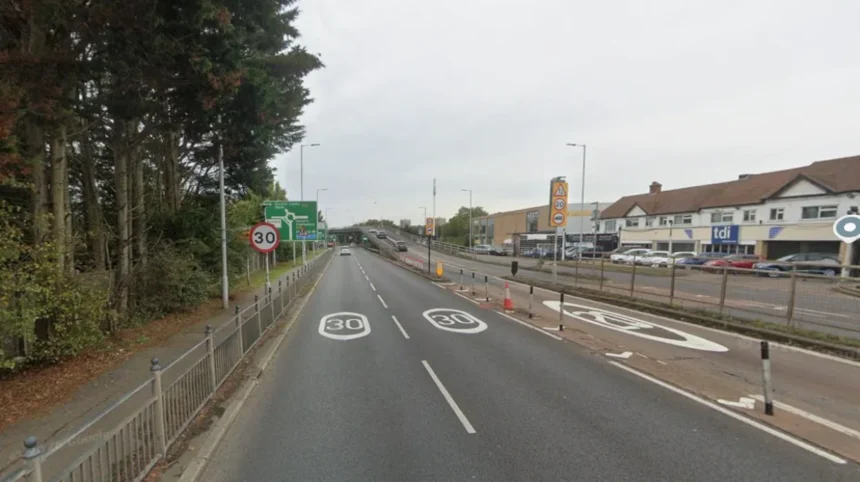
As reported by local traffic monitoring logs from Transport for London, emergency calls were raised earlier today following a severe vehicular collision at the busy junction where the A12 Eastern Avenue East meets the A127 Southend Arterial Road. According to published transport status updates from Transport for London, officers from the London Metropolitan Police alongside crews from the London Ambulance Service and the London Air Ambulance were scrambled to the crash location to provide critical medical assistance and secure the surrounding carriageways. Transport for London confirmed in its official operational status log that “the A12 is closed eastbound at Pettits Lane” and “the A127 is closed westbound at Squirrels Heath Drive due to a collision,” with traffic management teams warning that drivers must expect long delays throughout the area and along all local diversions.
As detailed in live incident alerts from the Romford Recorder, the intensity of the response required the landing of an Essex & Herts Air Ambulance near the flyover and roundabout complex to transport medical specialists directly to the incident zone. The closure of these vital arterial corridors has resulted in widespread queuing, with tailbacks extending along Eastern Avenue East, Colchester Road, and back towards the North Circular and M25 links as emergency responders work on scene.
How are emergency services responding to the Gallows Corner collision?
What actions are London Metropolitan Police and London Ambulance Service taking at the scene?
Emergency personnel established a broad security perimeter around the junction shortly after arriving at the scene to allow medical staff unhindered access to those involved in the collision. The London Metropolitan Police deployed traffic officers to halt oncoming vehicles and set up immediate diversions at major approach junctions including Pettits Lane and Squirrels Heath Drive.
Paramedics from the London Ambulance Service, supported by pre-hospital care doctors dispatched via helicopter, set up an incident treatment point on the highway to evaluate and stabilize patients. Metropolitan Police collision investigation units have also been positioned within the closed zone to examine the circumstances surrounding the crash, record physical road evidence, and assess vehicle damage before recovery teams can clear the carriageway.
Which roads remain closed and what are the primary diversion routes?
How is traffic being diverted across Havering and East London?
The closure of the Gallows Corner roundabout and its immediate connector roads has severed a principal highway artery between London and Essex, severely restricting traffic flow across the Borough of Havering.
- A12 Eastern Avenue East (Eastbound): Closed entirely at the junction with Pettits Lane, with all eastbound traffic diverted onto local borough roads toward Romford town centre.
- A127 Southend Arterial Road (Westbound): Blocked at Squirrels Heath Drive, preventing inbound traffic from Essex from accessing the Gallows Corner interchange.
- Local Connecting Roads: Heavy congestion and slow-moving traffic have been recorded along Colchester Road, Straight Road, Main Road, and Gubbins Lane as drivers attempt to navigate around the perimeter closures.
Transport for London operational bulletins urge long-distance motorists traveling between Central London, Essex, and the M25 to bypass the entire area by using the A13 or the A120 corridors where possible.
Background of the Gallows Corner development
Why is the Gallows Corner junction a persistent focal point for traffic safety and highway infrastructure projects?
Gallows Corner is widely recognized as one of the most complex and heavily congested road interchanges in Greater London. Situated in the London Borough of Havering, the junction serves as the primary intersection where the A12 (connecting Central London to East Anglia), the A127 (the major highway link to Southend-on-Sea and South Essex), and local arterial routes like the A118 Main Road meet.
The defining feature of the junction is its temporary steel flyover, which was constructed in 1970 as a short-term measure to relieve acute roundabout congestion. Over five decades later, the temporary structure remains in active service, carrying single-lane traffic in each direction over the roundabout. Due to its narrow design, sharp approach angles, and high daily traffic volumes, the junction has long been subject to frequent traffic collisions, mechanical breakdowns, and severe bottlenecks.
In recent years, Gallows Corner has been the subject of extensive highway safety studies, local community campaigning, and public funding allocations aimed at delivering a comprehensive structural overhaul. Transport for London and the Department for Transport have developed long-term regeneration proposals to replace the aging flyover with a modern, high-capacity road structure, widen roundabout lanes, and install enhanced pedestrian and cyclist crossing facilities. However, until full-scale redevelopment works are completed, any significant collision at the site routinely causes immediate, regional gridlock across Havering and adjacent East London boroughs.
Prediction and potential impacts on affected groups
How will this major road closure impact local residents, commuters, and emergency services across the region?
The prolonged closure of Gallows Corner and its surrounding corridors is expected to create several immediate and short-term operational challenges across the local transportation network:
Impact on Local Residents and Neighborhood Mobility
Residents living in nearby residential districts—including Romford, Harold Wood, Gidea Park, and Harold Hill—will face intense traffic overflow as residential side streets absorb displaced vehicles from the A12 and A127. Local journey times are anticipated to double or triple during peak hours, while local bus services operated by Transport for London will experience significant delays and route diversions throughout the duration of the emergency response.
Impact on Commercial Haulage and Regional Commuters
Commercial freight operators and long-distance commuters traveling between Essex, London, and the M25 motorways will encounter severe transit delays. Because Gallows Corner is a crucial link for goods vehicles traveling to and from Essex ports and distribution hubs, delays along this corridor ripple into broader supply chain schedules, increasing fuel consumption and logistics costs for regional businesses.
Impact on Emergency Service Network Response Times
With primary corridors completely blocked and surrounding diversion routes experiencing heavy congestion, emergency vehicles responding to unrelated incidents across Havering may face extended response times. Blue-light services will be forced to carefully coordinate routes with local traffic command centers to navigate through gridlocked residential streets until normal traffic flow is restored at the junction.