Key Points
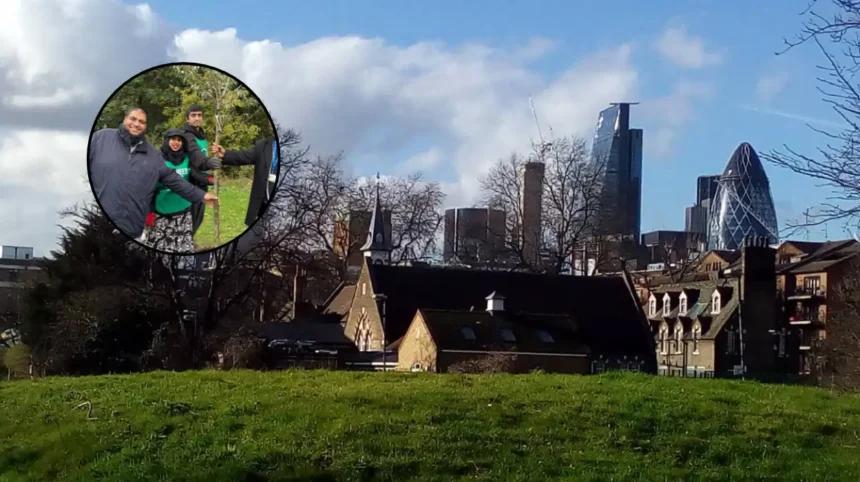
- Community Initiative: Volunteers of all ages joined the environmental charity Trees for Cities to plant over 100 new trees in Swedenborg Gardens on Saturday, 24 October.
- Council Alignment: The event was held during the London Borough of Tower Hamlets’ annual ‘Green Week’, celebrating local climate action and sustainability efforts.
- Tackling Inequity: Tower Hamlets is identified as one of London’s lowest tree equity boroughs, suffering from fewer trees and diminished access to green space.
- Climate Resilience: Species such as holm oak, black pine, common walnut, and European hackberry were specifically chosen for their ability to withstand heat and drought following an extreme summer.
- Corporate Support: The urban Greening initiative was supported by several financial partners, including the Bupa Foundation.
- Cultural Heritage: Participants decorated protective tree cages with colourful repurposed fabrics, paying homage to the East End’s historical textile industry.
- Long-Term Continuity: The planting expands upon previous local efforts dating back to 2010, including the nearby St George’s Estate orchard established in 2013.
Tower Hamlets (East London Times) October 26, 2026 – On Saturday 24 October, local residents of all ages assembled in Swedenborg Gardens, rolling up their sleeves and grabbing spades to plant more than 100 new trees. The initiative took place as part of the local authority’s annual ‘Green Week’ celebrations. Organized in partnership with the environmental charity Trees for Cities, the gathering marked the charity’s first community planting event of the winter season. The action follows an unprecedented summer characterized by severe heatwaves and prolonged drought, underscoring the urgent requirement to enhance urban canopy coverage across Greater London.
Although London holds status as a National Park City featuring more than 8.4 million trees, access to woodland and natural open spaces remains acutely unequal across the metropolis. Tower Hamlets is formally classed as one of the capital’s lowest tree equity boroughs. Consequentially, many local neighbourhoods suffer from a scarcity of mature foliage, depriving residents of natural defenses against environmental hazards such as surface water flooding, rising urban temperatures, and air pollution. The project at Swedenborg Gardens, supported financially by major partners including the Bupa Foundation, forms part of a continuous campaign by Trees for Cities to address environmental injustice by expanding green infrastructure in underserved urban areas.
Which Tree Species Were Chosen and What Benefits Will They Provide?
Organisers deliberately selected specific botanical varieties capable of flourishing despite changing climate patterns. Among the chosen foliage, holm oak was highlighted for its exceptional tolerance to extreme heat and dry spells. Additionally, specimens of black pine, common walnut, and European hackberry were integrated into the landscape due to their proven endurance during warmer conditions. As these specimens mature, they are projected to offer vital shade canopy, screen adjacent roadways to filter harmful particulate emissions, and establish new ecological habitats for local wildlife.
As stated by Kate Sheldon, Chief Executive Officer of Trees for Cities:
“In one of London’s lowest tree equity boroughs, every tree planted has the power to make a meaningful difference to people, place and nature. Tower Hamlets volunteers haven’t just put trees in the ground; they’ve strengthened a green legacy that will benefit local people for generations. As London faces more extreme weather events, the trees planted at Swedenborg Gardens will help create a greener, more resilient Tower Hamlets for years to come.”
The newly introduced specimens will grow alongside existing trees established by Trees for Cities and neighbourhood residents since 2010. This initiative reinforces a long-standing environmental commitment within the borough. Previous localized schemes include the creation of the Swedenborg Orchard on the nearby St George’s Estate in 2013, a flourishing natural site that continues to be maintained by local resident volunteers today.
How Did the Event Combine Urban Greening with Local Heritage?
Beyond environmental restoration, the planting day incorporated interactive public arts to celebrate neighbourhood heritage. Organisers invited participants to decorate protective tree cages using vibrant woven fabrics sourced from repurposed textiles. This creative feature was designed as a direct homage to the East End of London’s historical textile and garment industry. Volunteers contributed individual fabric elements, creating a collaborative public art display surrounding the young trees.
As reported by official representatives of Tower Hamlets Council, Councillor Shafi Ahmed, Cabinet Member for a Clean and Green Borough, stated:
“I’d like to thank all of the residents and volunteers who gave their time to this fantastic tree-planting event, as well as our partners at Trees for Cities for helping to make it possible. The hundreds of new trees planted at Swedenborg Gardens will leave a lasting legacy for future generations while helping us build a greener, healthier and more climate-resilient Tower Hamlets. This event has been a wonderful part of Green Week, which has seen residents, climate experts and community groups come together to take action for the climate. I encourage everyone to get involved in future activities and play their part in creating a cleaner and greener borough.”
The psychological and social benefits of the initiative were echoed by those working on the ground. Reflecting on the community effort, one young volunteer noted:
“I think when you live in London it’s very easy to not feel connected to your surroundings. Everything is on a screen these days, it’s constant stimulation. But it’s very nice to move a bit slowly. I think it’s also very rewarding because you know that you’re giving back to a community here and you’re providing more greenery, which I think everyone in London could benefit from.”
Background of Urban Greening and Tree Equity in Tower Hamlets
The London Borough of Tower Hamlets has historically faced significant environmental challenges rooted in its dense urban landscape, industrial history, and rapid modern redevelopment. As one of the most densely populated local authority areas in the United Kingdom, the borough experiences pronounced urban heat island effects, where built infrastructure retains heat and elevates local temperatures compared to surrounding rural regions.
To address these vulnerabilities, independent environmental charities such as Trees for Cities have operated alongside local government bodies for over a decade to rectify canopy deficits. Tree equity—the concept that all urban residents deserve equal access to the health, economic, and environmental benefits provided by trees—has become a central pillar of London’s wider environmental strategy. High-density areas with lower average household incomes have statistically been shown to contain fewer trees, exposing residents to higher levels of air pollution from major transport corridors and heightened risks of heat-related illnesses during summer months.
Initiatives such as the 2013 St George’s Estate orchard project demonstrate an ongoing strategy to integrate food-bearing and climate-hardy trees directly into residential housing estates. The ongoing collaboration between non-profit entities, commercial funders, and civic authorities reflects a structured, long-term framework to transform public parks like Swedenborg Gardens into resilient ecological buffers for inner-city communities.
Prediction: How This Development Will Affect Tower Hamlets Residents and the Local Community
The addition of over 100 climate-resilient trees at Swedenborg Gardens is set to generate long-term ecological, public health, and social benefits for the surrounding population of Tower Hamlets.
Environmental and Health Impacts
Over the coming decades, as the holm oak, black pine, common walnut, and European hackberry saplings mature into a full canopy, local residents will experience a measurable mitigation of the urban heat island effect. Neighborhoods immediately adjacent to Swedenborg Gardens can expect localized cooling during summer heatwaves, reducing ambient street temperatures. Furthermore, the foliage will serve as a biological filter, capturing airborne particulate matter generated by nearby traffic, which is projected to contribute to improved local air quality and lower rates of respiratory stress among vulnerable populations, such as children and the elderly.
Social and Community Cohesion
The integration of local history through public art projects—such as the textile tree-cage weaving—fosters a deeper sense of civic ownership over public spaces. By actively involving residents in the physical transformation of their neighbourhood, local authorities and charities build stronger community networks. This shared stewardship significantly lowers the likelihood of vandalism in urban parks and encourages ongoing volunteerism, ensuring that public green spaces remain well-maintained, safe, and accessible for future generations.