Key Points
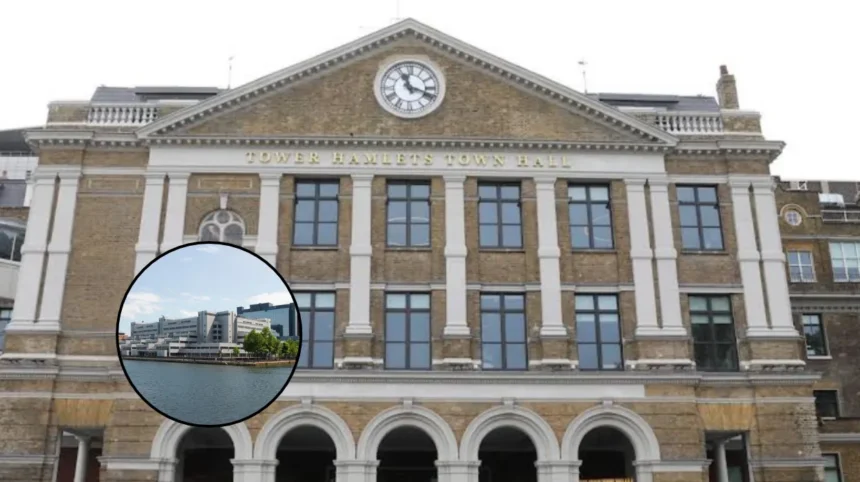
- Lease Agreement Secured: Tower Hamlets Council has approved a 10-year lease agreement to acquire four commercial office blocks located at 191, 193, 195, and 197 Marsh Wall in Thames Quay, Canary Wharf, near South Quay DLR station.
- 180 New Housing Units: The local authority plans to convert these former office spaces—previously occupied by tenants including Lyca Mobile—into 180 self-contained temporary accommodation flats for homeless families.
- Property Composition: The development scheme will deliver 167 two-bedroom flats and 13 three-bedroom homes to accommodate larger local family units.
- Rising Local Homelessness: The initiative arrives as temporary accommodation needs expand by 11 per cent annually across Tower Hamlets and London, with the borough currently housing 3,100 households in temporary shelter, including 2,700 families.
- Mitigating Relocation Out of Area: The scheme aims to reduce the borough’s reliance on placing vulnerable families outside East London or in costly commercial hotel accommodation.
- Financial Risk and Funding: The project is financed through General Fund borrowing; while expected to cost more than existing arrangements, council leaders argue the social value justifies the financial risk.
- London-Wide Crisis Context: According to London Councils, local authorities in the capital spend £5 million every day on temporary accommodation, with over 100,000 children living without permanent housing.
Tower Hamlets (East London Times) October 28, 2026 – Tower Hamlets Council has formally approved plans to secure a 10-year lease on four commercial office buildings in Canary Wharf, with intentions to convert the vacant spaces into 180 self-contained flats dedicated to housing local homeless families. The local authority confirmed the decision for the properties situated at 191, 193, 195, and 197 Marsh Wall in Thames Quay, located near South Quay DLR station, following a Cabinet approval meeting on Wednesday, October 21. Under the detailed scheme, the former office structures will undergo residential conversion to produce 167 two-bedroom units and 13 three-bedroom units, specifically targeted at easing severe local housing shortages.
- Key Points
- What Are the Details of the Canary Wharf Office Conversion Scheme?
- How Does This Move Address the Escalating Out-of-Borough Housing Crisis?
- What Is the Wider Impact of London’s Temporary Housing Shortage?
- Background of the Marsh Wall Office Conversion Development
- Prediction: How Will This Development Affect Homeless Families and Local Services?
The acquisition and adaptive reuse initiative comes amidst mounting financial and social pressures across London, where demand for temporary shelter continues to grow. Data from the borough indicates that the number of homeless families requiring temporary accommodation is rising by 11 per cent each year across Tower Hamlets and the wider capital. Tower Hamlets Council currently supports approximately 3,100 households in temporary accommodation arrangements, of which 2,700 are family units.
What Are the Details of the Canary Wharf Office Conversion Scheme?
The decision authorised by the council’s Cabinet empowers municipal officers to execute final lease terms, obtain independent rental valuations, commission technical consultants, select works contractors, and launch structural conversion preparations across the four commercial blocks. The office structures at Thames Quay, which were previously utilized by private corporate entities including telecommunications firm Lyca Mobile, will be entirely reconfigured into self-contained residential units.
Funding for the 10-year lease commitment and subsequent capital alterations is proposed to be managed through General Fund borrowing. Official local authority documentation released alongside the proposal acknowledges that while the initiative carries inherent financial risk and the 10-year lease costs exceed current standard temporary housing arrangements, municipal leaders consider the expenditure necessary. The administration believes the broader social benefits—such as keeping residents rooted within their local community—justify the outlay.
As reported by Luke Donnelly, Agenda Editor of MyLondon, Executive Mayor of Tower Hamlets Lutfur Rahman stated:
“By bringing these buildings into council use, we have an opportunity to create around 180 family-sized homes and provide better accommodation for local people who need it most.”
Lutfur Rahman expressed optimism that repurposing commercial space in Canary Wharf would directly decrease the local authority’s reliance on out-of-borough relocations and expensive commercial hotels.
As reported by Vaishnavi Pandey, Staff Writer at Secret London, Councillor Abu Talha Chowdhury, Cabinet Member for Finance, Assets, and Governance, stated:
“Councils across London are facing unprecedented pressures from rising homelessness and temporary accommodation costs.”
Councillor Abu Talha Chowdhury highlighted that the repurposing strategy offers a mechanism to make strategic, practical use of existing, underutilised commercial real estate while seeking to secure improved long-term value and stability for vulnerable borough residents.
How Does This Move Address the Escalating Out-of-Borough Housing Crisis?
The shortage of emergency residential units across East London has increasingly forced municipal bodies to place displaced households outside their home boroughs. A 2025 investigative report conducted by MyLondon into London’s temporary accommodation framework revealed that Tower Hamlets Council was compelled to place one displaced household 34 miles away in Maidstone, Kent, due to skyrocketing private sector rental costs within East London.
Despite these challenges, Tower Hamlets remained among only nine London local authorities that successfully retained displaced households within a 50-mile radius of the capital. In contrast, extreme shortages saw other London local authorities move residents significantly further, including Ealing Council, which placed a household 278 miles away in Newcastle upon Tyne.
By providing 180 local family-sized units directly within the Canary Wharf area, municipal planners intend to keep displaced children enrolled in their existing local schools and keep parents within proximity of their workplaces, medical services, and support networks.
What Is the Wider Impact of London’s Temporary Housing Shortage?
The conversion project in Tower Hamlets reflects a broader systemic challenge affecting local government authorities throughout Greater London. Figures released by London Councils, the collective body representing the capital’s 32 borough councils and the City of London, demonstrate that London boroughs spend an estimated £5 million every day on temporary accommodation provisions. Furthermore, data indicates that more than 100,000 children across London are currently living in temporary housing arrangements.
Commenting on the regional situation, Councillor Anthony Okereke, London Councils’ Executive Member for Housing and Homelessness, stated:
“Everyone deserves a safe and secure place to call home.”
Regional authorities continue to warn that without innovative local property solutions and expanded housing delivery, emergency accommodation expenditures will continue to place unsustainable pressure on municipal finances across the capital.
Background of the Marsh Wall Office Conversion Development
The decision to convert commercial office space into residential temporary accommodation marks a significant policy turn in Tower Hamlets, driven by a convergence of commercial property shifts and severe local housing demand.
Following the widespread adoption of hybrid working models and shifting financial sector requirements across Canary Wharf, several secondary office blocks near Marsh Wall have experienced reduced occupancy levels. Concurrently, East London has faced severe residential rent inflation and a contraction in private rented sector housing accessible to low-income residents.
Historically, Tower Hamlets Council relied on private sector leased housing and commercial hotel bookings to fulfill its statutory duty to homeless families. However, rapidly escalating temporary housing rent costs—which rose by 44 per cent in a single budget cycle—prompted the local authority to allocate £45 million in its annual budget specifically toward temporary housing provisions. The approval of the 10-year lease on 191, 193, 195, and 197 Marsh Wall follows a strategic review aimed at acquiring direct operational control over large-scale residential assets within borough boundaries to stabilise long-term accommodation emergency supplies.
Prediction: How Will This Development Affect Homeless Families and Local Services?
The conversion of the Marsh Wall commercial properties into 180 family-sized accommodation units is expected to produce direct, multi-faceted impacts across distinct community stakeholders in Tower Hamlets:
- Impact on Homeless Families: For the 180 families selected for placement, the initiative will provide stable, self-contained two- and three-bedroom housing within their home borough. This will eliminate the immediate threat of long-distance dislocation, enabling children to continue attending their current schools without disruption and allowing parents to maintain employment, childcare arrangements, and local healthcare access.
- Impact on Local Public Services: The concentration of 180 households within the South Quay and Marsh Wall corridor will generate targeted demand for neighbourhood infrastructure. Local primary education facilities, general practice surgeries, and community health services near Canary Wharf will need to accommodate an influx of residents with complex social support needs.
- Impact on Municipal Finances and Policy: For Tower Hamlets Council, while the scheme carries initial borrowing risks and higher base operational costs compared to historic temporary housing rates, it provides a predictable fixed-cost model over a 10-year horizon. If successful, this office-to-residential emergency housing framework is likely to serve as a practical operational template for other London boroughs seeking to convert underperforming commercial real estate into civic housing solutions.