Key Points
- A 21-member organized crime network responsible for smuggling migrants from the United Kingdom into France inside heavy goods vehicles via Dover has been dismantled.
- The gang received a combined total of 84 years in prison following a comprehensive investigation by the National Crime Agency (NCA) covering 10 distinct smuggling trips between July 2025 and January 2026.
- Migrants paid approximately £1,400 each to enter France, with the majority residing in the UK legally but seeking to bypass European Union border regulations.
- The final three defendants—Shuhal Ahmed, Robiul Islam, and Qasim Jan—were sentenced at Canterbury Crown Court on Wednesday.
- Shuhal Ahmed, identified as an East London-based ringleader, received eight and a half years in prison for coordinating the illicit operations.
- Taxi drivers Robiul Islam and Qasim Jan received sentences of five years and four years respectively for transporting migrants from London to Kent staging sites.
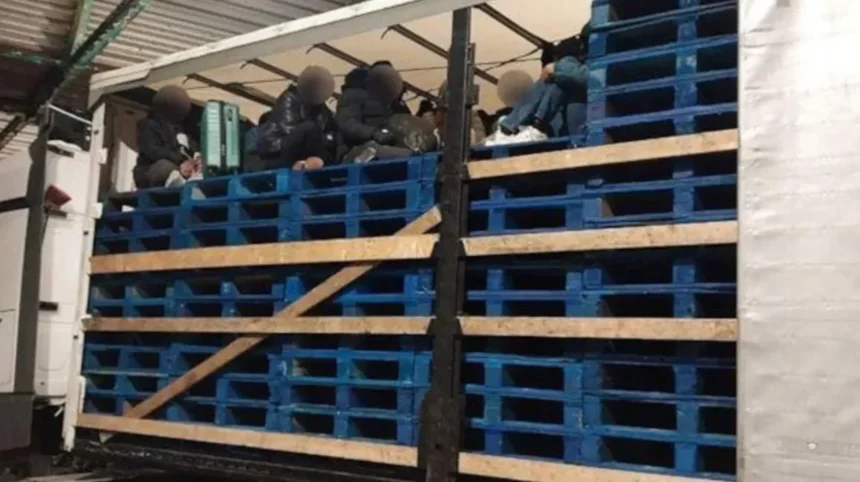
- In a single intercepted operation in January 2026, law enforcement discovered 23 individuals being transferred from London to a location near Whitstable before loading onto a lorry bound for Dover.
East London (East London Times) October 29, 2026 – A major human smuggling network that illicitly transported migrants from the United Kingdom into France by concealing them within freight lorries departing through Dover has been completely dismantled, culminating in a total of 84 years of imprisonment handed down to 21 individuals. The extensive law enforcement operation was spearheaded by the National Crime Agency, which meticulously tracked and investigated 10 separate human smuggling runs conducted between July 2025 and January 2026.
An official spokesperson for the agency detailed that migrants paid approximately £1,400 per person to secure passage across the English Channel into France. The agency noted that a significant majority of the migrants involved were lawfully present inside the UK at the time of their departure but sought clandestine transport in order to evade stringent border controls and immigration restrictions governing entry into the European Union.
The legal proceedings concluded at Canterbury Crown Court on Wednesday, where the remaining three members of the syndicate—Shuhal Ahmed, Robiul Islam, and Qasim Jan—received their custodial sentences. Court filings showed that Shuhal Ahmed, aged 44 and operating out of East London, served as a primary head of the enterprise, systematically charging individuals substantial fees to facilitate their unlawful entry into French territory without undergoing standard border scrutiny.
What Roles Did Key Gang Members Play in Transporting Migrants to Kent?
The logistical execution of the smuggling runs relied heavily on commercial transport within London and Kent. Robiul Islam, aged 50, utilized his position as a licensed taxi driver to pick up mostly Bangladeshi and Pakistani migrants from various locations across London and transport them to pre-arranged staging grounds in Kent. From these Kent rendezvous points, the crime group systematically coordinated the final channel crossings aboard international freight vehicles.
In January 2026, officers from the agency intercepted a major transport run involving 23 migrants. The group had been collected in London and moved directly to a designated staging location in the vicinity of Whitstable. From Whitstable, the individuals were systematically loaded into the rear of a heavy goods vehicle destined for the Port of Dover.
During the final sentencing hearing at Canterbury Crown Court, Shuhal Ahmed was sentenced to eight and a half years in prison for his supervisory leadership role. Robiul Islam received a five-year prison term for his extensive involvement in logistics and transport. Qasim Jan, aged 55, another taxi driver who assisted in ferrying migrants to the coastal transport hubs, was sentenced to four years in custody.
What Is the Background of This UK-to-France Smuggling Operation?
Traditionally, cross-Channel human smuggling operations have predominantly operated in the opposite direction, with criminal syndicates focusing resources on bringing undocumented migrants from continental Europe into the United Kingdom across the Straits of Dover. However, changing legal landscapes, increased enforcement mechanisms, and differing immigration statuses within the UK have generated a secondary, reverse trafficking route from English ports to European destinations.
Between July 2025 and January 2026, the National Crime Agency launched a targeted investigation into organized criminal groups exploiting heavy goods transport leaving Kent. The investigation revealed an organized network capable of sourcing migrants within London, providing temporary holding points in rural and coastal Kent such as Whitstable, and establishing contacts within the haulage sector to conceal individuals inside commercial vehicles crossing via Dover.
The profile of the migrants involved highlights a specific demographic pattern. Rather than individuals seeking asylum upon initial arrival in Europe, the majority of those using this specific network held valid legal status to remain inside the UK. However, due to administrative travel restrictions, visa limitations, or overstay concerns regarding entry into the Schengen Area, these individuals resorted to paying criminal gangs £1,400 per head to bypass formal European immigration checkpoints. The successful conviction of 21 members marks the total dismantling of this specific infrastructure by British law enforcement authorities.
Prediction: How Will This Legal Enforcement Action Affect Freight Operators, Migrants, and Border Security?
The conviction and lengthy sentencing of this 21-member network are expected to have several immediate and long-term consequences for haulage operators, legal authorities, and individuals seeking entry into European territories.
Impact on the Freight and Transport Sector
Commercial road haulage companies and freight drivers operating through Dover and the Channel Tunnel will likely face heightened security scrutiny and stricter liability assessments. Because criminal networks actively recruit or exploit heavy goods vehicles to hide migrants, freight operators heading toward Europe will need to implement more rigorous vehicle seal checks, thermal imaging inspections, and pre-boarding protocols in Kent to avoid vehicle impoundment or civil penalties from European border regulators.
Impact on Migrant Demographics and Illegal Transit Routes
For migrants holding legal status in the UK who wish to travel to Continental Europe without official documentation, the complete collapse of this network eliminates a prominent covert transit route. The severe sentences handed down to facilitators—particularly the four to eight-year terms given to drivers and coordinators—are expected to act as a significant deterrent to prospective smugglers operating inside London and Kent. Consequently, illicit passage fees across the Channel may increase substantially as surviving or prospective criminal groups adjust their rates to offset the elevated risk of detection by law enforcement agencies.
Impact on UK-EU Border Intelligence Sharing
The success of this 10-run investigation reinforces joint intelligence frameworks between United Kingdom law enforcement and European border authorities. Going forward, border enforcement agencies are anticipated to expand surveillance mechanisms on outgoing vehicular traffic leaving Dover, shifting traditional security focus from inbound border checks to dual-directional monitoring along key transport corridors in the South East of England.