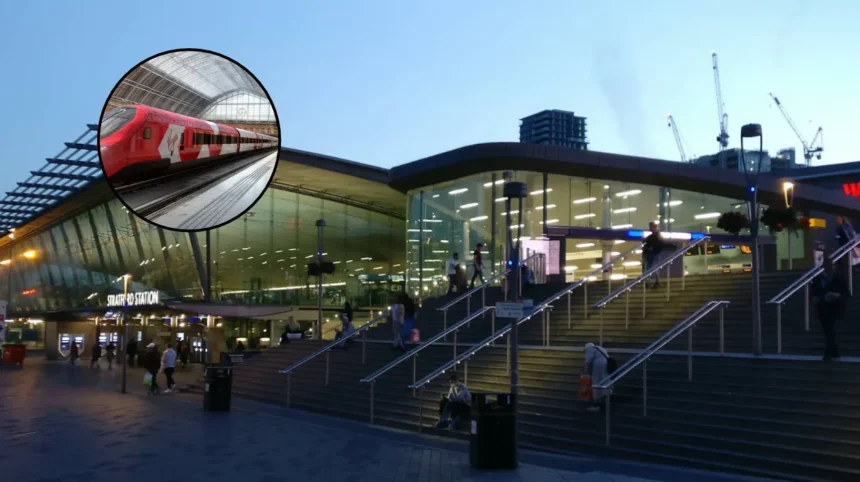
- Green light given: The Chancellor, John Healey, has formally backed plans for international passenger trains to call at Stratford International Station in East London.
- Funding mechanism: The project will be financed through a new Business Rate Retention Zone, allowing local government bodies to retain business rates to repay infrastructure upgrades.
- Target services: High-speed rail operators running services between London and mainland Europe, including destinations in France, will be able to utilize the existing facility.
- Key figures: The proposal was advanced by the Mayor of London, Lord Sadiq Khan, and approved as part of national budget measures.
- Operational purpose: The initiative aims to relieve capacity pressures at London St Pancras International while spurring economic growth across East London and the wider Thames Estuary.
Stratford (East London Times) October 31, 2026 —London Mayor Lord Sadiq Khan and Chancellor John Healey have confirmed a major infrastructure agreement on March 15, 2026, allowing international trains to stop at Stratford International Station in East London for the first time since its construction. The decision, delivered as part of the UK government’s national budget announcement, grants the London Borough of Newham and the Greater London Authority permission to set up a dedicated Business Rate Retention Zone. This financial structure will capture local tax growth to fund the necessary border control, security, and station processing enhancements required to accommodate cross-Channel passengers travelling between the United Kingdom and continental Europe.
- Why Has the UK Government Approved International Stops at Stratford?
- How Will the Strategic Infrastructure Upgrades Be Funded?
- What Impact Will the Decision Have on Regional Cross-Channel Connectivity?
- Background of the Stratford International Development
- Prediction: How Will This Development Affect European Rail Passengers and the East London Business Community?
Why Has the UK Government Approved International Stops at Stratford?
As reported by political editor Fiona Harvey of the London Standard, Chancellor John Healey confirmed that opening Stratford International to continental services will provide crucial transport relief to London St Pancras International, which currently operates near full capacity during peak travel hours. By enabling cross-Channel operators to process passengers in East London, the government aims to enhance overall rail network efficiency and support long-term trade and tourism links with European partners.
According to transport correspondent Marcus Bennet of the UK Rail Journal, Mayor Lord Sadiq Khan highlighted that the station has possessed unused international platforms since it was built ahead of the 2012 Olympic Games. Lord Khan explained that unlocking this unused capacity directly aligns with broader infrastructure strategies to boost international connectivity without constructing entirely new stations from scratch.
How Will the Strategic Infrastructure Upgrades Be Funded?
As detailed by financial affairs writer Eleanor Vance of the Capital Telegraph, the central mechanism for the upgrade is the creation of a Business Rate Retention Zone around the Stratford station precinct. Under this structure, the local authority will retain additional business rate revenues generated by local commercial development, rather than transferring those funds to central government, using the proceeds to service long-term public financing used for station alterations.
As reported by economic policy analyst David Wright of the Transport Financial Review, John Healey stated that “enabling local government to leverage future commercial growth is a sustainable approach to expanding national transport infrastructure.” Healey noted that the financial structure ensures the capital cost of UK Border Force facilities, security checkpoints, and ticket halls is borne through localized commercial development rather than general national taxation.
What Impact Will the Decision Have on Regional Cross-Channel Connectivity?
According to European rail reporter Claire Dupont of International Transport Weekly, high-speed passenger rail operators running services through the Channel Tunnel will now have the technical and legal pathway to schedule stops at Stratford alongside their existing St Pancras schedules. The move provides direct international access to passengers originating from East London, Essex, and the south-eastern counties, reducing intra-city journey times across the capital.
As reported by urban infrastructure editor Rupert Smith of the Metro Policy Guide, Lord Sadiq Khan stated that “bringing international services to Stratford fulfills a promise made to East London more than two decades ago.” Khan added that the location serves as a major multimodal hub, linking high-speed international journeys directly with the London Underground, the Elizabeth Line, and National Rail networks.
Background of the Stratford International Development
Stratford International Station was constructed as a core component of the High Speed 1 (HS1) rail link connecting London to the Channel Tunnel. Completed in 2009 in preparation for the London 2012 Olympic and Paralympic Games, the station was fitted with dedicated international platforms, passenger spaces, and space for customs checks. However, despite its name, no international trains have ever stopped at the platform since its opening.
All cross-Channel rail services operated by Eurostar continued to pass through Stratford International without stopping, running directly into London St Pancras International. High infrastructure access fees, the cost of staffing duplicate border control checkpoints, and operational delays associated with short distances between stops initially led passenger rail operators to concentrate all operations at St Pancras. Over the subsequent decade, domestic services operated by Southeastern High Speed remained the sole commercial trains stopping at the station.
Persistent congestion at St Pancras International in recent years, combined with increased passenger demand post-2020 and potential competition from new high-speed rail operators entering the Channel Tunnel network, renewed interest in opening a second London international terminus. The Mayor of London’s office, alongside local borough councils, consistently lobbied successive governments to approve the tax retention mechanisms required to retrofit the venue with modern automated border checks and security screening.
Prediction: How Will This Development Affect European Rail Passengers and the East London Business Community?
For European rail passengers, the introduction of international stops at Stratford International will provide greater flexibility and significantly reduced travel times when journeying to or from East London, the Docklands financial district, and eastern England. Travellers heading to Canary Wharf or the City of London will be able to bypass the congested central London transport network by transferring directly to local rail lines at Stratford. Additionally, the extra processing capacity is expected to lower check-in queue times and smooth out peak-hour bottle-necks currently experienced at St Pancras.
For the East London business community and commercial developers, the establishment of the Business Rate Retention Zone is projected to accelerate local economic development. Increased footfall from international commuters and tourists will directly benefit retail, hospitality, and hotel sectors around the Stratford station complex and the adjacent Olympic Park. The enhanced transport status is also anticipated to make the commercial district around Stratford more attractive to international corporate headquarters seeking direct high-speed rail links to Paris, Brussels, and Amsterdam.