Key Points
- Licensing Ruling Imposed: Waltham Forest Council’s licensing committee has issued eight new conditions on The Castle pub in Walthamstow Village following neighbour complaints.
- Curfew for Minors: Children under the age of 18 must now be off the premises by 9:00 pm and must be accompanied by an adult at all times.
- Neighbour Complaints: Local residents reported that unsupervised children were trespassing into private gardens, damaging parked cars, and harming their mental health through persistent noise and boisterous behavior.
- Community Support: The licence review drew 144 representations, with more than half of the submissions defending the 168-year-old establishment as a vital community hub.
- Management Requirements: The pub must maintain an outdoor management plan, install removable barriers and clear signage, log all complaints, and provide neighbours with a direct telephone line.
- Rejected Demands: The committee declined requests from campaigners for a total ban on outdoor drinking and the mandatory presence of weekend door staff.
- Owner’s Response: Landlord Adam Phillips welcomed the ruling, noting that pedestrianisation had increased the pub’s popularity as a family venue and confirming his commitment to neighbourhood harmony.
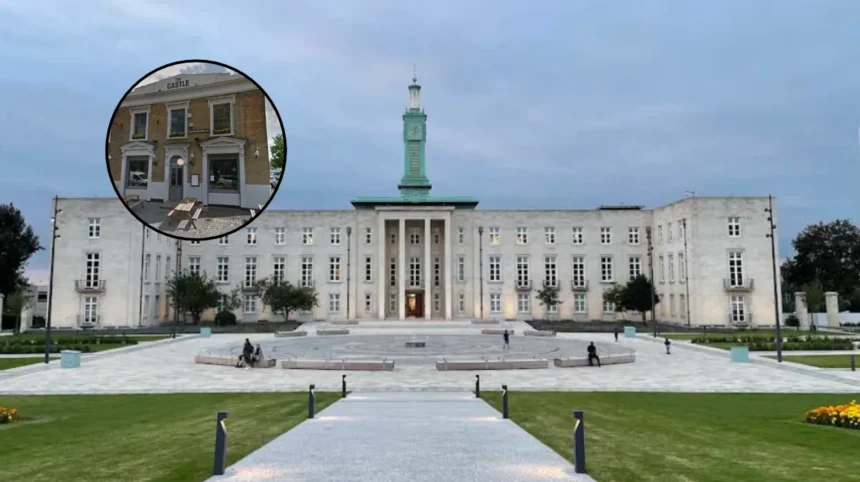
Waltham Forest (East London Times) November 6, 2026 – The Castle, a 168-year-old public house situated on Grosvenor Rise East in Walthamstow Village, has been subjected to a strict set of new operational conditions following a formal licensing review conducted by Waltham Forest Council. The decision came after nearby residents submitted official complaints regarding the conduct of customers’ children, alleging that unsupervised youth were causing significant disruption in the surrounding quiet residential area.
During the formal proceedings held on Tuesday, 3rd November, the council’s licensing committee evaluated 144 written representations submitted by local residents, patrons, and interested parties. Whilst more than half of the submissions praised the establishment as a treasured neighborhood asset, a group of local residents detailed ongoing issues with outdoor noise, property damage, and boundary intrusions.
In their official application for the review, affected residents highlighted that the situation outside their front doors had become intolerable. As stated by residents in the official review application, “We are reasonable people and we recognise the value of the pub as a meeting place in the community, especially when so many are closing. We want the Castle to remain a part of the neighbourhood.” However, the application further noted that householders should not have to tolerate antisocial conduct directly outside their homes: “However, we shouldn’t have to put up with such behaviour right outside where we live, in a quiet residential area.”
Neighbours explained to the panel that children running unchecked down the street was having a negative impact on their mental health. Statements included in the review documentation outlined instances where minors had trespassed into private residential gardens and damaged motor vehicles parked along the road. The applicants clarified that their intention was not to shut the establishment down or strip the landlord of his livelihood. As declared by the residents in the application, “We aren’t asking for the landlord to lose his licence. We are simply asking for some reasonable measures to be implemented so that we don’t feel intimidated or overwhelmed outside our own homes.”
What New Conditions Has Waltham Forest Council Imposed?
Following extensive deliberation, the licensing committee determined that eight additional conditions must be attached to The Castle’s premises licence to mitigate public nuisance and safeguard local amenities. Chief among these measures is a strict curfew governing minors. Under the new stipulations, any individual under the age of 18 must be accompanied by an adult at all times whilst on the premises and must vacate the pub completely by 9:00 pm.
In addition to the child curfew, the committee ordered the pub’s management to implement comprehensive administrative and operational safeguards. The Castle must now maintain a detailed written record of all complaints received from the public, alongside a dedicated phone number to allow neighbours to contact management directly during trading hours. Furthermore, the venue is required to formulate and adhere to an exhaustive outdoor management plan. This plan must explicitly address noise control, physical obstructions, public nuisance, unsafe behaviour, complaint resolution, and appropriate staffing levels for outdoor zones.
Physical alterations to the external area were also mandated. The council made it a formal condition for management to clearly delineate the pub’s outdoor perimeter using visible signage and removable barriers. This measure formalises recent steps taken by the establishment to remind guardians of their supervisory duties.
However, the licensing panel stopped short of granting all restrictions requested by the campaigning neighbours. The committee rejected proposals for a complete ban on patrons standing and drinking outside the venue. Additionally, councillors declined to impose a condition requiring professional security staff to be stationed outside the premises every weekend to enforce boundary lines and police public behavior.
How Did Local Residents and Patrons Defend the Establishment?
The licensing hearing on Tuesday morning saw a strong turnout from local residents and regulars who mounted a vigorous defense of the historical venue. Countering allegations of neglect, supporters “disagreed very strongly” with claims that there was “zero appropriate oversight” from management, describing the staff as attentive, proactive, and consistently receptive to community feedback.
Defenders of the pub argued that the presence of families created a welcoming environment rather than a public nuisance. One resident characterized children playing in the street near the establishment as a “very soft, gentle, and joyous environment,” acknowledging that whilst young people could occasionally become “boisterous,” their presence reflected a healthy neighborhood dynamic rather than criminal disorder.
The committee also received testimony from a local mother of three, who pointed out that recently installed signs requesting parents to supervise their children had already proven effective in curbing stray activity. This proactive step by management was cited by supporters as evidence that the venue was fully capable of self-regulation without the need for draconian measures.
Following the announcement of the committee’s decision, pub owner Adam Phillips offered a statement reflecting on the verdict and the evolution of the site. As reported by Sebastian Mann, Local Democracy Reporter, Mr Phillips stated: “Since the pedestrianisation of the area outside the Castle as part of the Mini Holland scheme, the pub has become an increasingly popular family-friendly meeting place for the local community.”
Mr Phillips expressed gratitude toward the customers and neighbours who backed the business during the review process. As reported by Sebastian Mann, Local Democracy Reporter, Mr Phillips added: “I am very grateful to the many local residents who wrote in support of the Castle. I welcome the council’s decision and recognise the importance of respecting the interests and concerns of our neighbours. I believe the additional licence conditions will enable The Castle to continue to be a valued community hub while addressing those concerns.”
Background of the Particular Development
The Castle has operated as a public house on Grosvenor Rise East for 168 years, establishing itself as a cornerstone of the historic Walthamstow Village conservation area. The venue markets itself online as a “traditional pub in the heart of Walthamstow Village,” offering food services until 9:00 pm and serving alcohol until 11:00 pm daily.
The friction between outdoor pub trade and surrounding residents increased significantly following the implementation of the “Mini Holland” scheme by Waltham Forest Council. This major urban planning initiative pedestrianised several thoroughfares throughout Walthamstow Village, drastically reducing vehicular traffic and expanding public space outside retail and hospitality venues.
While the reduction in traffic transformed the space outside The Castle into an attractive, car-free gathering point for local families, it also blurred the physical boundaries between commercial space and residential property. The expanded outdoor footfall inevitably brought pub patrons and playing children into closer proximity with private homes, culminating in the formal licence review and the subsequent intervention of the local authority.
Prediction: How This Development Can Affect the Community and Hospitality Sector
The imposition of these eight licensing conditions is likely to have immediate and long-term consequences for local families, the pub’s operational model, and the broader hospitality landscape in East London:
- Impact on Local Families: The 9:00 pm curfew and mandatory adult supervision rule will alter how local parents use the venue. While families can still gather for early evening meals, the strict cutoff time removes the pub’s utility as a late-evening family dining spot, forcing parents to clear out earlier and potentially shifting family gatherings to private spaces or alternative venues without age constraints.
- Impact on Pub Operations and Revenue: The Castle will need to reallocate staff resources to ensure strict compliance with the new conditions. Staff members will have to actively monitor customer ages, enforce the 9:00 pm clearance of minors, manage boundary barriers, and log complaints meticulously. Failure to meet these criteria could invite further legal scrutiny or licence revocation. However, because the council rejected the mandatory weekend bouncer condition, the pub avoids significant additional payroll expenses.
- Impact on Neighbourhood Relations: The provision of a dedicated telephone line and a structured complaint management plan offers a formal channel for grievance resolution. If management enforces the outdoor boundaries effectively, friction regarding property damage and noise should decrease, potentially restoring harmony between long-standing residents and pub patrons.
- Precedent for Urban Planning and Hospitality: This case highlights an unintended consequence of urban pedestrianisation schemes like Mini Holland. As councils convert street spaces into pedestrianised plazas, pubs and restaurants naturally spill outward. This ruling establishes a precedent across Waltham Forest and similar London boroughs: while pedestrianisation is designed to foster community spaces, commercial venues utilizing public outdoor areas will be held to strict operational boundaries if public space overlaps with residential quiet enjoyment. Other venues operating in pedestrianised zones may now face similar regulatory pressure to introduce formal child curfews and physical boundary controls.