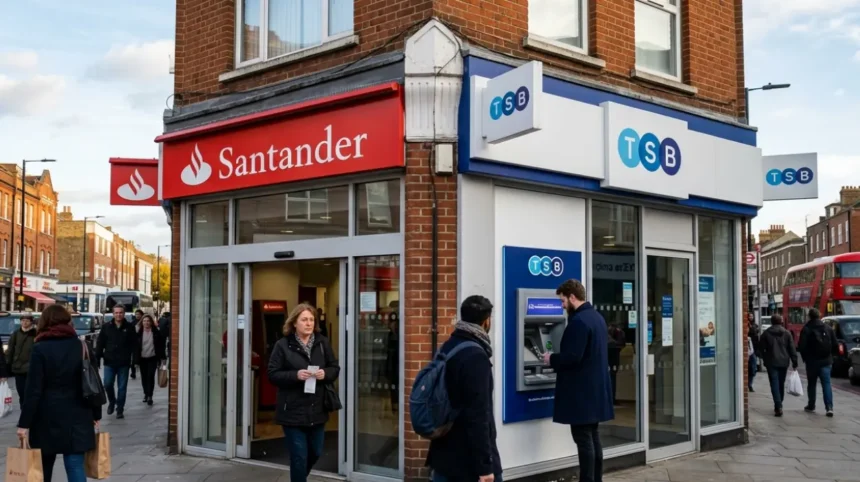
Santander UK plc operates as a major British bank owned by Spain’s Banco Santander. TSB Banking Group plc functions as a UK retail bank that Santander acquired in April 2026 for £2.9 billion.
- What is Santander Bank?
- What is TSB Bank?
- How did Santander acquire TSB?
- What services do Santander and TSB offer?
- Where are Santander and TSB branches in East London?
- What changes for customers after the acquisition?
- How does the merger impact East London communities?
- What are key differences between Santander and TSB?
- What should East Londoners consider when choosing between them?
What is Santander Bank?
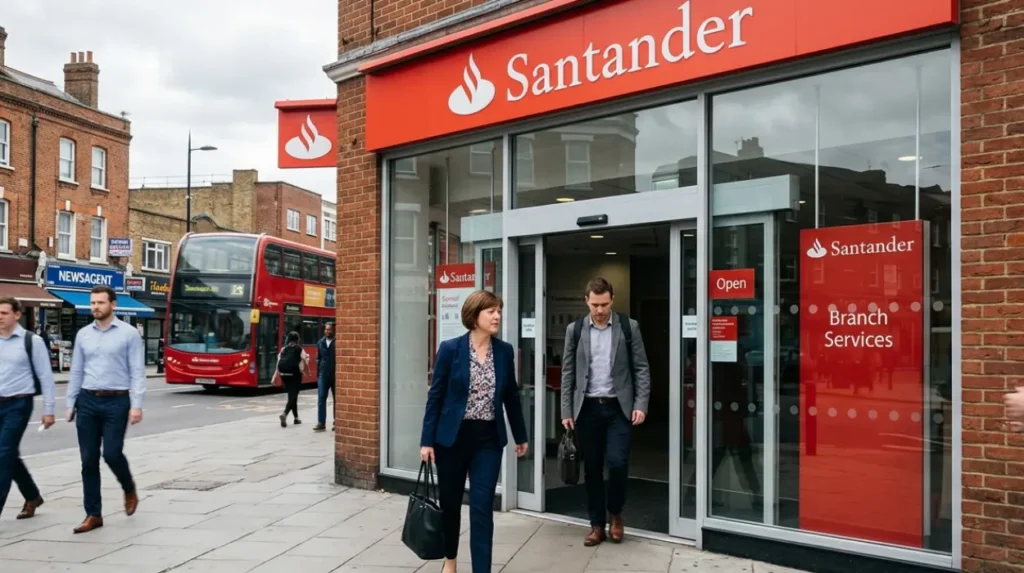
Santander UK plc provides personal banking, mortgages, savings, loans, and business accounts to 14 million customers across 460 branches as of May 2025. Headquartered in London’s Regent’s Place, it ranks among the UK’s top providers of mortgages and savings products.
Banco Santander founded Santander UK through mergers. Abbey National plc, acquired in 2004 for £9 billion, formed the core. Santander added Alliance & Leicester in September 2008 and Bradford & Bingley’s savings business in 2008 during the financial crisis.
The bank rebranded all branches to Santander by January 2010. This process included 1,045 locations nationwide. Santander UK employs 18,000 staff and maintains 64 corporate centers.
Services cover current accounts, credit cards, and online banking via app and website. The bank offers fee-free current accounts for mortgage customers since November 2009. Digital services include mobile apps and Cahoot internet banking.
In East London, branches operate in areas like Islington High Street and Cheapside. These locations provide cash services, account openings, and mortgage advice. Santander supports local communities through the Santander Foundation, established from predecessor charities.
Future growth includes technology investments. Santander prevented £3.5 million in fraud in early 2025 via its “Break the Spell” team. This initiative targets scams like romance fraud.
What is TSB Bank?
TSB Banking Group plc delivers retail banking with current accounts, mortgages, savings, and loans to UK customers through 220 branches. Traced to 1810 savings banks, it revived as an independent entity in 2013 after splitting from Lloyds.
TSB originated from Reverend Henry Duncan’s 1810 savings bank in Ruthwell, Scotland. By 1970s, 84 trustee savings banks merged. Parliament’s 1958 bill expanded services; flotation occurred in 1986 as TSB Group.
Lloyds TSB formed in 1995 merger. Regulatory requirements led to TSB’s 2013 demerger with 631 branches. Sabadell acquired TSB post-demerger.
Core offerings include Spend & Save accounts with cashback. TSB provides fixed-rate savings up to 4.30% AER and business accounts. Mobile app supports payments and balances.
London branches include Clapton Common (E5 9AQ), Highgate Hill (N6), The Broadway (N8), and High Road Leytonstone (E11). These serve East London with deposits up to £85,000 protected by FSCS.
Post-acquisition, TSB operates separately under its brand. CEO Nicola Bannister leads integration as of May 2026.
How did Santander acquire TSB?
Santander agreed to buy TSB from Sabadell in July 2025 for £2.65 billion cash, rising to £2.9 billion at April 2026 close. Regulators including PRA and ECB approved; TSB integrates into Santander UK group.
Negotiations valued TSB at 5x 2026 earnings post-synergies and 1.45x book value as of March 2025. Sabadell shareholders approved in August 2025.
Acquisition strengthens Santander’s UK position to third-largest by personal current accounts. Combined entity serves 28 million customers.
Process involved no customer action. Santander announced completion on April 30, 2026.
Implications include potential branch optimizations. Some TSB closures occurred pre-merger, like Rye Lane (SE15) in June 2025.
What services do Santander and TSB offer?
Both banks provide current accounts, savings, mortgages, loans, credit cards, and business banking. Santander emphasizes digital tools and international transfers; TSB focuses on cashback current accounts and higher savings rates up to 4.30% AER.
Current accounts at Santander include Everyday Current Account with no fees for mortgage holders. TSB’s Spend & Save offers 8% cashback on utility bills up to £120 monthly.
Savings options differ. Santander lists Instant Access (0.40% AER), Business Reward Saver (1.40%), Fixed Rate Bond, and Treasurer’s Account (up to 3.60% AER). TSB provides Instant Access (1.35%-0.90%) and Fixed Bonds. Examples: Santander Fixed Rate for 1-year term; TSB 12-month Fixed Bond.
Mortgages rank Santander fourth-largest in UK; fixed rates start from 3.99%. TSB offers competitive tracker mortgages.
Business services compare: Santander ranks higher in overdrafts (6th) and service quality (59% score). TSB trails in SME loans (11th). Both support £1 minimum deposits.
East London customers access loans via branches. Credit cards from Santander include All in One (0% on purchases up to 28 months).
Where are Santander and TSB branches in East London?
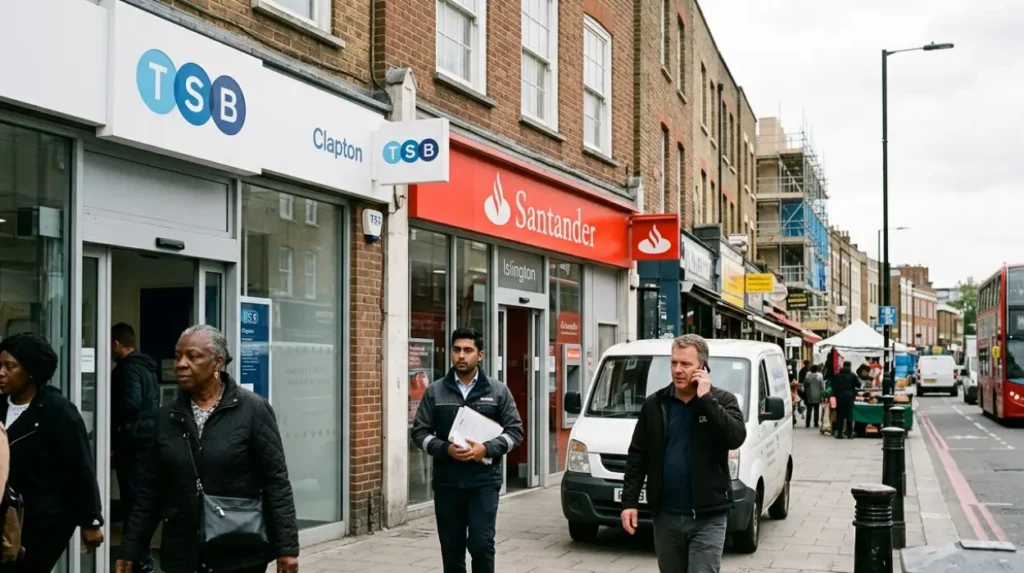
Santander branches operate at Islington High Street (N1), Cheapside (EC2V 6AZ), and Mark Lane (EC3R 7QR). TSB locations include Clapton Common (E5 9AQ), Leytonstone High Road (E11 4DA), and Highgate Hill (N6); hours typically 9am-4pm weekdays.
Santander’s Islington branch at 15-17 Islington High Street serves deposits and advice. Cheapside in City of London handles corporate needs. Mark Lane focuses on international finance.
TSB’s 174 Clapton Common (Hackney) opens 9am-4pm Monday-Friday, 9am-1pm Saturday. 539 High Road Leytonstone supports local savings. 34 The Broadway (East Finchley, bordering East) aids mortgages.
Post-merger, branches remain separate initially. No shared access yet; use respective ATMs fee-free.
Over 10 branches combined in Greater East London area. This network covers Tower Hamlets, Hackney, Newham.
What changes for customers after the acquisition?
No immediate changes occur; accounts, cards, sort codes, and apps stay identical. TSB runs separately; FSCS protects deposits up to £85,000 per bank. Future integrations announced in advance.
Santander customers face zero disruptions. TSB users continue normal operations; dual-bank holders keep separate accounts.
Interest rates, fees, and Direct Debits remain unchanged. Cards valid until expiry; cheques accepted.
Branches unaffected short-term. Complaints process identical; accessibility support continues.
Data privacy complies with UK laws; no unapproved sharing. Scams rise post-news—verify via 159.
Long-term, Santander may introduce products. Combined scale boosts mortgage and account options for 28 million users.
How does the merger impact East London communities?
Merger creates third-largest UK bank by current accounts, enhancing service scale in East London with 10+ branches. No branch closures announced locally; fraud protection expands via Santander’s £3.5m prevention in 2025.
East London gains from denser network. Hackney’s TSB Clapton and Santander Islington provide accessible banking amid regeneration.
Local economy benefits from business accounts. Santander’s corporate centers support SMEs in Newham and Tower Hamlets.
FSCS dual protection persists initially. Vulnerable customers receive ongoing support.
Future synergies cut costs, potentially lowering fees. 18,000 employees nationwide include London staff.
Communities access Santander Foundation grants. Sports sponsorships like Williams Racing indirectly boost visibility.
What are key differences between Santander and TSB?
Santander excels in service quality (59% score, 7th rank) and savings variety (up to 3.60% AER); TSB leads savings rates (4.30% AER max) but ranks lower (48% score, 12th). Santander has more branches; TSB offers better cashback.
Santander supports foreign currencies in savings. TSB focuses domestic retail.
Customer reviews: Santander 1.4/5 Trustpilot (6,868 reviews); TSB 4.2/5.
East London choice depends on needs: Santander for business, TSB for high-yield savings.
What should East Londoners consider when choosing between them?
Evaluate savings rates (TSB higher at 4.30%), service quality (Santander superior), and branch proximity. Post-merger, monitor updates; FSCS covers £85,000 per bank separately now.
Proximity matters in East London traffic. TSB Clapton suits Hackney; Santander Islington fits commuters.
Rates fluctuate: Check AER annually. Santander’s digital app suits tech users; TSB app basic.
Business owners pick Santander for overdrafts. Personal users favor TSB cashback if bills high.
Merger timeline: Full integration years away. Switch via Current Account Switch Service (7 days).
Stats show 14 million Santander customers value scale. TSB’s heritage appeals to traditionalists.
What is Santander UK plc?
Santander UK plc is a major British retail bank owned by Banco Santander, offering current accounts, mortgages, savings, loans, and business banking to around 14 million customers.