The London Borough of Barking and Dagenham continues to shape its long‑term future through a series of major planning decisions, centred on large‑scale regeneration schemes and tightly controlled housing‑led development. These decisions are steered by the council’s “It Starts Here: Partnerships for Change” borough plan, which sets growth targets, infrastructure requirements, and policy priorities until 2031. The borough’s planning pipeline is dominated by four key transformation areas: Barking Town Centre, Barking Riverside, Thames Road, Dagenham Heathway, and Beam Park, each of which has seen significant determinations in recent public‑committee meetings.
- How does Barking and Dagenham manage major planning applications?
- What are the key planning policy drivers in the borough?
- What has changed for Barking Riverside planning approvals?
- How is the Beam Park application being handled?
- What role do S106 agreements play in recent decisions?
- How do the Housing Strategy and Local Plan influence individual applications?
- How does the council balance brownfield intensification with local impact?
- How can residents engage with and influence planning decisions?
How does Barking and Dagenham manage major planning applications?
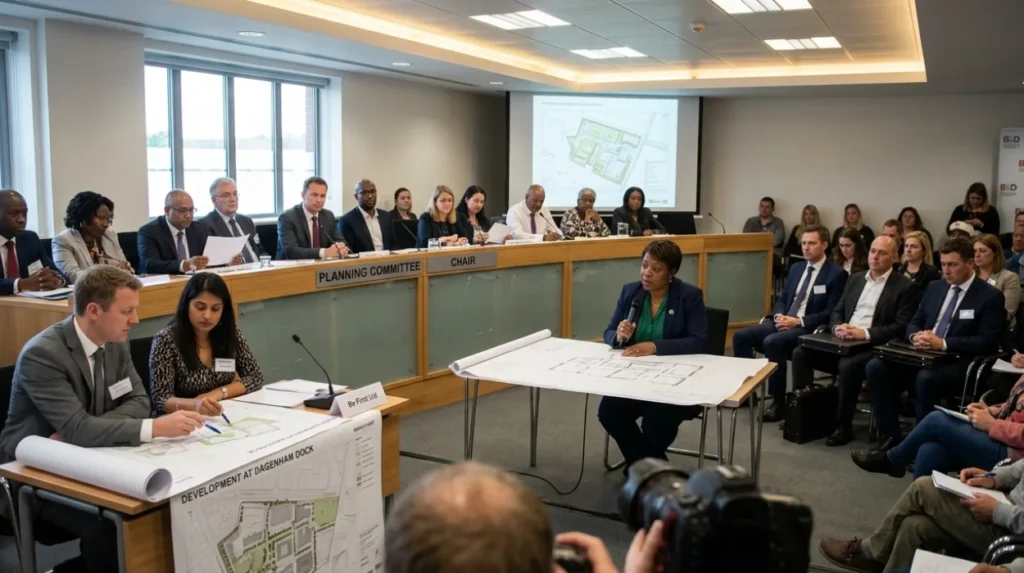
Barking and Dagenham manages major planning applications through a council‑led Planning Committee that reviews outline and detailed consents, supported by Be First Ltd, which delivers statutory planning services on behalf of the council and consistently decides all applications within statutory time limits.
The council’s own planning department, operated under Be First, commits to providing an up‑to‑date Local Plan with a robust evidence base and a decision on every application within the due timeframe. In practice, this has translated into a 100% record of making decisions within statutory deadlines for several consecutive years, a performance highlighted in the council’s Planning Performance Review Sub‑Committee. This reliability makes the borough attractive to developers while giving residents confidence that applications are not stalled indefinitely. Applications are categorised as outline, full, prior‑notification, or conditions‑amendment types, each with distinct technical and community‑impact implications.
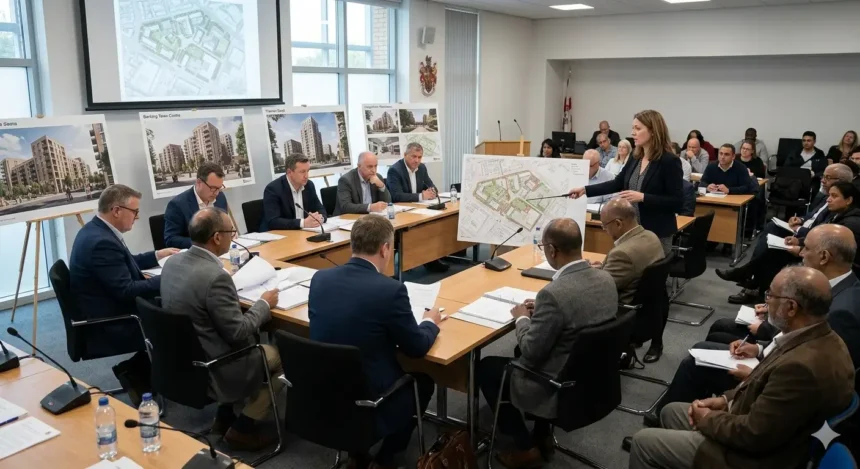
The Planning Committee itself sits above the officer‑led process and is responsible for referred items, such as large‑scale mixed‑use schemes and those that generate significant public interest. Officers prepare detailed reports weighing design, density, transport, affordable housing, and environmental factors; the committee then votes on whether to approve, refuse, or approve with conditions. Where decisions are challenged, the council has a strong track record in appeals, with a high dismissal rate that reflects the legal and policy robustness of its determinations.
What are the key planning policy drivers in the borough?
The key planning policy drivers in Barking and Dagenham are the adopted borough‑wide vision “It Starts Here: Partnerships for Change”, the 2026–2031 Housing Strategy, and the Local Plan plus supplementary planning documents, all of which set housing targets, affordability expectations, and infrastructure‑funding requirements.
Council‑wide, the “It Starts Here” plan sets a place‑based strategy focused on tackling poverty, inequality, health, safety, and environmental challenges through coordinated cross‑agency work. Within this framework, the 2026–2031 Housing Strategy explicitly links new housing to infrastructure, requiring that at least 44,000 homes and 20,000 jobs are delivered via the draft Local Plan and associated sites. The strategy also defines “high quality homes and neighbourhoods”, meaning that new dwellings must meet or exceed national standards for space, safety, and energy efficiency while complying with the Local Plan.
Supplementary planning documents (SPDs) add granular guidance for specific regeneration corridors. For example, the Thames Road SPD sets design and mix requirements for the route, encouraging better‑quality housing, mixed‑use spaces, and improved pedestrian environments. Together, the Local Plan, housing strategy, and SPDs create a tiered policy framework that developers must engage with when submitting applications, ensuring that each project contributes to the overall regeneration narrative rather than acting in isolation.
What has changed for Barking Riverside planning approvals?
Barking Riverside has moved from an initial outline consent into an expanded, infrastructure‑linked masterplan phase, with the council agreeing a revised outline permission that raises the projected housing capacity to around 20,000 homes and binds developers to a substantial package of S106 infrastructure obligations.
The initial Barking Riverside scheme was one of the largest brownfield regeneration projects in London, converting a former industrial site into a new residential neighbourhood. In recent determinations, the council’s Planning Committee approved a revised outline permission for Barking Riverside Limited (BRL), allowing the project to expand from earlier horizons to a total of up to 20,000 homes across approximately 443 acres in Zone 4. This decision is underpinned by a rationalised S106 agreement that consolidates earlier obligations into a single, composite planning obligation for the wider Barking Riverside site.
The approved masterplan includes new major public parks, additional health facilities, multiple schools, community centres, commercial space, river‑front improvements, and enhanced walking and cycling routes. These elements are funded through developer contributions negotiated via Section 106, ensuring that infrastructure keeps pace with population growth. The council’s own reports stress that the Riverside framework aims to create a self‑contained, sustainable neighbourhood rather than a pure housing estate, with local employment, services, and green space embedded in the planning strategy.
How is the Beam Park application being handled?
Beam Park is being handled through phased, cross‑boundary planning approvals and S106‑linked conditions that allow thousands of homes to be delivered even in the absence of a completed Beam Park Rail Station, while preserving the long‑term regeneration ambitions of the site.
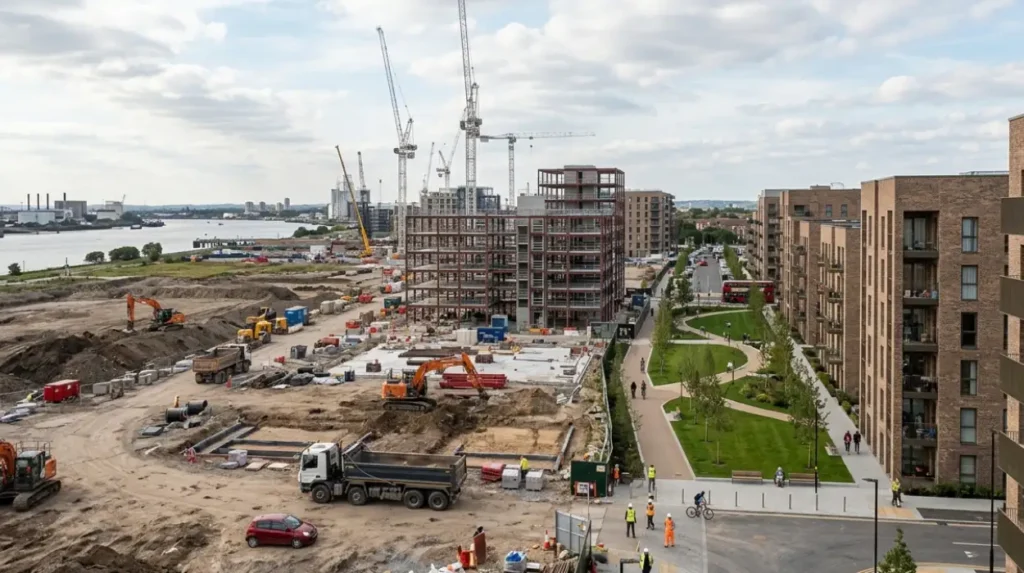
Beam Park is a cross‑boundary development lying partly within Barking and Dagenham and partly within the London Borough of Havering, which has historically required coordination via the Mayor of London’s planning powers. The overall site has outline planning permission for a substantial number of homes and non‑residential uses, with phased construction already underway; recent commentary notes that phases 2–3 of Beam Park are advancing without the Beam Park Rail Station, delivering over 2,500 units in the early phases. The council’s planning officers continue to monitor connectivity and transport impacts, even as the TfL‑led station element lags behind housing delivery.
On the policy side, Beam Park sits within one of the borough’s designated transformation areas, alongside Barking Riverside and Dagenham Heathway, meaning that its development is expected to contribute broad housing numbers and local amenities. The council’s decision‑making on Beam Park‑related applications includes reviewing non‑material amendments and S106‑related conditions, such as those adjusting delivery triggers for phases E, F, and G, to maintain momentum without compromising the long‑term masterplan. This approach ensures that the project remains viable while keeping future infrastructure and design options open.
What role do S106 agreements play in recent decisions?
Section 106 agreements play a central role in recent Barking and Dagenham planning decisions by locking developers into legally binding commitments for infrastructure, affordable housing, and community facilities, turning growth into a funded driver of public‑benefit rather than a cost‑shifting exercise.
Section 106 is a mechanism under the Town and Country Planning Act 1990 that allows local authorities to secure planning obligations attached to a planning permission. In Barking and Dagenham, the council has published a Planning Obligations SPD that sets out how it negotiates affordable‑housing percentages, contributions to open space, schools, health, and transport among other benefits. These agreements are then recorded as planning obligations and enforced through the planning conditions and legal covenants that accompany the permission.
For example, at Barking Riverside, a consolidated S106 combines earlier separate obligations into one overarching agreement, capturing commitments across transport, open space, biodiversity, skills, and community facilities for the whole 20,000‑home programme. At Beam Park and other transformation‑area sites, S106 clauses are adjusted via amendment applications to reflect changes in phasing, market conditions, or delivery timelines, ensuring that the legal framework remains aligned with the as‑built reality. This structured use of S106 helps the council meet its own infrastructure‑funding objectives without relying solely on general‑taxpayer support.
How do the Housing Strategy and Local Plan influence individual applications?
The Housing Strategy and Local Plan shape individual applications by setting non‑negotiable frameworks for housing density, tenure mix, design quality, and infrastructure contribution, so that every planning decision must demonstrably align with the borough’s 2026–2031 targets and transformation‑area priorities.
The Housing Strategy 2026–2031 explicitly identifies Barking Town Centre, Barking Riverside, Thames Road, Dagenham Heathway, and Beam Park as the core sites that will underpin the 44,000‑home goal. Each new application within these areas is assessed against the strategy’s expectations for good‑quality homes, space standards, safety, and energy performance, as well as the Local Plan’s policies on density, design, and affordable‑housing percentages. This means that even smaller‑scale proposals, such as infill flats or rear‑extension‑type prior‑notification applications, must still fit within the broader housing‑supply and design‑quality narrative.
Where applications propose departure from the Local Plan or established SPD guidance, officers must explain why the proposal is still acceptable, often through design‑led justification or increased community‑benefit contributions. The council also uses the evidence base from the Housing Strategy when negotiating S106 obligations, so that higher‑value or more intensive sites are expected to contribute proportionately more to infrastructure, skills, and community facilities. This policy‑driven approach ensures that every approved application, large or small, incrementally advances the borough’s regeneration and housing‑supply goals.
How does the council balance brownfield intensification with local impact?
The council balances brownfield intensification with local impact by prioritising development on previously used land, embedding strict design and environmental standards, and requiring detailed transport, noise, and amenity assessments that are tested against planning policy and S106‑funded mitigation measures.
Barking and Dagenham has a long‑standing emphasis on brownfield regeneration, including sites such as Barking Riverside (a former industrial and land‑fill area) and disused garage plots across the borough. The Housing Strategy explicitly encourages the use of infill and underutilised sites to avoid greenfield loss and to concentrate growth where infrastructure already exists. However, increased density on these sites can raise concerns about traffic, overshadowing, noise, loss of parking, and strain on local services, so the planning process requires developers to submit detailed technical assessments and, where necessary, design changes.
For example, at Barking Riverside, the council has required the integration of two new major public parks, improved river‑front access, and new health and education facilities as part of the approved masterplan, ensuring that green‑space and services expand alongside homes. At Beam Park, design‑led responses have been used to mitigate overshadowing and wind‑tunnel effects, while transport‑impact assessments underpin the S106‑linked contributions to bus services and connectivity. Officers also consult residents and local groups, and their comments are recorded in case reports and can influence the conditions attached to a permission. This combination of policy, technical review, and community‑feedback mechanisms allows the council to intensify brownfield sites without unacceptably degrading local amenity.
How can residents engage with and influence planning decisions?
Residents can engage with and influence planning decisions by viewing and commenting on live applications online, attending Planning Committee meetings, and using statutory consultation channels, so that their views on design, scale, and local‑impact factors are formally recorded and considered in the decision‑making process.
The council’s online planning portal publishes all active applications, including outlines, prior‑notification extensions, and conditions‑amendment cases, with links to officer reports, plans, and decision notices. Anyone can submit comments or objections via the council’s “Comment or Object to a Planning Application” page, and those comments form part of the planning officer’s report, which is then presented to the committee or used in delegated decisions. Comments are most effective when they focus on material planning considerations such as design, density, transport, highways, and amenity rather than personal preference, and they are more likely to influence conditions or design changes than the outright grant or refusal of permission.
For larger or more contentious projects, the public can also attend Planning Committee meetings, either in person or via live streaming, where applicants, councillors, and officers debate the merits of significant applications. Residents may also campaign through local groups or ward councillors, who can raise concerns directly with the committee or request that applications be referred upwards instead of decided by officers under delegated powers. This multi‑channel engagement system allows residents to participate in the planning process at multiple stages, from initial design‑feedback to the final decision‑making phase.
How does Barking and Dagenham approve big housing developments?
Major developments are decided by the council’s Planning Committee, supported by Be First. Planning officers assess proposals, and councillors vote to approve, reject, or apply conditions.