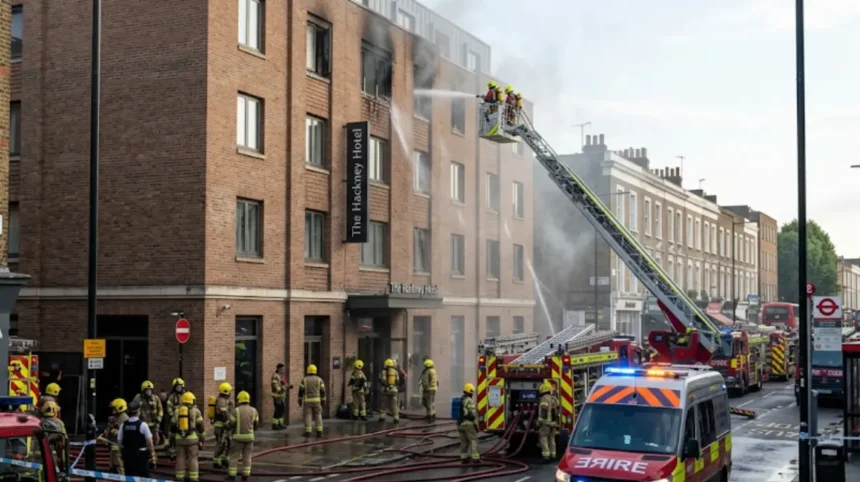
The most recent significant fire in Hackney occurred on 28 June 2026 at a hotel on Amhurst Road, near Hackney Central station, requiring ten fire engines and approximately 70 firefighters to bring the blaze under control by 18:20. The fire affected two rooms on the fifth and sixth floors of the hotel, led to the evacuation of around 16 people to a rest centre, and caused traffic disruption on Amhurst Road and surrounding streets while firefighting operations were ongoing. No injuries were reported, and the incident was treated as accidental, believed to have been caused by the unsafe use of incense sticks.
- When did the fire start and how long did it take to control?
- Which streets and areas were closed during the firefighting operation?
- How many people were evacuated and where were they taken?
- What caused the fire and how was it treated by authorities?
- What emergency response resources were deployed to the scene?
- What safety advice was issued to local residents during the incident?
- How does this incident compare to previous Hackney fires in 2026?
- What historical context exists for fire safety in Hackney and East London?
- What should residents do if they experience a fire emergency in Hackney?
- What ongoing investigations or follow-up actions resulted from the incident?
- What are the broader implications for fire safety policy in East London?
This incident represents one of several notable fire events in Hackney during 2026, each triggering emergency responses from the London Fire Brigade and temporary road closures across the borough. Understanding the full scope of what occurred, which streets were affected, and how residents and commuters should respond requires a detailed breakdown of the incident timeline, emergency protocols, and historical context of fire safety in East London.
When did the fire start and how long did it take to control?
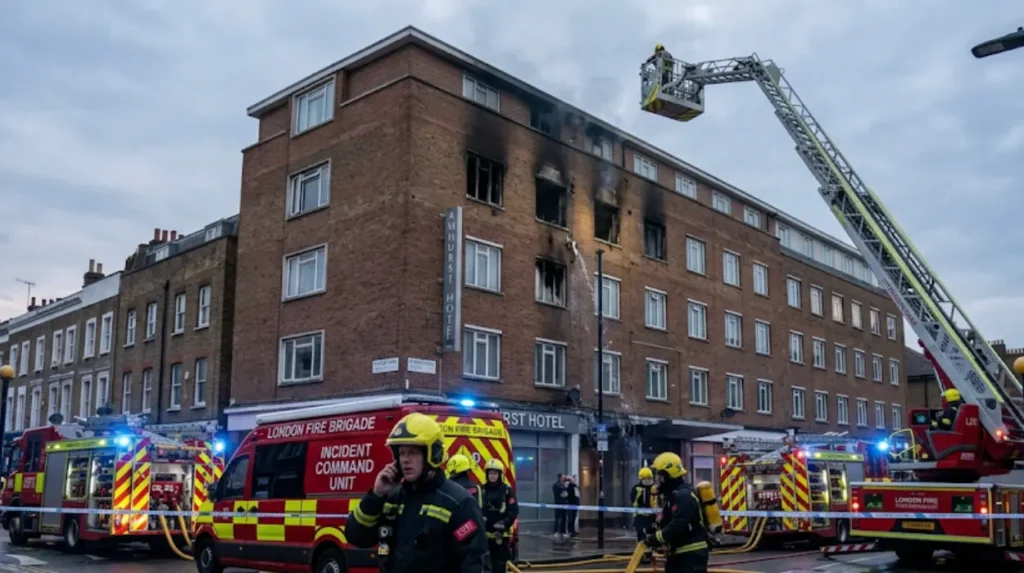
The Amhurst Road hotel fire was first reported at 16:52 on Sunday 28 June 2026, with the London Fire Brigade bringing the incident under control by 18:20, taking approximately one hour and 28 minutes to contain the blaze. Control officers received the first of 16 emergency calls at 16:52 and immediately mobilised crews from Homerton, Bethnal Green, Shoreditch, Islington, and surrounding fire stations to the scene.
The rapid response time reflects standard London Fire Brigade operational targets for structural fires in urban areas. Crews deployed a 32-metre turntable ladder from Tottenham Fire Station, which served as an observation tower to provide the Incident Commander with enhanced situational awareness during firefighting operations. The fire affected two rooms on the fifth and sixth floors, requiring coordinated efforts across multiple fire engines to prevent vertical spread through the hotel structure.
Historical data from previous Hackney fires shows similar containment timelines. The Dunloe Street flat fire on 27 February 2026 was reported at 19:20 and brought under control by 20:20, taking exactly one hour. The Cottrill Gardens outdoor fire on 24 May 2026 took longer, from 18:10 to 20:42, reflecting the challenges of tackling vegetation fires along railway embankments. These timelines demonstrate the London Fire Brigade’s capacity to respond swiftly to structural fires while adapting tactics to different fire types and locations.
Which streets and areas were closed during the firefighting operation?
Amhurst Road and surrounding roads near Hackney Central station experienced traffic disruption and partial closures while the London Fire Brigade conducted firefighting operations on 28 June 2026. The Brigade explicitly warned the public to avoid the area during the incident, with road closures implemented to ensure safe access for emergency vehicles and protect pedestrians from potential hazards.
The specific closure zones typically extend 100 to 200 metres from the fire scene in urban Hackney incidents, affecting primary thoroughfares and adjacent side streets. For the Amhurst Road incident, this likely included sections of Amhurst Road itself, connecting streets leading to Hackney Central station, and nearby residential roads where smoke dispersion posed health risks. Local residents received advisories to keep windows and doors closed due to smoke production from the fire.
Previous Hackney fires demonstrate consistent closure patterns. The Dalston Lane fire in June 2024 saw full road closure on Dalston Lane, with the London Fire Brigade advising the public to steer clear of the area during firefighting efforts. The Dunloe Street incident on 27 February 2026 required similar access restrictions to allow ten fire engines and 70 firefighters to operate safely. The Cottrill Gardens fire on 24 May 2026 disrupted Overground services across the borough, with the Mildmay line experiencing no service between Stratford and Gospel Oak until late evening. These closures reflect standard emergency protocols prioritising firefighter safety and operational efficiency over traffic flow.
How many people were evacuated and where were they taken?
Approximately 16 people were evacuated from the Amhurst Road hotel and taken to a rest centre, where they were left in the care of Hackney Council’s local authority emergency support services. No injuries were reported among evacuees or firefighters, and all individuals received immediate support from the local authority following evacuation.
Rest centres in Hackney typically operate from community facilities such as schools, churches, or council buildings, providing temporary shelter, food, and welfare support during emergency incidents. The London Fire Brigade coordinates with Hackney Council to activate these facilities when residential or commercial evacuations exceed the capacity for informal accommodation with friends or family. In the Dunloe Street flat fire incident, residents affected by the blaze received support at a local rest centre while firefighters remained on scene throughout the night damping down hot spots.
Evacuation numbers vary significantly based on fire type and location. The Dalston Lane fire in June 2024 saw around 50 individuals evacuated to St John’s Church, with none permitted to return to their residences immediately after the incident. Approximately half of those residents opted to stay with friends or relatives, while the remainder received emergency hotel accommodation arranged by the Council. The Dunloe Street incident on 27 February 2026 resulted in all residents of Fellows Court being swiftly evacuated, with the majority able to return to their homes Friday night after the fire was contained. These variations demonstrate the London Fire Brigade and Hackney Council’s adaptive approach to emergency accommodation based on incident severity and building safety assessments.
What caused the fire and how was it treated by authorities?
The Amhurst Road hotel fire was treated as accidental and believed to have been caused by the unsafe use of incense sticks, according to the London Fire Brigade’s initial investigation findings. Fire investigators classified the incident under accidental fire categories, distinguishing it from suspicious or deliberate ignition sources that would trigger Metropolitan Police counter-terrorism or arson investigations.
The London Fire Brigade issued specific safety guidance following the incident, emphasising that incense sticks, candles, and oil burners rank among the most common causes of fire within homes and commercial properties. A Brigade spokesperson stated that residents should never leave these items unattended, must place incense sticks in suitable fire-resistant holders, keep them away from curtains and flammable materials, and ensure they are entirely extinguished when leaving rooms or before sleeping.
Historical fire causation data in Hackney shows diverse ignition sources. The Dunloe Street flat fire on 27 February 2026 was believed to have been caused by an electrical incident, though the specific cause remained undetermined pending further investigation. The Cottrill Gardens fire on 24 May 2026 was attributed to sunlight focusing through a discarded glass bottle, which ignited dried vegetation on a railway embankment. The Stanway Street flat fire on 24 April 2026 resulted from unsafe disposal of smoking materials. These varied causation patterns underscore the importance of comprehensive fire prevention education across multiple risk categories in East London residential and commercial properties.
What emergency response resources were deployed to the scene?
Ten fire engines and around 70 firefighters from the London Fire Brigade attended the Amhurst Road hotel fire, with crews mobilised from Homerton, Bethnal Green, Shoreditch, Islington, and surrounding fire stations across East London. A 32-metre turntable ladder from Tottenham Fire Station also attended and was deployed as an observation tower to provide the Incident Commander with enhanced situational awareness during operations.
The London Fire Brigade maintains three permanent stations within Hackney: Shoreditch station at 235 Old Street, Stoke Newington station at 64 Stoke Newington Church Street, and Homerton fire station at 97 Homerton High Street. These stations provide primary coverage for the borough, with additional support from neighbouring stations in Bethnal Green, Islington, Whitechapel, and Tottenham when incidents exceed local capacity or require specialised equipment.
Resource deployment scales according to incident severity. The Dunloe Street flat fire on 27 February 2026 saw identical deployment of ten fire engines and 70 firefighters, with crews from Shoreditch, Whitechapel, Islington, and Stoke Newington responding to the scene. The Cottrill Gardens outdoor fire required eight fire engines and 60 firefighters, reflecting the different tactical demands of vegetation fires versus structural fires. The Dalston Lane fire in June 2024 mobilised 15 fire engines and approximately 100 firefighters, representing one of the largest single-incident responses in recent Hackney fire history. These deployment patterns demonstrate the London Fire Brigade’s flexible resource allocation based on fire type, building height, occupancy levels, and potential spread risks.
What safety advice was issued to local residents during the incident?
People in the local area were advised to keep their windows and doors closed due to smoke being produced from the fire, while the London Fire Brigade warned the public to avoid Amhurst Road and surrounding roads during firefighting operations. These advisories represent standard public health and safety protocols during structural fires in dense urban environments where smoke dispersion can affect air quality across multiple streets.
The London Fire Brigade’s safety guidance extends beyond immediate incident response to encompass broader fire prevention education. Following the Amhurst Road fire, the Brigade reiterated that incense sticks, candles, and oil burners constitute one of the most common causes of fire within homes, urging residents to never leave these items unattended and to use fire-resistant holders. Similar safety reminders followed the Stanway Street flat fire in April 2026, where firefighters issued smoking safety advice after the blaze was caused by unsafe disposal of smoking materials.
Smoke-related health advisories become particularly critical during warm weather conditions when atmospheric conditions can trap particulate matter at ground level. The Dalston Lane fire in June 2024 generated substantial smoke, prompting the London Fire Brigade to advise locals to securely shut windows and doors during firefighting efforts. The Hackney Central station area, where the Amhurst Road hotel is located, experiences high pedestrian traffic and dense residential occupancy, making clear communication of safety protocols essential during emergency incidents.
How does this incident compare to previous Hackney fires in 2026?
The Amhurst Road hotel fire represents the third major structural fire incident in Hackney during 2026, following the Dunloe Street flat fire on 27 February and the Cottrill Gardens outdoor fire on 24 May, each requiring substantial London Fire Brigade resources and triggering temporary evacuations. All three incidents resulted in zero fatalities, demonstrating effective emergency response protocols and building safety measures across the borough.
The Dunloe Street flat fire on 27 February 2026 destroyed the 12th floor of a split-level maisonette at Fellows Court, with part of the staircase from the 11th to 12th floor also damaged. Two children were taken to hospital, though the specific nature of their injuries was not disclosed. All residents of Fellows Court were swiftly evacuated, with the majority able to return to their homes Friday night after the fire was contained. The fire was believed to have been caused by an electrical incident, though the specific cause remained undetermined.
The Cottrill Gardens fire on 24 May 2026 affected outdoor structures rather than residential buildings, with two mid-terraced houses, a garage, three sheds, fencing, a caravan, and two scrap cars damaged by the blaze. Nine people managed to leave the two affected properties before firefighters arrived, and no injuries were reported. The fire also damaged a 25-metre grass embankment running alongside the train line where the fire is believed to have begun, causing significant disruption to Overground services across the borough.
These incidents collectively demonstrate diverse fire typologies in Hackney: high-rise residential fires, outdoor vegetation fires, and commercial property fires. Each requires distinct tactical responses, resource allocations, and public safety communications from the London Fire Brigade.
What historical context exists for fire safety in Hackney and East London?
Hackney has experienced multiple significant fire incidents over recent years, prompting ongoing fire safety improvements across the borough’s residential and commercial building stock, particularly in high-density housing estates and tower blocks. The London Fire Brigade maintains dedicated community engagement programmes in Hackney, operating from Shoreditch, Stoke Newington, and Homerton stations to provide fire prevention education and emergency response coverage.
Notable historical incidents include the June 2024 Dalston Lane fire, which caused significant damage to a four-storey block of flats’ roof and required evacuation of around 50 individuals to St John’s Church. The March 2024 house fire on Sidworth Street, which police investigated as a potential antisemitic hate crime, resulted in four injuries and led to enhanced police visibility across Jewish communities in Hackney during the Purim holiday period. These incidents, alongside the 2026 fires, demonstrate the diverse causation patterns and community impacts of fire events in East London.
Fire safety regulations in London residential buildings underwent significant revision following the 2017 Grenfell Tower fire, with enhanced requirements for fire door maintenance, evacuation procedures, and building material standards. Hackney Council implemented additional safety measures for council-owned properties, including regular fire risk assessments and resident evacuation drills. The February 2026 Fellows Court fire occurred in a split-level maisonette on the 11th and 12th floors, testing these enhanced safety protocols in high-rise residential settings.
Explore More Help & Resources
Bethnal Green Fire What Started It and Emergency Response
Fellows Court Fire Hackney What Happened and Who Was Affected
What should residents do if they experience a fire emergency in Hackney?
Residents experiencing a fire emergency in Hackney should immediately call 999, evacuate the building if safe to do so, and follow London Fire Brigade instructions regarding assembly points and rest centre locations. Do not attempt to retrieve personal belongings once evacuation has begun, and never re-enter buildings until fire officers declare the structure safe for occupancy.
The London Fire Brigade recommends specific preparatory actions for Hackney residents: test smoke alarms weekly, maintain clear escape routes, know the location of fire extinguishers in communal areas, and participate in building evacuation drills when offered by landlords or Hackney Council. Residents in high-rise buildings should familiarise themselves with stay-put policies versus full evacuation protocols, which vary based on building fire safety assessments and construction materials.
During active fire incidents, residents should monitor London Fire Brigade social media channels and Hackney Council notifications for real-time updates on road closures, air quality advisories, and rest centre locations. Avoid sharing unconfirmed reports from social media during ongoing incidents, as misinformation can compromise emergency response effectiveness and cause unnecessary community anxiety. Follow official London Fire Brigade communications for verified incident information and safety guidance.
What ongoing investigations or follow-up actions resulted from the incident?
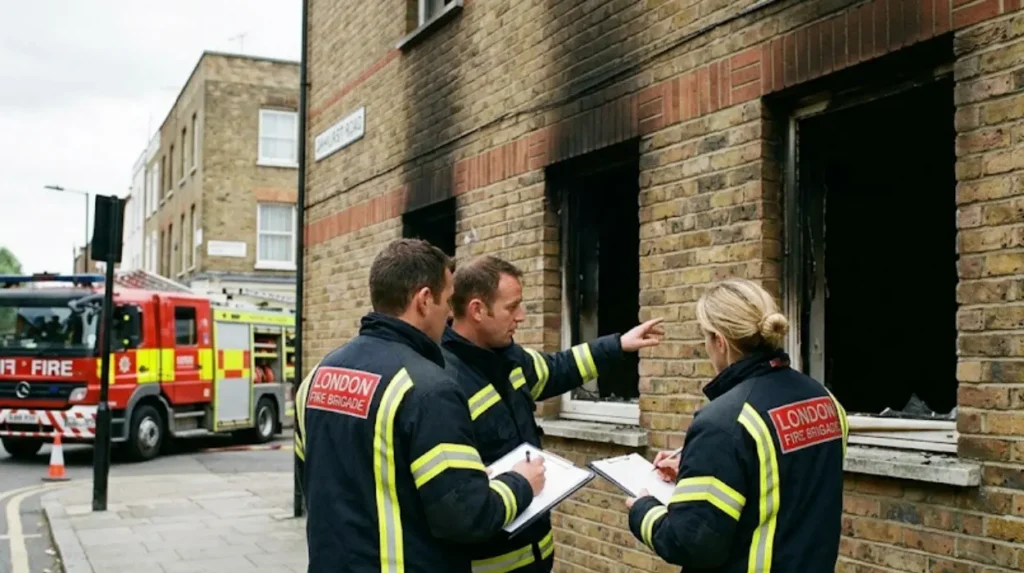
The London Fire Brigade treated the Amhurst Road hotel fire as accidental, with no ongoing criminal investigation required, though standard fire investigation protocols were followed to confirm the incense stick causation theory. Fire investigators documented the scene, interviewed witnesses, and examined fire patterns to validate the accidental classification before closing the incident file.
Hackney Council’s emergency planning team conducted post-incident reviews to assess rest centre operations, evacuation coordination, and communication effectiveness during the Amhurst Road fire. These reviews inform continuous improvement in emergency response protocols, ensuring that future incidents benefit from lessons learned regarding evacuee welfare, traffic management, and inter-agency coordination between the London Fire Brigade, Metropolitan Police, and Council services.
The London Fire Brigade used the incident as an educational opportunity, issuing fire prevention guidance specifically addressing incense stick safety to prevent similar occurrences across Hackney and wider London. Community fire safety officers from Shoreditch, Stoke Newington, and Homerton stations incorporated these lessons into local engagement activities, visiting residential properties to provide tailored fire safety advice based on incident learnings.
What are the broader implications for fire safety policy in East London?
The Amhurst Road hotel fire reinforces the importance of comprehensive fire prevention education covering all ignition sources, including incense sticks, candles, electrical appliances, and smoking materials, across Hackney’s diverse residential and commercial property types. The incident demonstrates that accidental fires remain prevalent despite improved building regulations, requiring sustained public education efforts alongside structural safety measures.
Fire safety policy in East London increasingly emphasises multi-hazard preparedness, recognising that fires can originate from diverse sources requiring tailored prevention strategies. The varied causation patterns across 2026 Hackney fires—electrical incidents, incense sticks, discarded bottles focusing sunlight, and smoking materials—illustrate the need for comprehensive rather than singular prevention approaches.
The London Fire Brigade’s integrated response model, combining rapid emergency deployment with post-incident education and community engagement, provides a replicable framework for fire safety policy across dense urban areas. Hackney Council’s coordination with the Brigade on rest centre operations, evacuee support, and resident communication demonstrates effective inter-agency collaboration that other London boroughs can adopt to enhance emergency response capabilities.
Residents and businesses in Hackney should remain vigilant about fire prevention, maintain functional smoke alarms, and participate in local fire safety initiatives to reduce the likelihood and impact of future incidents across the borough.
What happened in the Hackney hotel fire on 28 June 2026?
A fire broke out at a hotel on Amhurst Road near Hackney Central station on Sunday, 28 June 2026. The blaze affected two rooms on the fifth and sixth floors, prompting a major emergency response from the London Fire Brigade. Around 16 people were evacuated to a rest centre, no injuries were reported, and the fire was brought under control by 6:20pm.