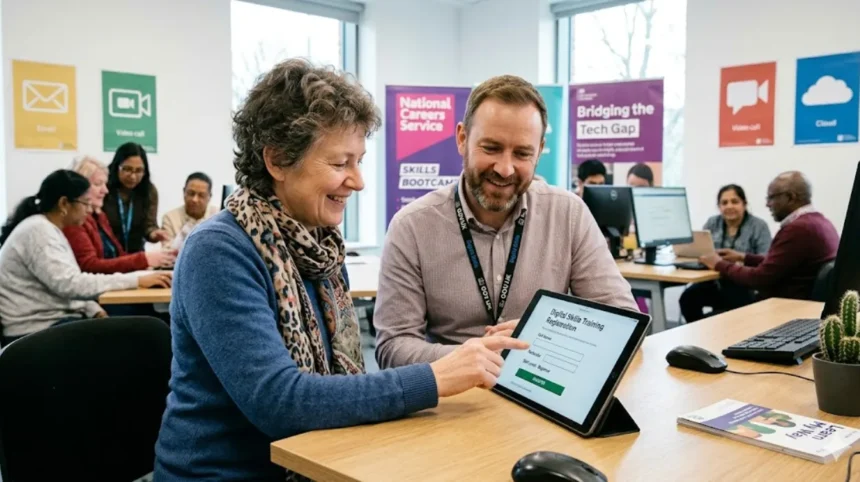
Digital skills training is one of the most practical ways to close the gap between everyday life and the increasingly online world of work, services, and education. In England, adults with low digital skills can access fully funded Essential Digital Skills qualifications, while London and East London residents also have access to local college, borough, charity, and community programmes designed to build confidence and capability online.
For readers of East London Times, this is not just a policy issue. It is a practical route into better jobs, easier access to public services, and more independence in daily life, especially for people who feel left behind by rapid technological change.
Why digital skills matter
Digital inclusion is now treated by government as an essential part of participation in modern life, not a niche technical issue. The government defines digital inclusion as having the access, skills, support, and confidence to engage in digital society and the economy, and its 2025 action plan says the goal is to break down the barriers that leave people offline or underprepared.
The skills covered by the national framework are deliberately broad. They include communicating, handling information and content, transacting, problem solving, and being safe and responsible online, which means the training is designed for practical use rather than abstract theory. That matters because many people do not need advanced coding or specialist IT knowledge; they need the confidence to send emails, apply for jobs, use online banking, book appointments, or protect themselves from scams.
Digital skills are also closely linked to employability. Government and local providers repeatedly frame these qualifications as a bridge into work, further study, and day-to-day independence, while employers continue to report that basic digital competence is increasingly a requirement across most sectors.
What counts as digital skills training
Digital skills training can mean different things depending on your level and your goals. For some people, it begins with absolute basics such as using a smartphone, logging into email, or finding trustworthy information online. For others, it means moving on to recognised qualifications that support jobs, apprenticeships, or further learning.
The national Essential Digital Skills framework is the clearest benchmark for low-to-basic digital skills training in England. It was created to define the skills adults need to benefit from the digital world safely and confidently, and it underpins the qualifications funded through the adult education system. These qualifications are intended for adults aged 19 and over with low digital skills, and are fully funded if they meet the eligibility rules.
In London, the picture is broader still. The Greater London Authority has supported an Essential Digital Skills Entitlement that gives adults over 19 access to fully funded entry and Level 1 digital skills courses through local colleges, helping Londoners who have no or low digital confidence progress in life and work. That means a resident in East London can often choose from a college class, a council-supported programme, or a charity-based course, depending on age, need, and location.
Who can apply
Eligibility depends on the provider and the funding route, but the main government-backed entitlement in England is aimed at adults aged 19 and over who are assessed as not having essential digital skills and who meet residency requirements, which in most cases means being resident in England when learning starts. In practice, providers will usually assess your current level before placing you on the right course.
If you are in London, the entitlement can be even more accessible because the Mayor’s Adult Education Budget has supported fully funded courses for adults over 19 with low digital skills. Some community providers also target specific groups, such as older adults in Newham, where Community Links runs a digital skills programme for people aged 50 and over, and Age UK East London offers digital inclusion support within its local catchment area.
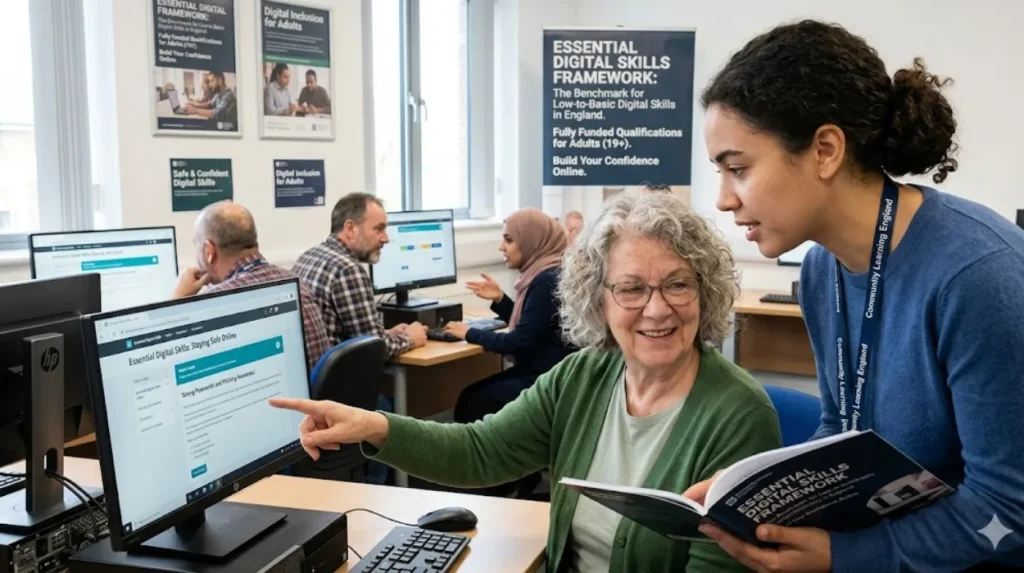
Younger learners can also benefit. Some colleges provide digital skills as part of study programmes for 16 to 19-year-olds, and vocational providers in Newham offer digital qualifications for younger people and those with additional educational support needs. In other words, digital skills training is not just for retirees or jobseekers; it is a pathway for school leavers, workers, parents, carers, and anyone who needs to become more confident online.
Where to start
The easiest way to begin is to decide what kind of support you need. If you are completely new to computers or smartphones, a community class or introductory college course may be best. If you already use devices but want a recognised qualification, then an Essential Digital Skills course through a college or adult education provider may be the right fit.
In East London, local options include Newham College, which offers digital skills courses for adults at different levels, including beginner and more advanced pathways. Waltham Forest’s Adult Learning Service also offers digital skills courses and requires an assessment and advice session before joining. For older learners, Community Links in Newham runs a structured programme focused on everyday digital confidence, while Age UK East London provides digital inclusion support tailored to older adults in its area.
If you are employed in the public sector, there are also government learning campaigns such as Get Tech Certified, which offers free digital and technology learning pathways through the Government Digital and Data Hub for public sector workers. That programme is more specialised, but it shows how wide the digital training landscape has become.
How to register
The registration process is usually simple, but it depends on whether you are applying through a college, a local authority, or a charity. The common first step is to make an enquiry online or by phone, then complete an assessment so the provider can place you at the right level.
If you are applying to a college course, such as Newham College, you typically start by exploring the digital skills page, sending an enquiry, and attending an assessment so the provider can understand whether you need beginner, intermediate, or more advanced support. Waltham Forest uses a similar approach, asking candidates to book and attend an initial assessment and advice session before joining. This is important because the courses are designed to match your current ability, not to assume everyone starts from the same point.
If you are applying through a community organisation, the process is often even more personal. Community Links’ programme in Newham is designed for local residents and includes direct contact as part of the application route, while Age UK East London provides an email and telephone contact for its digital inclusion service. For many learners, this route feels less formal and more supportive, especially if anxiety or low confidence has stopped them from taking the first step.
If you want funded Essential Digital Skills qualifications, ask the provider whether the course is part of the national entitlement and whether your circumstances make you eligible. The provider will usually confirm residency, age, and skill level, then advise on the most suitable route.
What the courses usually cover
Although course content varies, most digital skills training is built around the same practical foundations. The national framework sets out five categories: using devices and handling information, creating and editing, communicating, transactions, and being safe and responsible online. That structure keeps training focused on the skills people actually need in daily life and work.
In practical terms, learners may cover topics such as using a keyboard and mouse, opening and saving files, setting up and using email, searching online safely, filling out forms, making online payments, using video calls, and recognising scams. Some East London courses also include employment support, with learners at Poplar HARCA gaining access to job-search help, CV support, and interview preparation alongside digital learning.
Many providers also adapt training for specific needs. Newham College offers digital skills for ESOL learners, recognising that language learning and digital confidence often go hand in hand. Community Links aims to help older learners with tasks like online shopping, booking doctor’s appointments, messaging family, and online banking, which are exactly the kinds of digital tasks that can transform independence. This flexibility is one reason digital skills training remains evergreen: the tools change, but the underlying confidence gap stays the same.
What makes the training worthwhile
The best digital skills courses do more than teach buttons and screens. They help people feel less isolated, more employable, and more able to handle everyday tasks without asking for help. That can matter for older adults, jobseekers, parents managing school systems, or workers trying to keep up with online admin at work.
For many learners, the biggest result is confidence. Government and community programmes consistently describe digital inclusion as a mix of access, skills, support, and confidence, not just technical training. That distinction matters because someone may own a phone yet still be unable to use it effectively for banking, benefits, healthcare, or training applications.
There is also a clear work benefit. Essential Digital Skills qualifications are designed to support adults who want to participate in the digital world for life, work, or further study, while employers and training organisations continue to position digital literacy as a baseline requirement across industries. In a labour market where online applications, remote collaboration, and digital recordkeeping are commonplace, basic confidence can be as valuable as a formal certificate.
East London opportunities
East London has a particularly active ecosystem of digital inclusion support, which makes it a strong place to look for training. Newham College offers digital skills courses for adults, with routes that range from basic confidence-building to more advanced IT learning. Community Links in Newham runs a targeted programme for older adults, and Age UK East London offers digital inclusion support for people in its service area.
Borough-level support is also visible in Waltham Forest, where the Adult Learning Service provides digital skills courses and a structured assessment process. Meanwhile, London-wide policy has supported the Essential Digital Skills Entitlement for adult learners, making it easier for Londoners with low digital skills to access fully funded training through local providers. For East London residents, this means the route into training is often closer than expected and may be available through a local college, charity, or council service rather than a distant specialist institution.
How to choose the right course
Choosing the right training starts with honesty about your current ability and your goal. If your aim is to book appointments, use email, and avoid scams, a beginner or entry-level course may be enough. If you want a qualification for work or further study, look for an Essential Digital Skills course or a college pathway that leads to recognised progression.

It also helps to consider the format. Some learners benefit from in-person classes because they can ask questions and practise with support, while others prefer flexible or community-based settings. If you are anxious about technology, a smaller local class may work better than a larger college intake, especially if the provider offers assessment, guidance, and ongoing support.
Finally, check whether the provider offers extra help beyond the classroom. A course linked to employability support, device access, or follow-on learning can make a bigger difference than a standalone lesson series. The best course is not necessarily the most advanced one; it is the one that helps you keep using digital tools after the class ends.
The bigger picture
The digital skills gap is not just a skills problem. It is a social and economic issue that affects access to work, public services, health information, and community life, which is why government policy now treats digital inclusion as a priority. Training matters because it gives people the ability not only to keep up, but to participate on more equal terms.
For East London, the good news is that the infrastructure already exists. Government entitlement funding, London-wide adult education routes, and local charity provision all make it possible to register for digital skills training without needing to pay private tuition fees in many cases. What remains is awareness, confidence, and the simple act of taking the first step.