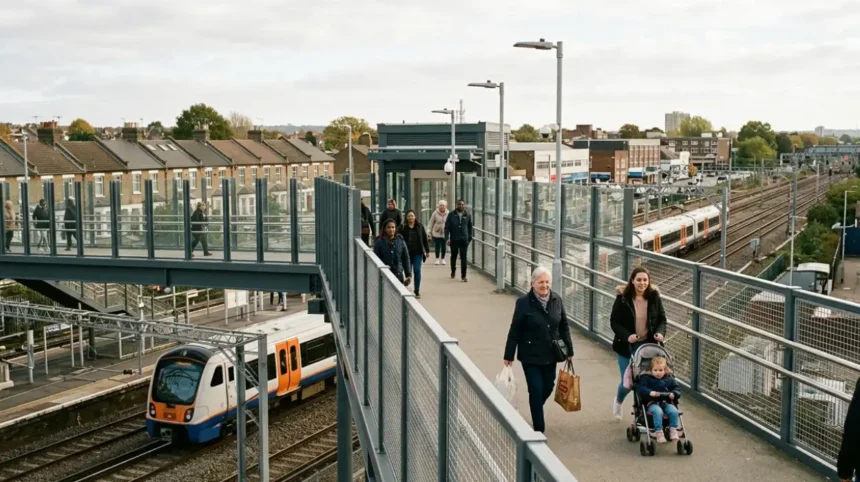
The Kennedy Road footbridge in Barking has reopened as a replacement pedestrian crossing over the railway, restoring a direct link between Harrow Road and Kennedy Road for the first time since 2022. For East London walkers, the main gain is simple and practical: safer local movement, shorter walking routes, and better access to everyday destinations such as shops, schools, parks, public transport, churches, and medical centres.
What is the Kennedy Road Footbridge?
The Kennedy Road Footbridge is a replacement pedestrian bridge in Barking that crosses the railway and reconnects Harrow Road with Kennedy Road. It restores a direct walking route lost in 2022 and serves as a local access point for residents moving between two sides of the railway.
The bridge sits in Barking, in the London Borough of Barking and Dagenham, within East London. It was opened after the old footbridge was removed following a serious safety incident in 2022, when a member of the public fell through the structure. Network Rail says the new bridge brings back a “vital connection” that had been absent for several years.
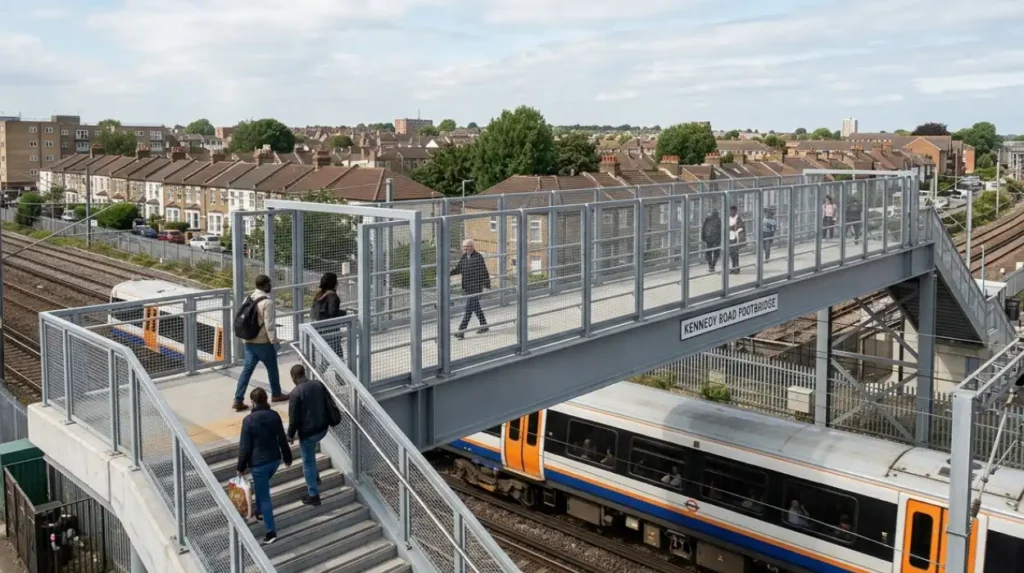
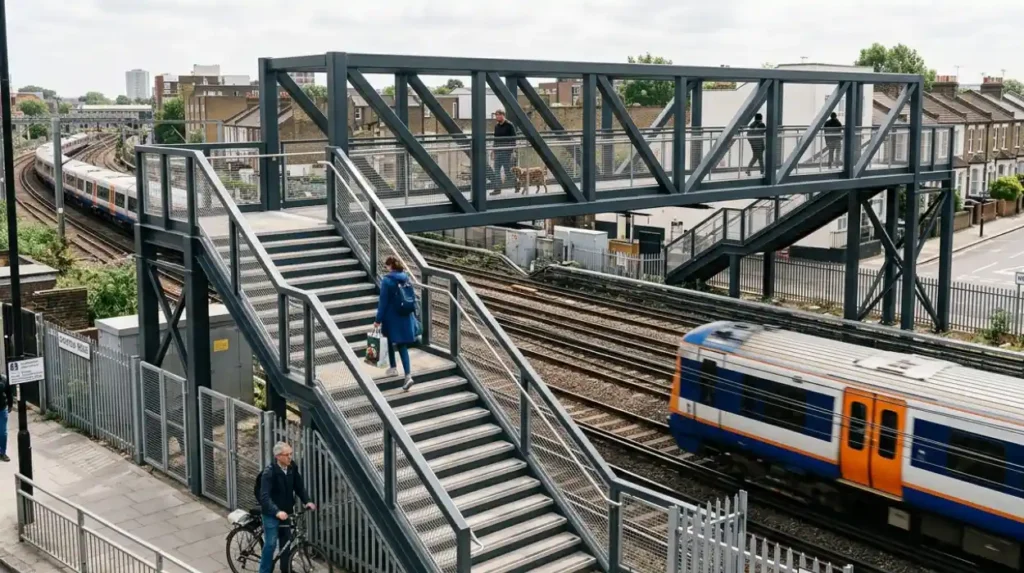
The bridge is a pedestrian-only structure with stepped access and a steel frame. Network Rail states that ramps were not included because of physical constraints around the site. That design matters because it shapes who can use the crossing comfortably and how local walking routes now function.
Why did the bridge need replacing?
The bridge needed replacing because the previous structure was closed in 2022 after a serious safety incident, and the railway crossing lost its safe direct pedestrian link. The replacement provides a long-term fix rather than a temporary repair and restores access across the line.
Safety is the central reason this project existed at all. Network Rail said the former footbridge was closed after a member of the public fell through it, and although he was not seriously injured, the incident forced closure and removal. Once the bridge went out of service, pedestrians lost the direct connection they had relied on for daily trips.
That loss affected routine movement in the area. The only way to cross by foot became less direct, which increased travel time and reduced convenience for local residents. In urban neighbourhoods, even a short missing link changes how people access work, school, health care, and public transport.
The replacement was therefore not just an infrastructure upgrade. It was a restoration of a basic walking corridor that had been severed for three years.
How does the new bridge help walkers?
The new bridge helps walkers by restoring direct access, reducing detours, and improving everyday connectivity across the railway. It supports walking trips to homes, schools, parks, shops, churches, transport links, and medical services in a busy residential area.
The clearest benefit is route efficiency. A direct bridge shortens journeys that otherwise require longer paths around rail infrastructure or along busier roads. That is especially important for short local trips, where walking is often the fastest choice if the crossing exists.
The bridge also supports active travel. Councillor Alison Cormack described it as an essential access link that encourages safe and accessible active travel for residents. In practical terms, that means more people can complete everyday journeys on foot instead of relying on cars for very short distances.
The location matters too. Barking is a densely used urban area, so small improvements in connectivity have outsized value. When a footbridge reopens, it reconnects neighbourhoods, not just streets.
What did Network Rail build?
Network Rail delivered a steel footbridge with stepped access, replacing the old structure with a safer long-term crossing. The design reflects the original bridge layout, but it does not include ramps because of the physical constraints around the site.
The new structure was delivered by contractor Taziker. Network Rail said the bridge was planned, designed, and installed as a safe and long-term replacement. That language is important because it shows the project focused on durability, not short-term patching.
The bridge uses steps rather than level access. That means it provides an immediate crossing for able-bodied pedestrians, but it does not deliver full step-free accessibility. For many walkers, the bridge still restores the missing link. For some disabled users, parents with buggies, and cyclists pushing bikes, the lack of ramps limits convenience.
The original design context also matters. Network Rail said the new bridge reflects the layout of the original bridge. That suggests the replacement was built to fit within a constrained rail corridor rather than to redesign the whole local crossing system.
When did the project happen?
The project began with a construction start planned for late July 2025, with completion expected in autumn 2025. Network Rail then announced the bridge had opened on 29 December 2025, confirming the route had been restored before the end of the year.
The timeline gives a useful picture of delivery. In June 2025, Network Rail said construction would begin that summer and that completion was expected in autumn, subject to site progress. Later, Network Rail confirmed the bridge had opened on 29 December 2025.
That sequence shows a standard infrastructure pattern: planning, installation, testing, and reopening. It also reflects how rail corridor works depend on site safety, weather, logistics, and nearby traffic management. For local residents, the key milestone was the return of a usable crossing before year-end.
The three-year gap between closure and reopening is the central fact in the story. Since 2022, the railway had cut the direct pedestrian route. The new opening closes that gap.
What changes for local residents?
Local residents gain a restored walking route that improves access to daily amenities and makes short trips simpler. The bridge also reduces separation between communities on either side of the railway, which strengthens neighbourhood movement and local social connection.
Councillor Cormack said the bridge supports access to parks, shops, church, schools, public transport, and medical centres. Those examples show how a single crossing can affect multiple parts of daily life. A footbridge is not only a transport asset; it is part of a local access network.
The reopening also matters for community continuity. When a railway cuts off one side from the other, people lose familiar walking patterns, and the neighbourhood feels less integrated. Restoring the bridge returns the area to something closer to its earlier layout.
For families, older residents, and people making repeated local trips, a direct crossing has clear value. It reduces route complexity and supports regular movement across the railway without depending on a car for very short journeys.
Why does this matter for East London?
This matters for East London because pedestrian links are a core part of how the area functions day to day. In a dense city environment, a single footbridge can shape access, safety, travel times, and the usability of local services across a railway boundary.
East London contains many places where rail lines, roads, and rivers divide neighbourhoods. In those settings, a missing footbridge creates a local bottleneck. The Kennedy Road reopening is a small-scale example of a much bigger urban principle: walkability depends on continuity.
Transport policy across London increasingly prioritises safer walking and cycling links, and TfL continues to fund borough-led schemes for pedestrian crossings, protected routes, and safer streets. The Kennedy Road bridge fits that wider direction because it restores a basic walking connection that had been lost.
The significance is local, but the logic is citywide. When short pedestrian links work well, communities feel closer together and local services become easier to reach.
What should walkers know now?
Walkers should know that the bridge is open, it is a stepped steel replacement, and it restores the direct connection between Harrow Road and Kennedy Road. They should also know that the bridge does not include ramps, so accessibility is not step-free.
This matters when planning daily routes. The bridge now allows pedestrians to cross the railway directly again, which should shorten many local journeys. For people who used the old link before 2022, the route will feel familiar in purpose even if the structure itself is new.
The access limitation is equally important. Because the bridge has steps only, not ramps, some users will still need alternative routes. That is a practical constraint, not a minor detail, because accessibility determines who benefits most from the crossing.
The opening also ends a period of disruption that required patience from residents. Network Rail thanked the community for understanding during the works, and local leaders framed the bridge as an essential part of everyday movement. For walkers, the message is direct: the shortcut is back.
Why this story has lasting relevance
The Kennedy Road Footbridge story has lasting relevance because it shows how one small piece of infrastructure affects safety, access, and daily life across a neighbourhood. It also shows how rail maintenance and local walking networks intersect in a growing city.
This is an evergreen transport story because the underlying issue is permanent. Cities rely on a network of crossings, and when one disappears, everyday movement becomes harder. The restoration of Kennedy Road is a concrete example of how public infrastructure repairs community connectivity.
The project also demonstrates a common pattern in urban transport: safety incidents trigger closure, replacement takes time, and reopening brings back a route people notice immediately. That sequence is useful for readers, planners, and local journalists because it explains how infrastructure outcomes translate into lived experience.
What is the Kennedy Road Footbridge in Barking?
The Kennedy Road Footbridge is a pedestrian bridge in Barking that crosses the railway line and reconnects Kennedy Road with Harrow Road. It reopened as a replacement crossing after the previous bridge was removed in 2022.