Key Points
- Council Approval: Barking and Dagenham Council’s planning committee voted by a majority on 14 October to approve 300 homes within its boundary as part of the wider Crowlands Heath redevelopment.
- Cross-Borough Scheme: The proposed scheme totals 1,298 homes across a 22.5-hectare site that straddles the boundary between Barking and Dagenham and Havering.
- Havering Decision Outstanding: Construction cannot commence until Havering Council issues a separate planning decision for its portion of 998 homes.
- Section 106 Agreement: The approval in Barking and Dagenham remains subject to the completion of a Section 106 legal agreement, meaning an official planning permission has not yet been issued.
- 100 Per Cent Affordable Housing: The application specifies that all 1,298 homes across the wider site will be affordable, featuring a tenure mix of 763 social-rent homes and 535 key-worker rental homes aimed primarily at NHS staff.
- Green Belt and Grey Belt Assessment: The application proposes building on Metropolitan Green Belt land, which planning officers treated as potentially qualifying as “grey belt” due to its former use as a quarry and landfill site.
- Infrastructure and GLA Role: The Greater London Authority supported the principle of housing subject to transport improvements, whilst planning obligations include over £1 million toward health infrastructure in Romford.
Barking and Dagenham (East London Times) October 17, 2026 – Councillors sitting on Barking and Dagenham Council’s planning committee have voted by a majority to approve the borough’s portion of a major proposed residential development at Crowlands Heath Golf Course. However, local authority officials confirmed that the decision does not yet grant full authorization for construction to commence on the ground.
- Key Points
- How will the Crowlands Heath scheme address local affordable housing demand?
- Why is the application on Metropolitan Green Belt land generating debate?
- What infrastructure contributions and local traffic changes are included?
- Background of the particular development
- Prediction: How this development could affect local residents and NHS key workers
The resolution covers a total of 300 homes designated for the Dagenham side of the boundary and remains strictly conditional upon the final execution of a Section 106 legal agreement. The wider development scheme encompasses 1,298 homes in total, meaning that progress on the project remains dependent upon a separate decision from the neighbouring London Borough of Havering, where the remaining 998 homes are planned.
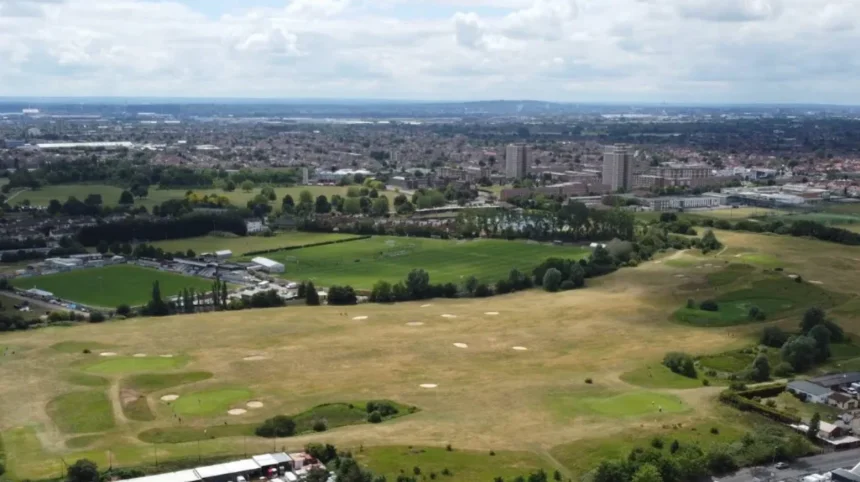
The 22.5-hectare development site sits directly across the administrative boundary separating the two east London boroughs. Under the submitted application, the existing golf course and driving range would be decommissioned and replaced by residential blocks reaching up to six storeys in height. Beyond the residential units, the master plan incorporates community spaces, retail facilities, outdoor sports areas, children’s play zones, extensive landscaping, and publicly accessible open space. Vehicle access and infrastructure modifications form a core element of the submission, including a new junction leading from Crow Lane alongside structural alterations to the existing Wood Lane junction.
The formal committee meeting took place on 14 October, during which Barking and Dagenham’s planning committee formally registered a majority vote to support the portion of the scheme situated within its jurisdictional boundary. Planning officers reminded committee members that a resolution to approve subject to a Section 106 legal agreement sets binding obligations upon the applicant, and that until such an agreement is fully finalized, the resolution does not constitute an issued planning permission.
How will the Crowlands Heath scheme address local affordable housing demand?
The applicant’s submitted master plan designates all 1,298 homes across the entire cross-borough development as affordable housing units. The proposed tenure distribution comprises 763 social-rent homes and 535 key-worker rental homes. Planning documents outline that these figures apply to the full 22.5-hectare site rather than solely the 300 homes approved under the Barking and Dagenham committee vote.
Within the key-worker rental category, the developer identified National Health Service (NHS) staff as a primary target demographic for tenancy. The emphasis on social-rent and key-worker housing was presented as a fundamental pillar of the planning case to address local housing waiting lists in east London.
Why is the application on Metropolitan Green Belt land generating debate?
The proposed development occupies land designated as Metropolitan Green Belt, raising questions regarding development policy and environmental protections. In assessing the application, planning officers considered whether the location met the criteria for “grey belt” status, a category within national planning policy designed for previously developed Green Belt land with limited environmental value.
Officers referenced the historical usage of the site as a commercial quarry and subsequent landfill facility during their policy assessment. Furthermore, the applicant’s planning case relies heavily on the overall volume of affordable housing proposed for the area. However, municipal officers noted that neither the planning committee debate nor the majority vote removes the requirement for local planning authorities to conduct full assessments regarding the statutory policy and environmental implications of the scheme.
The Greater London Authority (GLA) completed its stage-one assessment of the master plan, expressing support for the principle of residential development on the site subject to specific planning conditions. However, GLA officials raised concerns regarding current public transport connectivity across the site, requesting formal transport enhancements as part of the progression of the application. A separate formal decision from the Mayor of London will also be required under the standard strategic planning process.
What infrastructure contributions and local traffic changes are included?
During the committee proceedings, councillors raised questions concerning local transport capacity, residential parking allocations, and the anticipated pressure a substantial population influx would place on existing public services and neighboring streets. The application allocates 70 parking spaces across the development, comprising 60 designated resident bays and 13 accessible bays. Transport for London (TfL) requested that parking provision be kept at a low level to encourage walking, cycling, and the use of public bus and rail services.
To mitigate local operational impacts, the draft planning obligations outline financial contributions exceeding £1 million toward health infrastructure in nearby Romford. Additional planning contributions are allocated toward regional transport improvements and a localized review of controlled parking zones (CPZs). Planning officers stressed that these figures represent proposed legal contributions dependent upon the successful execution of the Section 106 agreement and the physical commencement of the development.
The master plan reserves approximately 4.6 hectares for public green space. Under its current operation, the golf course remains accessible primarily to paying club members. The submitted layout would convert private recreational land into publicly accessible open space, alongside planned upgrades to Wantz Boating Lake, dedicated sports courts, and play areas for children.
Barking and Dagenham Council acquired the freehold of the golf course in March and subsequently agreed to sell its interest to the developer, contingent upon achieving the required planning approvals. Following the committee vote on 14 October, one stage of the local authority process is complete, though final approval across the full 1,298-home scheme remains pending Havering Council’s decision and the final execution of legal contracts.
Background of the particular development
The land occupied by Crowlands Heath Golf Course has a complex history tied to industrial activity and municipal land ownership in east London. Situated on the border of Dagenham and Romford, the 22.5-hectare area originally operated as an aggregate quarry in the mid-twentieth century. Following the conclusion of extraction activities, the land was repurposed as a landfill site before being redeveloped in the 1990s as a commercial nine-hole golf course and driving range.
Due to its history of soil disturbance, national planning policy framework guidelines led planning officers to evaluate whether the site met the criteria for “grey belt” land—a designated category intended to prioritize low-quality or previously developed Green Belt areas for housing development.
In March, Barking and Dagenham Council completed the purchase of the golf course freehold. Seeking to address acute local housing shortages, the local authority subsequently entered into a conditional agreement to sell its interest in the site to the housing developer, explicitly linking the land transaction to the attainment of full planning consent across both affected London boroughs.
Prediction: How this development could affect local residents and NHS key workers
If full planning permission is granted across both local authorities and the development progresses to completion, the project will significantly alter the local residential and social landscape in Barking and Dagenham and Havering.
- Impact on Housing Availability and NHS Staff: The delivery of 1,298 all-affordable homes, including 763 social-rent units, will provide substantial relief to local housing waiting lists in both boroughs. The 535 key-worker rental homes earmarked specifically for NHS personnel are expected to improve recruitment and retention rates at nearby healthcare facilities, including Barking, Havering and Redbridge University Hospitals NHS Trust, by offering sub-market rental options close to key medical sites.
- Impact on Local Infrastructure and Road Networks: The introduction of a large residential population is likely to increase demand on local social infrastructure, public transport routes, and surrounding road networks. While the allocation of over £1 million toward healthcare infrastructure in Romford and contributions to local transport networks aim to offset this pressure, neighboring residents may experience short-term construction disruptions and increased traffic around Crow Lane and Wood Lane during the build phase.
- Impact on Community Access to Open Space: The conversion of a private, fee-paying golf facility into 4.6 hectares of publicly accessible green space will grant the wider community open access to leisure areas, upgraded facilities at Wantz Boating Lake, sports courts, and play areas, altering public land use along the borough boundary.