Key Points
- Call for Northern-Style Focus: Dominic Twomey, the Labour leader of Barking and Dagenham Council, has asserted that the government should treat the outer East London borough with the same strategic focus and resources as post-industrial regions in the north of England.
- Invitation to National Leadership: Councillor Twomey called for the Prime Minister to include Barking and Dagenham in any official national tour to demonstrate that the borough shares the exact ambition and economic challenges seen across Greater Manchester and northern industrial hubs.
- Opposition Concerns Over ‘Number 10 North’: The political debate was triggered during a full council meeting by Reform UK opposition leader Ben Suter, who questioned whether the creation of a northern government branch (‘Number 10 North’) in Manchester leaves outer London boroughs at risk of being sidelined.
- Shared Socio-Economic Realities: Both Labour and Reform UK councillors acknowledged that Barking and Dagenham shares structural economic profile traits, social challenges, and regeneration needs that closely resemble northern post-industrial towns rather than affluent central London districts.
- Demands for Equitable Investment: Local leaders are urging central government not to overlook deprived outer London communities under the assumption that all capital-adjacent areas are wealthy and self-sustaining.
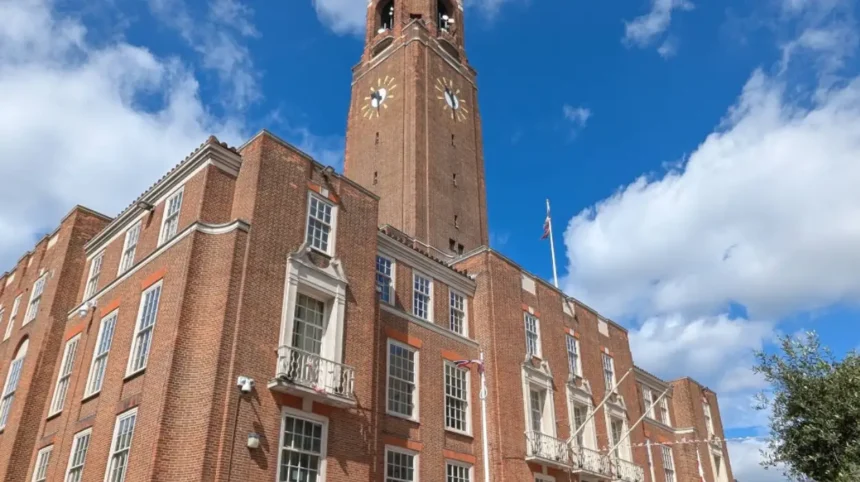
Barking and Dagenham (East London Times) July 24, 2026 –In a significant political exchange during a recent full council meeting, the Labour leader of Barking and Dagenham Council, Councillor Dominic Twomey, declared that central government figures and regional policymakers must treat the outer East London borough as if it were situated in the north of England. Responding to questions regarding the decentralisation of governmental operations to northern hubs, Councillor Twomey argued that Barking and Dagenham possesses the same structural economic profile, industrial legacy, and high-reaching regeneration ambitions as major northern urban centres.
- Key Points
- How Did Opposition Concerns Over ‘Number 10 North’ Spark the Debate?
- What Was the Response from Council Leader Dominic Twomey?
- What Is the Background of This Particular Political Development?
- How Has the Industrial Heritage Shaped Barking and Dagenham?
- Why Do National Levelling-Up Models Present Challenges for Outer London?
- What Is the Prediction for How This Development Will Affect the Local Community?
The council leader issued an open call for the Prime Minister to visit the borough as part of any national tour. Councillor Twomey emphasized that a direct visit would clearly illustrate to national leadership that Barking and Dagenham matches the transformational goals championed across Greater Manchester and other northern regional powerhouses.
How Did Opposition Concerns Over ‘Number 10 North’ Spark the Debate?
The floor was opened to this debate following a formal parliamentary-style inquiry from Councillor Ben Suter, the leader of the Reform UK opposition group at Barking and Dagenham Town Hall.
Councillor Suter raised direct concerns regarding the potential unintended consequences of establishing a secondary government executive hub—often termed ‘Number 10 North’—in Manchester.
As reported by local government reporting teams covering town hall proceedings, Councillor Suter questioned whether outer London boroughs like Barking and Dagenham face a genuine threat of economic marginalisation as national focus shifts towards northern devolution projects.
Addressing the chamber, Councillor Ben Suter of Reform UK stated:
“Our town has much more in common with northern neighbourhoods and towns. Towns like Barking and Dagenham – are they at threat by this move to move our capital up north?”
Councillor Suter pressed the administration on what specific lobbying efforts would be undertaken to ensure that the borough receives adequate funding, infrastructure backing, and policy focus from Westminster.
What Was the Response from Council Leader Dominic Twomey?
In his formal response, Council Leader Dominic Twomey firmly rejected the notion that Barking and Dagenham should accept being overshadowed by northern regional development initiatives.
While acknowledging the shared socio-economic characteristics between East London and northern industrial communities, Councillor Twomey stressed that geographic proximity to central London does not dilute the borough’s urgent need for targeted national support.
Directly confronting the challenge, Councillor Dominic Twomey stated:
“We are exactly the sort of place with the same ambitions that [regional leaders have] in Greater Manchester.”
Councillor Twomey reiterated that the council executive would actively press national ministers to recognise that outer London boroughs encounter severe localized deprivation, housing demand, and public service strain that mirror the most challenging post-industrial landscapes in the Midlands and the North.
What Is the Background of This Particular Political Development?
To fully understand the friction between outer London local authorities and national regional funding frameworks, it is necessary to examine the historical and structural context of Barking and Dagenham within the wider Greater London economy.
How Has the Industrial Heritage Shaped Barking and Dagenham?
Historically, Barking and Dagenham served as one of the UK’s paramount manufacturing centers, anchored by major industrial complexes such as the Ford Dagenham plant.
Over recent decades, the nationwide transition away from heavy manufacturing led to structural economic shifts, creating long-term challenges in local employment, skill transition, and council tax base generation.
Why Do National Levelling-Up Models Present Challenges for Outer London?
Under traditional UK regional development models, national funding allocations often rely on regional statistical averages.
Because Greater London as a whole generates high economic output driven by central financial districts, outer boroughs such as Barking and Dagenham are frequently categorized within an affluent region.
Local leaders across party lines argue that this high-level categorization hides deep pockets of local poverty, social housing demands, and infrastructural deficits.
What Is the Prediction for How This Development Will Affect the Local Community?
The ongoing political debate surrounding national funding equity and regional policy focus carries direct implications for several key stakeholder groups across Barking and Dagenham and the wider Thames Estuary corridor.
If lobbying efforts by local leadership fail to persuade central government to grant outer London boroughs access to tailored regeneration funding,
Barking and Dagenham Council could face persistent budget constraints. Without supplementary national grants, the local authority may be forced to rely more heavily on council tax adjustments or make difficult decisions regarding discretionary social and youth services.
Barking and Dagenham is currently undertaking major long-term infrastructure and housing redevelopment programs.
Securing official recognition as a priority zone—akin to northern regeneration areas—will be crucial for maintaining momentum on large-scale civil projects, environmental initiatives, and commercial developments.
The explicit alignment between Labour council leadership and Reform UK opposition on the specific issue of outer London’s socio-economic identity signals a shift in local governance.
Both major political factions in the town hall are expected to continue pressing national ministers to abandon binary “North vs. South” funding formulas in favor of targeted, need-based capital distribution.