
Infrastructure used to mean bridges, ports, and the unglamorous machinery of a functioning state. It still does. But the money has found something new to call infrastructure, and the relabelling is worth more than £760 billion a year. Whether it merits the label remains an open question, one that markets appear reluctant to examine too closely.
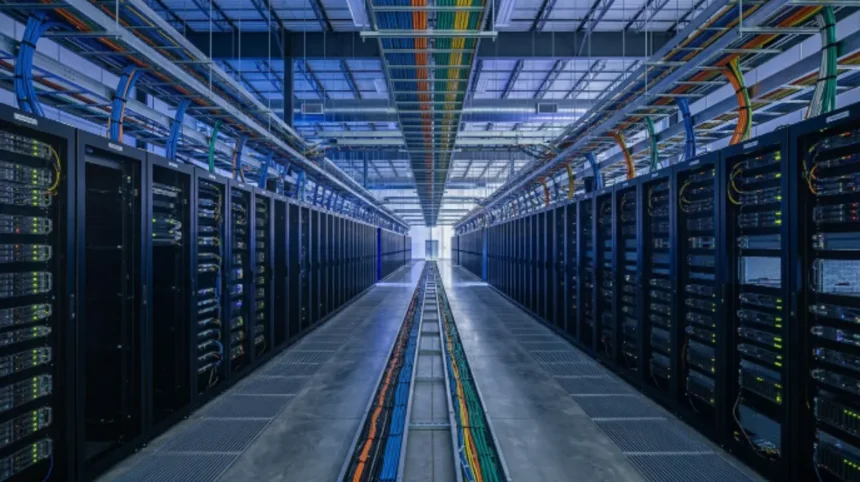
Consider what a pension fund is buying when it buys a data centre. Not a building, exactly, though there is a building. Not a technology company, though the tenant is usually one. What it is buying is a contracted stream of rent from a credit worthy counter party, secured against a physical asset, with a long tenor and a low correlation to the public equities. In other words, a bond that happens to have a ceiling. This is the trick at the centre of the infrastructure boom, and it is a clever one.
The numbers have moved from large to faintly absurd. Global private infrastructure activity reached £1.2 trillion in 2025, with the power and digital sectors doing most of the heavy lifting. The top six hyper scalers spent more than £630 billion of capital over five years, the bulk on AI infrastructure, and that figure is now forecast to exceed £2.4 trillion between 2026 and 2030. McKinsey puts the cumulative global bill for compute infrastructure at close to £5.5 trillion by the end of the decade. There are not the sums one normally associates with an emerging asset class. These are the kinds of expenditures one would expect with rebuilding a continent.
And yet the most interesting aspect about the data centre boom is not its size at all. It is the speed at which finance has agreed to treat as infrastructure at all.
Why the Label Matters
Classification is never neutral. Call something infrastructure and you unlock a particular type of capital: patient, regulated, mandated to hold long-dated assets with predictable cash flows. Pension funds, insurers, sovereign wealth funds. Money that is by design, allergic to the volatility of a technology stock but perfectly comfortable with a thirty-year toll road. The reclassification of digital infrastructure as, well, infrastructure, gives the AI buildout access to that capital pool. It is literally the financial equivalent of getting a nightclub reclassified as a community centre to qualify for the grant.
There is a respectable case for the label. The cash flows are real and contracted. Private infrastructure shows a correlation to global equities of roughly 0.32, which is genuinely useful in a portfolio. Tenants sign long leases. A stabilised fully let data centre throwing off rent from a hyper scaler with an investment-grade balance sheet does look, squinting, a lot like utility.
The trouble here is what sits underneath the squint. A toll road does not become obsolete just because someone invents a faster car. A data centre built for one generation of chips can be stranded by the next. The asset’s useful life, the single most important metric in any infrastructure model, is being estimated against a technology that reinvents its own hardware requirements every eighteen months. Nobody actually knows how long a 2026-vintage GPU hall will remain economically viable. The model assumes fifteen years. The honest answer is that this is a guess dressed as an assumption.
Follow the Debt
Here is where it gets interesting, and where the sober observers are now looking. For the majority of this cycle, the hyperscalers paid for their own build-out from cash. Amazon. Microsoft, Google, Meta: balance sheets deep enough to self-fund. That is coming to an end, not because the money has run out but because the pace of spending began to threaten their credit ratings. So, the build-out has migrated to debt. And the debt has migrated, increasingly, off the public balance sheet and into the private markets where it attracts less scrutiny.
UBS counted £100 billion of AI data centre and project financing deals in the first eleven months of 2025, up from £12 billion in the same period of 2024. An eightfold increase in just one year. Morgan Stanley estimates that private credit could supply more than half of the £1.2 trillion needed for the data centre build-out through 2028. The asset-backed securities market for digital infrastructure, currently around £20 Billion, faces projected take-out needs approaching £240 billion. Bank of America notes the ABS segment has expanded more than ninefold in under five years, with data centres now backing 63 percent of it.
Read those figures again, slowly. A market growing ninefold in five years, funded increasingly through private credit and securitisation, secured against assets whose useful life is a matter of educated guess work, with the rent paid by a handful of tech tenants whose own profitability, in at least one prominent case, depends on a compute deal priced at a temporary discount. This is not a prediction of disaster. It is merely an observation that markets tend to discover the durability of assumptions only after they have been financed. Healthy demand has met the supply so far. It is, rather, an observation that the structure has begun to rise with previous episodes in which finance grew very confident about the durability of cash flows that turned out to be less durable than the spreadsheet implied.
T.Rowe Price’s fixed income desk put it carefully, which is how these things are always put out before they matter: the rapid growth of credit as a funding source for AI has raised some concerns, and it is the area to watch. Translated from the dialect of buy-side caution, that means somebody here is nervous.
The Green Finance Contradiction Nobody Resolves
Now layer climate onto this. A single AI-focused data centre can draw as much electricity as 100,000 homes. Global data centre consumption is heading towards roughly 1,050 terawatt hours by the end of 2026, which would rank the sector in fifth among nations if it were one. The carbon arithmetic is unflattering and, more importantly, deliberately murky, because the operators disclose as little as they can get away with.
This collides head on with the way infrastructure capital has spent the last decade marketing itself. The same pension funds and infrastructure platforms now chasing data centre yield have net-zero commitments and ESG mandates pinned to their prospectuses. The reconciliation on offer is that AI infrastructure is increasingly built alongside renewable generation, with onsite solar and storage folded into the capital stack to create what the advisers call a blended infrastructure platform. It is an elegant phrase. It does real work in a marketing deck.
It also obscures a tension that remains unresolved. A data centre’s defining characteristic is that is has a constant hunger for power, regardless of whether the sun is up or the wind is blowing. Renewables are intermittent by nature. Bolting solar onto a hyperscale campus reduces the grid draw at the margin; it does not make the asset clean in any sense a serious climate analyst would accept. The green wrapper lowers the cost of capital. Whether it lowers the emissions is a separate question, and the two are being allowed to blur precisely because the blur is profitable.
What the Big Players Are Actually Doing
Watch the behaviour, not the statements: BlackRock has told clients that Ai compute investment has risen massively and that roughly 148 gigawatts of additional power capacity will be needed by the end of the decade, with the pointed observation that power, not capital, is now the bindin constraint. That single line explains most of the smart money’s positioning. When capital is abundant and power is scarce, you buy the scarce one.
So, the infrastructure funds have moved upstream, into generation. Private equity sponsors are splitting power from real estate, letting different investor bases buy the parts of the stack that match their risk appetite. Debt funds have stretched their mandates into digital infrastructure. Renewable platforms are acquiring data centre development pipelines. The clever structural innovation of this cycle, forward sale structures that allow developers to sell an in-development project while keeping completion risk, exists for one reason: to monetise value before the asset is even finished, because everyone wants the exposure now and nobody wants to be patient.
Meanwhile, the banks are doing what they did back in 2006: originating, structuring, scrutinising, and distributing the risk onto someone else. There is nothing sinister here. It is purely the function of the capital market. It is worth noticing only because increasingly, that someone else is becoming a pension fund holding the paper inside an infrastructure allocation it believes to be conservative.
The Hot Names, and a Note of Caution About Them
For those who are keeping score, the equity market has already drawn its map. The data centre REITs, Equinix and Digital Realty, are the landlords. The power and cooling layer, Vertiv and the grip-equipment names, is where some of the sharpest gains have concentrated; one digital infrastructure fund posted a 53 percent annual gain before consolidating. The utilities have been quietly re-rated as AI plays: Constellation Energy, Vistra, Duke Energy, the last of which now expects the data centre load to climb from 3 percent of commercial sales in 2023 to 10 percent by 2028. The Global X Data Centre and Digital Infrastructure ETF offers the index tracker version of the whole thesis.
A caution that the price tends to drown out: when the trade is consensual, the easy money has usually been made. A 53 percent annual gain is not a forecast of what is to come. More often, it is a measure of how much optimism is already in the price. The structural demand story is sound. The valuations attached to it are a separate matter, and the two are routinely conflated by people who should know better.
The East London Angle
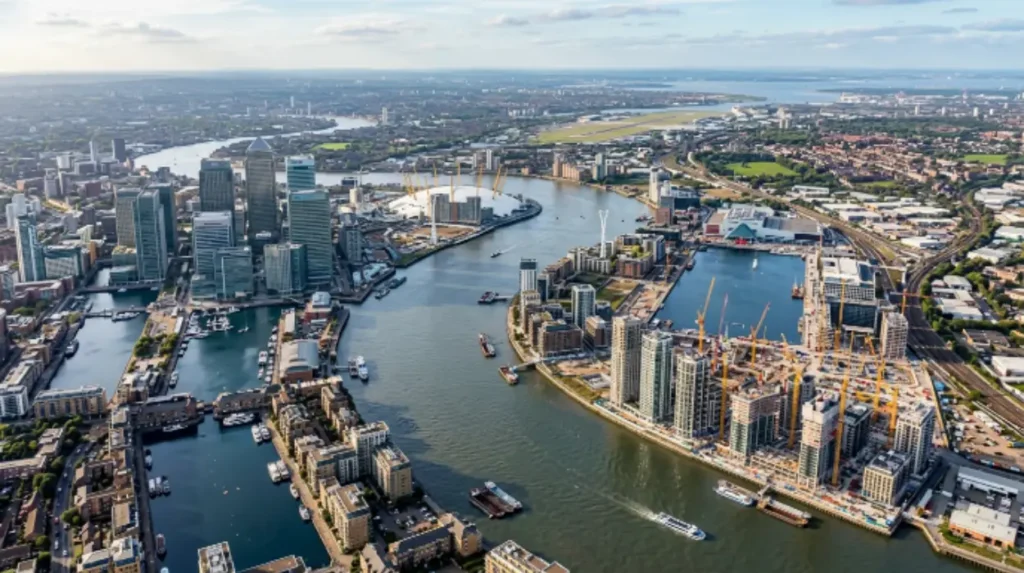
Which brings the question home, as these questions eventually do. London’s data centre market has historically clustered in Slough and the western fringe, where the cloud availability zones sit. Power is now the constraint there, so the development frontier has moved. CBRE expects the boundary to push north and notably east, into the Docklands and Essex. Ada Infrastructure is developing roughly 70 megawatts of data centre capacity across East London sites. The UK market is set to nearly double by 2028, with capacity forecast to exceed the four-gigawatt mark by 2030, and the government has reclassified data centres as critical national infrastructure to grease the planning machinery.
For East London this is the familiar arithmetic in a new costume. A data centre is, by nature, a building that employs very few people once it is running. It consumes enormous power, occupies land, and generates returns to institutional investors who are overwhelmingly not local. The construction phase brings jobs; the operation phase brings a humming shed and a substation. The borough’s that host the infrastructure of the AI economy are not on current terms the boroughs that will reap its returns. Newham and Tower Hamlets have seen this film before, with the Docklands financial district itself. They know how it ends, and they know who is in the closing credits.
There is a version of this that works better. AI Growth Zones in the Northeast are being sold on the promise of 5,000 jobs and community benefit; in principle the East London developments could be structured to route some value locally through power-cost arrangements, skills funding, or community ownership of the energy layer. Whether any of that materialises depends on decisions not yet made, by people not especially inclined to make them. Optimism here is permitted but should be kept on a leash.
A Prediction, Held Loosely
So where does this go? My best guess, offered with the appropriate humility of anyone forecasting a market mid-mania, runs roughly as follows. The demand for compute is real, and it will persist, so the underlying infrastructure thesis survives. But the financing structure is running ahead of the fundamentals, and the weak point is not demand but the assumed durability of the assets and the leverage stacked against them. Somewhere in the next two to three years, a cohort of data centre assets financed at today’s optimistic useful life assumptions will be revealed as obsolete faster than the models allowed. The equity will absorb it first. More painfully, the securitised debt, sold to investors who believed they were buying infrastructure grade safety will absorb it second, because that is where the mispricing is least visible today.
The reclassification of digital infrastructure as infrastructure will, in other words, be tested by the one thing that infrastructure is supposed to be and that technology never is: permanent. The bridges will be standing. The question will be what is running on the servers underneath them, and whether anyone still wants to rent the space. The old kind of infrastructure earned its names by lasting. The new kind has borrowed the name and is hoping to grow into it. Markets have extended that hope a great deal of credit, in both senses of the word. We will find out whether the hope was warranted. As ever, the moment has not waited to be sure.